We don't just develop apps; we engineer experiences, innovate
solutions, and redefine possibilities. With a legacy of over a
decade, our commitment to excellence, cutting-edge technologies,
and a talented team of professionals is what sets us apart.
How To Choose An IT Staff Augmentation Company For Startups
When I speak with CTOs and product leaders about staff augmentation, the same concern comes up again and again. Teams are shipping more features than ever, but their systems are becoming harder to change, slower to deploy, and more expensive to run. In 2026, that usually shows up as rising cloud bills, fragile releases, and a codebase that no one...
Last update date: Feb 25, 2026
Table of Content
Share on:
When I speak with CTOs and product leaders about staff augmentation, the same concern comes up again and again. Teams are shipping more features than ever, but their systems are becoming harder to change, slower to deploy, and more expensive to run.
In 2026, that usually shows up as rising cloud bills, fragile releases, and a codebase that no one fully owns. Many companies reach for IT staff augmentation to solve this, only to find that the wrong partner makes the problem worse, not better.
I see these failures when delivery teams grow without clear architectural and ownership boundaries. Engineering capacity increases, but accountability disappears. If scaling the team feels risky because quality, cost, or control might slip, those concerns are justified.
This guide is designed to show how to add outside engineers without giving up stability, ownership, or long-term scalability.
Staff augmentation works when it is treated as an extension of engineering leadership, not a way to rent developers. Choose teams and pods over individuals, enforce ownership and governance, and use pilots, contracts, and KPIs to manage risk.
How do startups choose an IT staff augmentation company without ruining their architecture?
Startups protect their architecture by choosing partners who take responsibility for how the system is built, not just how quickly features are delivered. A strong augmentation partner owns API contracts, data models, release quality, and cloud cost discipline as the team scales.
A weak one only adds developers, which almost always leads to technical debt and unstable delivery.
Cloud waste typically accounts for nearly one-third of total cloud spend, a risk that grows when external teams are not aligned on cost control.
In practice, this difference becomes visible within the first few months. Teams initially move faster, then deployments start breaking, cloud bills creep up, and no one is quite sure who is allowed to change core parts of the system.
At that point, engineering velocity drops even though more people are writing code.
That is why I never evaluate IT staff augmentation for startups based on resumes or rates alone. I look for technical ownership.
The right startup-focused tech staffing partners ask how the product is expected to scale, where the data boundaries live, and how releases are protected before they commit to a single sprint. They push back when a feature threatens stability or cost control.
That pushback is not friction. It is what keeps the product healthy.
Tactical hire versus architecture-safe partner
Area
Tactical hire
Architecture-safe partner
Backlog intake
Works through tickets
Reviews scope and flags design or scaling risks
APIs and data
Adds endpoints as needed
Protects contracts and schema stability
Cloud usage
Focuses on short-term speed
Tracks cost per user and growth paths
Releases
Often rushed
Controlled with testing, monitoring, and rollback
Ownership
Unclear
Explicit technical and domain ownership
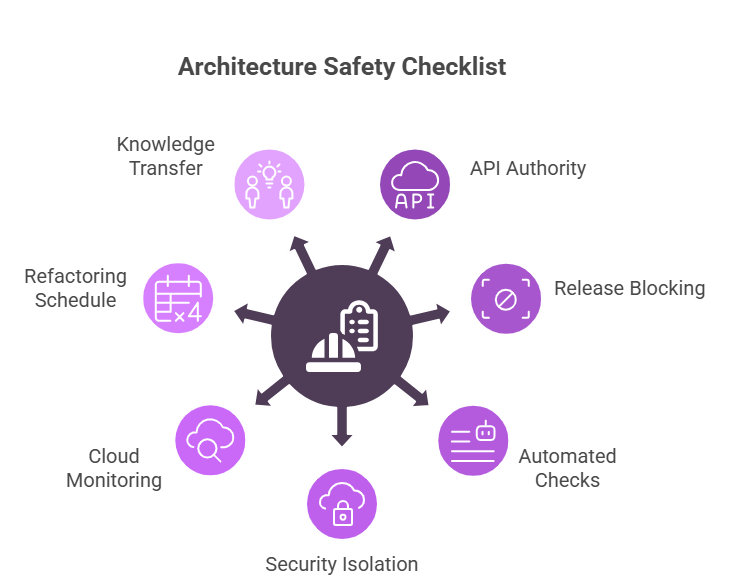
Architecture safety checklist
These questions should be answered clearly before any engagement starts:
Who has final authority over API and data model changes
Who can block a release that introduces an architectural or security risk
What automated checks must pass before anything reaches production
How secrets, credentials, and environments are isolated and audited
Who monitors cloud spend and performance trends
How refactoring is scheduled when requirements evolve
How knowledge is transferred back to the internal team
When these controls are in place, staff augmentation increases delivery capacity without eroding the product. When they are missing, every additional developer increases long-term cost and operational risk instead of reducing it.
Review Your Staff Augmentation Setup
Use the evaluation, pilot, and contract checks from this guide to assess whether your current or planned partner is safe to scale with.
What are the key criteria and red flags for choosing IT staff augmentation at scale?
When staff augmentation moves beyond a few contractors and becomes part of how a product is delivered, the risks change. At scale, the wrong partner does not just miss deadlines. They introduce instability into hiring, delivery, and system ownership.
Organizations with heavy technical debt can spend 20%–40% of their IT budget on maintenance, making architectural ownership and quality controls essential considerations in augmentation decisions.
That is why experience in a stack is not the same as expertise in running teams inside a growing product.
Strong IT staff augmentation for startups and scaleups is built around delivery accountability. The partner must be able to take responsibility for output, quality, and continuity, not just provide resumes. Teams that scale safely have clear technical leadership, predictable release cycles, and engineers who understand the product context, not just their assigned tickets.
Experience versus expertise
Experience answers the question, “Has this person used the tools before?” Expertise answers a different one: “Has this team delivered real products under pressure?”
A startup-focused tech staffing partner should be able to show how they have handled:
codebase handovers without slowing delivery
releases during peak usage
refactoring while features were still being shipped
incidents and rollbacks when something broke in production
Vendors who only talk about certifications or years in a language rarely know how to operate inside a live product.
Red flags that show up early
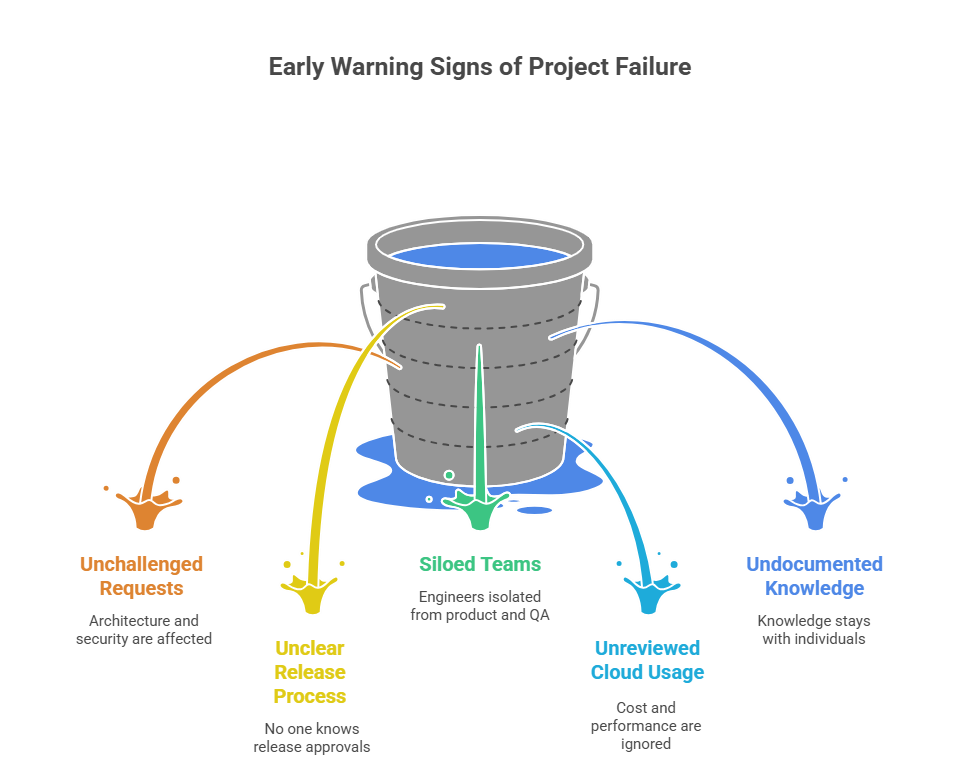
The warning signs usually appear before the first sprint ends. Some of the most common are:
Every request is accepted without challenge, even when it affects architecture or security
No one on the team can explain how production releases are approved
Engineers work in isolation from product and QA
Cloud usage is never reviewed against cost or performance
Knowledge stays inside individual developers instead of being documented
These are not minor issues. They are signals that the vendor is optimizing for short term output, not long term system health.
Red flags scoreboard
Area
Healthy partner
Red flag
Technical leadership
A named tech lead owns design and quality
No one is accountable for architecture
Delivery process
Releases are planned, tested, and monitored
Code is pushed when it seems ready
Product understanding
Engineers ask about users and workflows
Engineers only ask for tickets
Cloud and cost
Usage and spend are reviewed regularly
No one tracks what the system costs
Knowledge sharing
Documentation and handover are built in
Knowledge lives in private chats
When teams ignore these signals, the cost usually shows up later as unstable releases, rising infrastructure spend, and a growing gap between what the product should do and what it safely can do.
The goal of staff augmentation at scale is not to add more people. It is to add capacity without losing control. Partners who demonstrate real delivery expertise, not just technical experience, are the ones who make that possible.
What is the safest early-stage IT staff augmentation model for SaaS and scaleups?
The safest early stage model is the one that transfers execution risk away from the startup instead of pushing it back onto the internal team. In SaaS and scaleups, that usually means avoiding pure individual augmentation and moving toward small, accountable delivery units.
Individual developers can add short term velocity, but they also fragment ownership. Teams and pods, when structured correctly, preserve continuity, code quality, and delivery rhythm.
For IT staff augmentation for startups, this distinction matters. A startup focused tech staffing partner that provides a stable team or pod takes responsibility for how features are built, tested, and released. That creates a single line of accountability. A collection of individuals does not.
Comparison matrix
Model
How it works
Risk profile
Ownership
Individual augmentation
One or more developers join an existing team
High risk of fragmented design and knowledge silos
Shared and often unclear
Team augmentation
A small group joins with a lead and QA
Moderate risk with better delivery discipline
Clear technical ownership
Pod or squad model
A self contained team delivers features end to end
Lowest risk with strong continuity
Single accountable unit
The model that scales most safely is the pod or squad approach. It protects the codebase from becoming a patchwork of styles and assumptions, and it makes it much easier to manage quality, releases, and knowledge transfer.
Why model choice matters for ROI
Return on investment in staff augmentation is not measured by how many developers are added. It is measured by how much useful software ships without creating future drag.
Teams that rely on individual contractors often see early progress followed by rising rework and support costs. Pods and well structured teams cost more on paper, but they usually deliver higher ROI because they reduce downtime, stabilize releases, and limit technical debt.
In real SaaS environments, this shows up as fewer rollbacks, faster onboarding of new engineers, and lower cloud and support costs over time.
That is why early-stage IT staff augmentation models that prioritize ownership and continuity tend to outperform cheaper but fragmented approaches.
Staff augmentation for Startups vs hiring: what offers better ROI and timelines?
Staff augmentation for startups works differently. When structured with a startup focused tech staffing partner, teams can be added in weeks, not quarters. That means features reach customers sooner, and revenue, retention, or cost savings begin earlier.
The risk is not the rate. The risk is whether the augmented team can deliver without increasing technical debt.
Only around 31% of software projects deliver on time and on budget, meaning decisions about augmentation or hiring have a significant impact on delivery confidence
Long term velocity also matters. A poorly chosen hire can slow a team for years. A well structured augmentation pod can be adjusted or replaced if it is not working. That flexibility is often what protects ROI in fast moving products.
Decision matrix
Factor
Hiring
Staff augmentation
Time to first production release
Often 8 to 16 weeks
Often 2 to 4 weeks
Upfront cost
Recruiting, onboarding, benefits
Engagement based, predictable
Flexibility
Hard to reverse a bad hire
Teams can be adjusted or rotated
Impact on architecture
Depends on seniority
Depends on partner discipline
Long term velocity
High if hire is strong
High if ownership and governance exist
In practice, cost-effective staff augmentation for startups wins when speed, flexibility, and risk control matter more than headcount.
Hiring wins when a company is ready to lock in long term ownership and can afford the time and uncertainty that comes with it.
How to evaluate startup-focused tech staffing partners beyond CVs and rates
What actually determines success is how much delivery ownership the team is willing to take. A strong startup-focused tech staffing partner treats production stability, release quality, and architectural health as part of their responsibility, not something to be handled by the client after the fact.
They should be able to explain who approves changes, how incidents are handled, and how quality is enforced once work is underway.
One who can plan, adapt, and communicate inside that reality will keep delivery moving without sacrificing control.
Vendor scorecard
Area
What to look for
Warning sign
Delivery ownership
Named lead accountable for releases and quality
No clear owner for production
Process fit
Comfortable with evolving scope and priorities
Needs fixed requirements to start
Engineering discipline
Code reviews, testing, and CI built in
Quality checks left to the client
Communication
Regular, transparent reporting
Work happens out of sight
This kind of evaluation reveals far more than any CV ever will.
How do you structure a low-risk pilot with a staff augmentation partner?
You should start a pilot by giving the team work that actually touches shared code, data, and the release pipeline. That is where real behavior shows up. I have evaluated many partners, and the ones that look good on simple tickets often fall apart once their changes have to go through code review, staging, and production. Those are the moments that reveal whether a team can really be trusted.
What I have found works better is assigning a feature that requires coordination with product, QA, and operations. When a team can move that kind of work through without breaking other parts of the system, it shows they understand more than just their own code.
Here is something to avoid. Do not build a pilot around small, isolated tasks. I have seen those pass almost every time, even with weak partners, because they never test architecture, ownership, or delivery discipline.
A pilot is only worth continuing when releases stay predictable, quality does not drop, and the team can clearly explain what they changed and why.
What contract terms matter most for cost-effective staff augmentation for startups?
The first layer to get right is IP and NDA coverage. Every line of code, design, and configuration produced by an augmented team must legally belong to the company, not the vendor or the individual developer.
Strong NDAs also matter because augmented engineers usually touch production data, customer information, and proprietary systems. Weak or missing confidentiality language is one of the fastest ways to create legal and compliance risk.
The next layer is exit, knowledge transfer, and continuity. This is where most cost overruns happen. A contract should clearly state how much notice is required to end or change an engagement, how documentation is delivered, and how replacement engineers are ramped up.
Without these clauses, startups end up paying for months of overlap just to keep systems running.
Contract checklist
Use this to evaluate whether a staff augmentation agreement is actually startup safe:
All IP, code, and deliverables automatically belong to the company
NDA covers source code, customer data, and infrastructure details
Clear notice periods for reducing or ending the team
Mandatory knowledge transfer and documentation before any exit
Defined process for replacing engineers without losing momentum
No hidden fees tied to onboarding or offboarding
Access rights and credentials remain under company control
Cost-effective staff augmentation for startups is not about finding the cheapest rate. It is about avoiding contracts that make it expensive to change direction, recover knowledge, or regain control of the product.
When these terms are in place, teams can scale up or down without putting their business at risk.
How do augmented teams align with agile, security, and delivery processes?
Augmented teams only work when they operate inside the same operating model as the internal engineers. When they do not, velocity may increase for a few weeks but quality, security, and predictability quickly decline.
Real alignment is not about attending standups. It is about sharing the same definition of done, release gates, and risk controls.
Security and compliance guardrails matter just as much. Augmented teams should never have broader access than internal staff. Production credentials, customer data, and infrastructure controls must follow least privilege rules, with audit trails and environment separation.
When these controls are enforced, external engineers can contribute safely without increasing regulatory or operational risk.
Operating model table
Area
Aligned team
Misaligned team
Sprint planning
Participates in estimates and scope
Receives tasks after planning
Code and QA
Uses the same review and testing gates
Pushes code outside normal checks
Releases
Follows shared release and rollback process
Deploys independently
Security
Least privilege with audit trails
Broad or unmanaged access
Compliance
Works inside required controls
Bypasses governance
When these patterns are in place, augmented teams behave like part of the company rather than a disconnected vendor.
What’s a realistic ROI timeline for augmented teams?
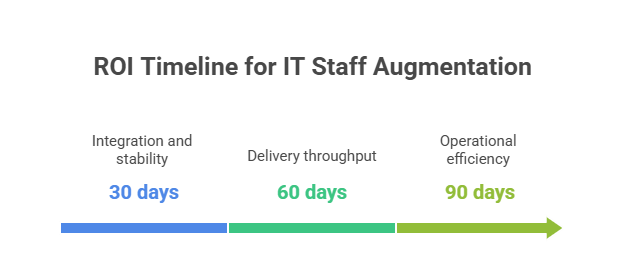
Return on investment from staff augmentation does not show up all at once.
In the first 30 days, the signal to watch is not velocity. It is whether the augmented engineers can work inside the existing codebase, follow release discipline, and ship without creating noise.
By 60 days, useful capacity should be visible. Features start reaching production faster, support tickets drop, and internal engineers spend less time fixing problems created by rushed work.
By 90 days, ROI becomes measurable through shorter cycle times, fewer incidents, and more predictable releases.
When these signals move in the right direction, augmentation is paying for itself. When they do not, scaling the team only increases cost without increasing value.
How do CTOs know they chose the right IT staff augmentation company?
The right IT staff augmentation company proves their value after the contract is signed, not before. Early signals show up in delivery behavior, not in status reports. When releases stay stable, cloud costs stay predictable, and engineers take responsibility for what they ship, the partnership is working. When velocity looks high but incidents, rework, and handoffs start increasing, something is wrong.
The safest way to judge success is to combine technical and operational indicators. A strong partner should improve delivery without creating new risk. That means fewer production issues, faster turnaround on changes, and better visibility into what is happening across the codebase.
Final decision checklist
A named technical lead owns architecture and release quality
API and data model changes are reviewed and approved, not pushed ad hoc
Builds, tests, and deployments follow the same gates as the internal team
Cloud usage and cost are tracked and discussed regularly
Knowledge is documented and shared instead of staying with individuals
The team can explain what they shipped and why
Post-selection KPIs
Time from code commit to production
Number of failed or rolled back releases
Volume of defects and support tickets
Cloud cost per active user
Onboarding time for new engineers
When these indicators stay healthy, the augmentation partner like TechnBrains is not just adding people. They are strengthening the way the product is built and delivered.
Wrapping it Up
Staff augmentation is not a shortcut to faster delivery. It is a way to extend engineering capacity without losing control, when done with the right structure, partners, and safeguards.
Teams that focus on ownership, architecture, and governance avoid the instability that often follows rapid growth.
By choosing the right model, validating partners through pilots, and tracking real delivery signals, startups and scaleups can grow their teams while keeping their products stable and scalable.
Validate Before You Scale
Apply the ROI and pilot framework in this article to test real delivery behavior before committing more budget or expanding your augmented team.
Table of Content
Frequently Asked Questions
Yes, when it is structured around ownership and delivery discipline. Startups benefit most when augmented teams take responsibility for quality, releases, and system stability, not just feature output.
Staff augmentation integrates external engineers directly into the product team and operating model. Outsourcing hands work off to a separate delivery organization with limited ownership of the system.
Most teams begin contributing within two to four weeks. Meaningful ROI usually becomes visible between 60 and 90 days when delivery and release cycles stabilize.
The main risks are unclear ownership, weak code quality controls, and lack of knowledge transfer. These lead to technical debt, unstable releases, and long term dependency.
Through strong contracts that assign all code and deliverables to the company, backed by NDAs and controlled access to systems and repositories.
Yes, when security, compliance, and access controls are enforced. Augmented engineers should follow the same governance, audit, and data protection rules as internal staff.
Small, accountable teams or pods with a technical lead are usually safer than adding individual developers because they preserve continuity and ownership.
By tracking release stability, cycle time, defect rates, cloud cost trends, and how quickly new engineers become productive.