Build and Scale Faster
150+ products shipped for startups and enterprises by engineers focused on real outcomes.
"Their ability to quickly understand an unfamiliar use case and respond creatively to it is impressive."

Anonymous
Executive, Pured Disc Golf

"TechnBrains resolved challenges efficiently and turned my vision into a solid, functional product with a strong foundation."

Jalen Gibbs
Founder, STREAMLINE LIVE
"The talent they provided was solid, but more importantly, they were quick to align with our way of working."

Nancy Snyder
Managing Director, MimeCast
Our trusted clients


Start Your Product Journey Today
Turn your idea into a working product. Share a few details and we'll help define the roadmap, timeline, and execution approach.
How Outsourcing Mobile App Projects Accelerates Innovation
If you’re leading a product team, you already feel the pressure: roadmaps growing faster than your ability to hire, and delivery timelines slipping quarter after quarter. In my experience, scalable outsourced mobile teams change that dynamic by adding bandwidth and expertise when you need it most. Organizations partnering with external development teams can achieve up to 37% faster delivery and...

Updated Aug 13, 2026
If you’re leading a product team, you already feel the pressure: roadmaps growing faster than your ability to hire, and delivery timelines slipping quarter after quarter. In my experience, scalable outsourced mobile teams change that dynamic by adding bandwidth and expertise when you need it most.
Organizations partnering with external development teams can achieve up to 37% faster delivery and time-to-market compared to traditional models.
That’s not theoretical. It’s the difference between winning users today or chasing them tomorrow. Outsourcing allows you to compress cycles, run parallel streams, and keep innovation moving without sacrificing product quality or architectural stability.
Let’s discuss it in detail!
TL;DR
Outsourcing mobile app development isn’t about cutting costs. It’s about increasing delivery speed, reducing time-to-revenue, and scaling innovation. When governed correctly, outsourced teams enable parallel development, faster release cycles, and better ROI than in-house hiring alone.
Why Scalable Outsourced Teams Reduce Time-to-Market
It’s simple! They allow you to add delivery capacity faster than traditional hiring ever can, and they do it without destabilizing your core product or architecture.
In practice, high-performing outsourced mobile teams function as plug-in pods of senior engineers that integrate with your backlog, tooling, and release cadence, meaning product work streams run in parallel, not serially.
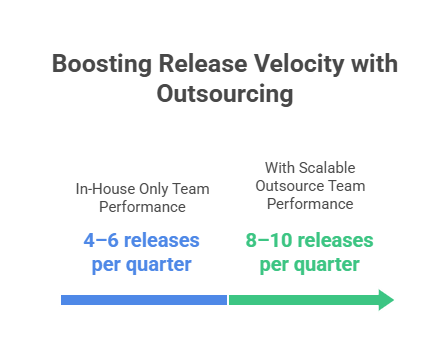
Companies leveraging external development talent consistently ship features 30% or even faster than teams limited to internal staff alone.
That acceleration isn’t magic. It’s the result of capacity scaling, reduced onboarding overhead, and mature execution practices built into the partner’s delivery model.
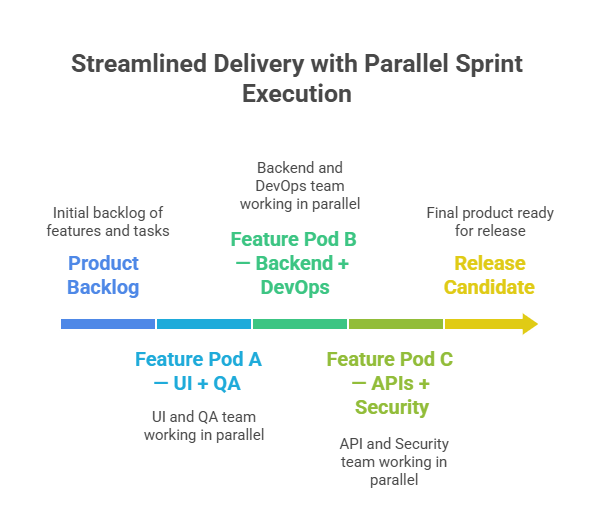
How Parallel Sprint Execution Works in Outsourced Teams
In traditional in-house models, sprint execution capacity is constrained by the size of your internal team. If you need to add features, fix technical debt, and improve performance all in the same cycle, someone gets deprioritized.
Scalable outsourced teams shift that dynamic by enabling parallel sprint execution:
- Integrated sprint planning: Outsourced engineers participate in your sprint ceremonies and align with your Definition of Done.
- Dedicated feature pods: Instead of bolting on “extra heads,” you form autonomous feature pods that own vertical slices (UI, backend, API, QA) for specific backlog items.
- Standardized tooling and standards: They adopt your existing CI/CD, code review, and quality gates so there’s zero rework after handovers.
Release Velocity vs In-House Bottlenecks
Release velocity, the frequency at which your team ships working software, is the ultimate measure of time-to-market efficiency. Two common bottlenecks in in-house models are:
- Hiring & ramp-up delays:
Even with aggressive recruiting, ramp-up time for mid-to-senior engineers can be 3–6 months before productivity matches team expectations.
- Context switching & bottleneck queues:
In a fully internal team, UI work, backend services, QA validation, and DevOps deployments often back up in sequence.
Scalable outsourced teams mitigate both:
- Senior expertise from day one: Partners bring engineers who already follow modern practices (e.g., clean architecture, automated testing, CI/CD).
- Parallel workflows: Instead of linear task queues (design → build → test → deploy), outsourced capacity allows overlap: while one pod builds, another integrates and yet another validates.
How Outsourcing Cuts Development Cycles by 30–50%
Outsourcing reduces development cycles not by cutting corners, but by removing the two biggest drag factors in software delivery: constrained capacity and sequential workstreams.
When you augment your core team with seasoned dedicated mobile developers, backend engineers, DevOps specialists, and QA professionals, you eliminate waiting periods between handoffs and dramatically reduce idle time.
Below, we break down the delivery mechanics that make this possible.
Team Topology: Pods vs Functional Silos
In traditional development models, teams are often organized as functional silos, like UI folks in one group, backend in another, QA separately, DevOps in ops, etc. This creates serial handoffs, where each group must wait for the previous one to finish before starting their work. That’s a natural brake on cycle time.
Outsourcing flips this by organizing work into cross-functional pods:
Functional Silos
- UI team
- Backend team
- QA team
- DevOps team
Work flows serially through these groups.
Cross-Functional Outsourced Pods
- Developer(s)
- QA engineer
- DevOps specialist
- Product integrator
Work flows in parallel, within one cohesive unit aligned to a specific feature or product slice.
QA, DevOps & Frontend Running in Parallel
Outsourcing accelerates cycles by breaking the classic waterfall sequence, where frontend waits on backend, QA waits on build completion, and DevOps waits on QA, and instead enables these functions to operate concurrently.
To do this effectively, your outsourced teams should include or align to:
- Dedicated QA automation engineers who write tests as code, not afterthought scripts.
- DevOps specialists who embed CI/CD from day one, not just at release time.
- Frontend engineers who consume APIs in parallel with backend development.
- Shared sprint ownership aligned with your backlog priorities.
Here’s a practical checklist to ensure parallel execution:
Parallel Execution Checklist
- Shared sprint cadence with internal team
- Unified backlog with prioritized feature slices
- CI/CD pipelines running at every commit
- Automated test suites (unit, integration, UI)
- Dedicated DevOps support for deployment automation
- Real-time dashboards tracking build and test health
When these elements are in place, the result is continuous delivery and compressed cycle times, not a series of dependent checkpoints.
Modernizing or expanding an existing mobile app?
Validate your architecture, capacity, and timelines before committing to major delivery decisions.
How to Manage Outsourced App Teams Without Losing Control
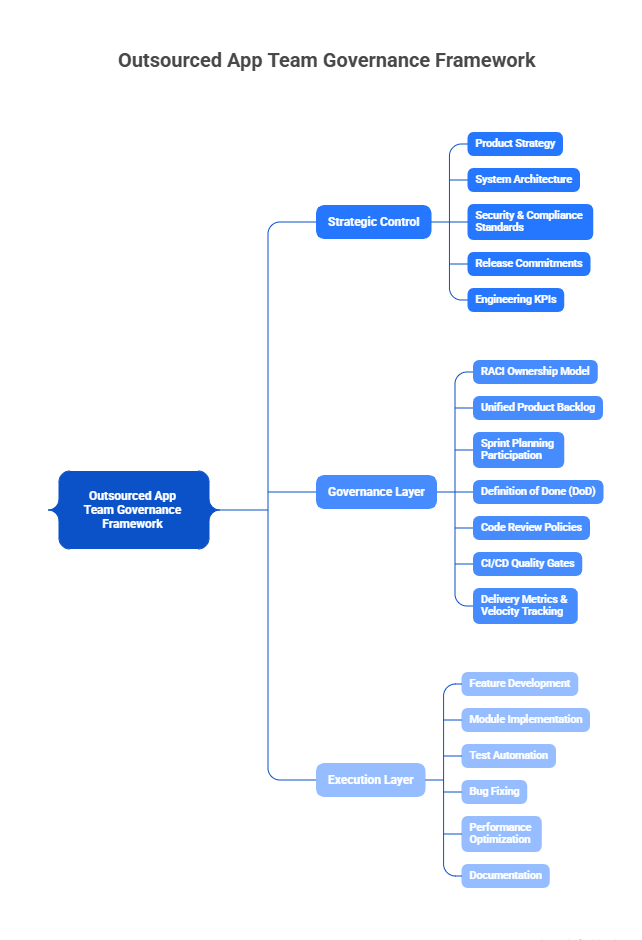
You don’t “hand over work” and hope for the best. You build governance, ownership clarity, and delivery visibility into the way your outsourced teams operate. The goal isn’t micromanagement, it’s predictable delivery with aligned accountability.
High-trust governance models allow you to enforce standards, protect architecture integrity, and ensure velocity without sacrificing product quality or internal decision authority.
The most reliable way to do this is through a clear RACI model tied to your delivery process, combined with role-specific ownership of architecture, codebase, and roadmap cadence.
Below, we break down the governance structures that make outsourcing a controlled, scalable extension of your core team.
Who Owns Architecture, Code & Velocity
When you bring outsourced engineers into your development ecosystem, it’s vital to define who owns what, because ambiguity kills delivery speed and technical quality.
Architecture Ownership
- Internal Architects / Tech Leads: Retain architectural authority, especially for core modules and interfaces.
- Outsourced Senior Developers: Implement architecture under guidance and contribute to non-core modules within approved patterns.
Code Ownership
- Internal Repositories & Standards: You own the codebase, branch policies, and static analysis rules.
- Outsourced Contributors: Follow and enforce those standards through pre-merge checks and shared linting/test suites.
Velocity Ownership
- Internal Engineering Leadership: Own release commitments, sprint goals, and quality metrics.
- Outsourced Teams: Own delivery of agreed sprint items and work against your velocity targets.
Sprint, Roadmap & Backlog Governance
Once ownership is clear, the next challenge is orchestrating delivery within your product rhythm, meaning sprints, backlogs, and roadmaps must be shared and transparent.
The solution is a governance layer that treats outsourced teams as first-class participants in your delivery process:
- Unified Backlog: All work, internal or outsourced, lives in the same backlog with transparent priorities.
- Sprint Sync: Outsourced teams join your sprint planning, standups, demos, and retros, just like internal teams.
- Definition of Done: Shared acceptance criteria for every story, including performance, security, and compliance gates.
- Velocity Metrics: Measure outsourced contributions as part of team velocity, not separate KPIs.
Here’s a simple, repeatable template for sprint governance:
RACI for Delivery Governance
To operationalize the above, a RACI matrix is invaluable:
| Activity | Internal Product | Internal Engineering | Outsourced Team | Delivery Lead |
| Define Architecture | A | R | C | C |
| Code Development | C | A | R | C |
| Code Review & Quality | C | A | R | R |
| Sprint Planning | A | R | R | C |
| Deployment & Release | R | A | R | C |
| Performance Monitoring | R | A | C | C |
R = Responsible | A = Accountable | C = Consulted | I = Informed
This governance model locks accountability where it matters, but still leverages the execution power of outsourced teams.
What is the real ROI for startups when they outsource mobile app development versus building internally?
Outsourcing mobile app development is a return-on-velocity and time-to-revenue strategy. For startups, speed, experiment iterations, and early monetization matter more than ever.
When executed right, outsourcing can drive measurable ROI through faster delivery, lower burn rate, and earlier revenue capture, without sacrificing product quality or long-term technical viability.
Below, we break down the ROI math and what it looks like in real terms.
How does outsourcing impact your monthly burn compared to in-house scaling?
Startups often assume that outsourcing equals higher per-hour cost. In reality, the effective cost per delivered feature often goes down because velocity increases and internal friction drops.
Here’s a simplified model comparing internal hiring vs outsourcing for a typical mobile app sprint:
| Cost Element | In-House Team (4 engineers + QA + DevOps) | Outsourced Model (Dedicated External Team) |
| Monthly Salaries + Benefits | $80,000 | $50,000 |
| Recruiting & Ramp-Up | $30,000 (one-time) | $0 |
| Overhead (HR, tools, training) | $10,000 | $5,000 |
| Delivery Velocity (Story Points per Sprint) | 20 | 35 |
| Cost per Story Point | $4,000 | ~$1,571 |
In this example, even though external rates may seem higher on paper, you get nearly double the throughput per dollar spent, and you avoid long recruiting cycles that add hidden costs to your burn.
The larger the backlog and the more complex the delivery needs, the more outsourcers unlock ROI through parallel workstreams and expertise leverage.
How much earlier can a startup start generating revenue when outsourcing accelerates delivery?
Time-to-revenue is one of the most compelling ROI levers for founders and investors: shipping core features faster means capturing users and monetization earlier.
Let’s break down a simple calculation:
- In-house delivery estimate for MVP: 24 weeks
- Outsourced delivery estimate: 14 weeks
- Projected weekly revenue post-launch: $15,000
Revenue difference from faster launch:
(24 weeks − 14 weeks) × $15,000 = $150,000 additional revenue
For startups on a tight runway, bringing forward revenue by even a quarter can dramatically improve financial stability, investor confidence, and product–market fit validation.
ROI Table — Startups (Example)
| Metric | In-House | Outsourced |
| Time to MVP | 24 weeks | 14 weeks |
| Launch Revenue Acceleration | $0 | $150,000+ |
| Burn Rate Impact | High | Lower |
| Feature Throughput | Medium | High |
| Quality & Market Fit | Variable | More predictable |
Outsourcing becomes not just an expense, it becomes a strategic lever that compresses runway risk and maximizes monetization potential earlier in the startup lifecycle.
When should a startup or scaling company rely on in-house teams vs outsourced teams for mobile app delivery?
The decision is about what part of your delivery engine needs scale, specialization, or flexibility right now. In-house teams are essential for deep product knowledge, strategic ownership, and long-term platform evolution.
Nearly 66% of US businesses outsource at least one department. Outsourced teams are most effective when you need burst capacity, specialized skills, or parallel execution without slowing the internal organization. The real ROI comes when you combine both in a way that leverages each model’s strengths.
Below, we compare the two models and show why hybrid approaches are often the best path for scaling mobile products.
When In-House Fails to Scale
65% of tech leaders report that talent shortages directly slow development cycles, especially for mobile and cloud-native capabilities.
In-house teams can struggle when the product roadmap outpaces hiring capacity or when specialized skills are needed faster than the market supply can deliver. Common scaling failure patterns include:
| Constraint | In-House Team | Impact |
| Hiring Lag | 3–6 months to onboard senior engineers | Delivery timelines slip |
| Expertise Gaps | Limited to generalists | Complex domains (DevOps, AI, security) suffer |
| Ramp-Up Overhead | Cultural + tooling training | Lower early throughput |
| Cost Pressure | High fixed labor cost | Budget squeeze |
When these constraints hit, teams often resort to overtime, re-prioritization, or de-scoping; all signs that in-house capacity has maxed out.
How can you get the best of both worlds?
Hybrid delivery models combine the strategic ownership of in-house teams with the execution horsepower of outsourced expertise. Instead of outsourcing entire products, hybrid models assign:
- In-house teams: Product strategy, architecture vision, core platform ownership
- Outsourced teams: Feature pods, parallel workstreams, specialized tasks (e.g., QA automation, DevOps pipeline setup, performance engineering)
This approach retains core decision authority while scaling capacity on demand.
Key benefits of hybrid models:
- Architectural continuity: In-house architects steer the platform’s long-term evolution.
- Elastic delivery: Outsourced pods accelerate specific streams without disrupting core squads.
- Cost predictability: You pay for capacity you need when you need it.
- Knowledge transfer: Internal teams benefit from external expertise through paired development and documentation standards.
This hybrid approach is widely adopted in scaling tech organizations because it balances control, velocity, and quality, exactly what CTOs and Heads of Product care about.
Is Outsourcing Right for Your App Roadmap?
Use this checklist the way I do when evaluating whether external delivery capacity will actually improve execution, not just add noise. If you can check most of these, outsourcing is likely to increase your roadmap velocity without increasing risk.
Strategic Fit
- Our product roadmap requires more delivery capacity than our current team can realistically staff in the next 90 days.
- We have revenue, growth, or competitive milestones tied to faster feature releases.
- We need specialized skills (mobile, DevOps, QA automation, cloud, AI) that are hard to hire quickly.
Execution Readiness
- We have a clear backlog and sprint cadence that external teams can plug into
- Our architecture and APIs are documented well enough for parallel development
- We can enforce code quality, CI/CD, and security standards across all contributors
Financial & ROI Logic
- Faster releases would materially impact revenue, churn, or user acquisition
- Hiring internally would take longer than our market window allows
- We can measure velocity, cost per feature, and time-to-revenue
Governance & Control
- We can assign internal owners for architecture, roadmap, and release decisions
- We are prepared to run unified sprint planning and demos across teams
- We can use shared tools for backlog, source control, and deployment
If you reach the end thinking, “Yes, that’s exactly where we are,” then outsourcing isn’t a risk, it’s a delivery lever.
If you want to sanity-check your situation, you can always talk to engineering and walk through your roadmap, timelines, and team structure with someone who’s done this before.
Wrapping it Up
Outsourcing, when done with proper governance, architecture ownership, and integrated delivery models, becomes a way to increase engineering throughput and reduce time-to-market while maintaining technical control.
Whether you’re a startup racing to product–market fit or an enterprise modernizing a legacy mobile platform, scalable external teams allow you to run more experiments, release faster, and turn roadmap ambition into shipped software, without the friction and delays of traditional hiring.
Working on a mobile platform that needs to move faster?
Get a clear view of what’s slowing delivery and what would actually improve release velocity.
Table of Contents
Frequently Asked Questions
When structured correctly, outsourcing reduces risk by adding capacity, specialization, and delivery redundancy. Risk only increases when ownership, architecture, and governance are unclear, not when execution is distributed.
By keeping architecture ownership, code standards, CI/CD pipelines, and reviews under your control. Outsourced teams should contribute within your technical guardrails, not define them.
Yes, in fact, that’s where it works best. Outsourcing provides parallel execution and specialization that complements in-house domain knowledge and product leadership.
Treating it as staff replacement instead of delivery scaling. The goal is to increase throughput and speed, not offload responsibility.
When time-to-market, feature velocity, or revenue timing matters more than building long-term headcount, which is usually the case during growth and product-market fit phases.
Track release frequency, sprint velocity, cost per feature, and time-to-revenue, not just hours billed. Those metrics reveal whether outsourcing is improving real business outcomes.
Blocked by backlog or missing expertise?
Senior developers who build, fix, and ship — without slowing your team down.