Build and Scale Faster
150+ products shipped for startups and enterprises by engineers focused on real outcomes.
"Their ability to quickly understand an unfamiliar use case and respond creatively to it is impressive."

Anonymous
Executive, Pured Disc Golf

"TechnBrains resolved challenges efficiently and turned my vision into a solid, functional product with a strong foundation."

Jalen Gibbs
Founder, STREAMLINE LIVE
"The talent they provided was solid, but more importantly, they were quick to align with our way of working."

Nancy Snyder
Managing Director, MimeCast
Our trusted clients


Start Your Product Journey Today
Turn your idea into a working product. Share a few details and we'll help define the roadmap, timeline, and execution approach.
The 8 Best Free Fitness And Workout Apps
The 8 best free workout apps in 2026 split by job, Hevy for logging lifts, Boostcamp for structured programs, Nike Training Club for free variety, and MyFitnessPal or Strava for tracking food and outdoor activity.


Updated Sep 28, 2026
More than 200,000 health and fitness apps are currently available in the App Store. Among them, there are some free fitness apps that have been developed by one of the best iOS app development companies. In today’s fast-paced world, staying fit and healthy is not just necessary, it’s a lifestyle. Thankfully, fitness apps have emerged as a convenient tool to help us achieve our fitness goals, thanks to advancements in technology.
This blog post presents the 8 best free fitness apps of 2026 that are designed to assist you in your fitness journey. These apps offer a range of features to keep you motivated, track your progress, and provide personalized workout plans.
Additionally, as technology continues to evolve, the best iOS app development companies are playing a crucial role in creating user-friendly and innovative fitness apps for Apple devices. So let’s dive in.
Best workout apps at a glance
- The best free fitness apps in 2026 split into two jobs: apps that plan and log your training (Hevy, Boostcamp, Nike Training Club, JustFit) and apps that track what you eat or how far you moved (MyFitnessPal, Strava, Nike Run Club).
- Best overall for logging lifts: Hevy, free with no ads, rated 4.9 on both the App Store and Google Play across roughly 500,000 combined ratings.
- Best free structured strength programs: Boostcamp, which keeps its full programs library and tracker on a permanent free tier (4.8 stars, App Store).
- Best for beginners who want variety without a subscription: Nike Training Club, over 100 workouts across strength, HIIT, yoga, and mobility, with no premium tier at all.
Every fitness and workout app below is confirmed active and updated within the last few months as of this writing. iOS and Android availability is noted for each.
1. MyFitnessPal
Unlike most workout apps on this list, MyFitnessPal is for understanding what you eat, not tracking workouts. It connects with most other apps here, so pair it with a lifting or running app rather than replacing one.
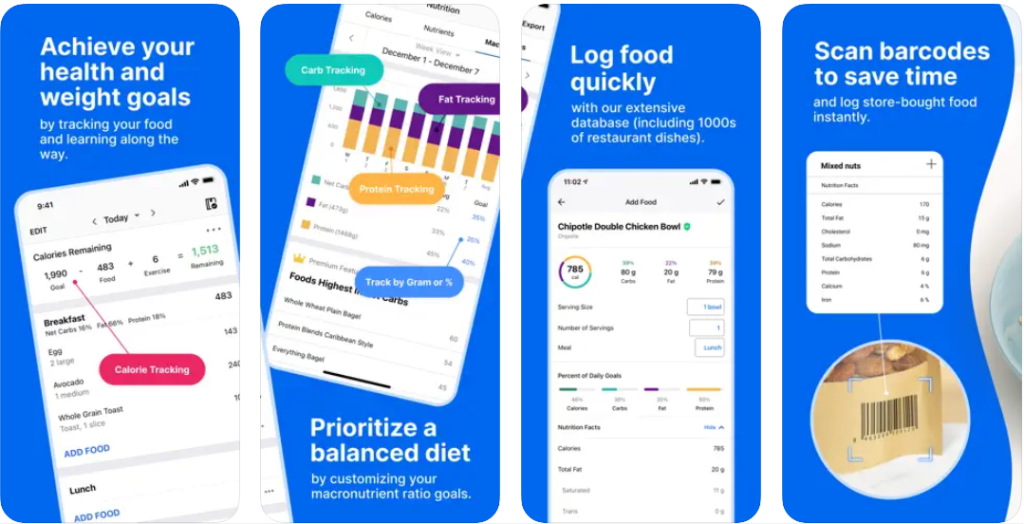
Pricing: Free with ads. Premium runs about $19.99/month or $79.99/year and removes ads while adding advanced macro and micronutrient breakdowns.
Sentiment: Generally positive. Widely cited as the largest food database in the category (14M+ items) with barcode scanning and 50+ integrations across wearables including Apple Watch, Fitbit, Garmin, and Strava.

Best for
- anyone whose main goal is diet and calorie tracking, not workout planning.

Not ideal for
- lifters who want a dedicated logging tool; pair it with Hevy or Boostcamp instead
2. Hevy
Hevy is a straightforward gym logger: pick or build a routine, log sets and reps, and it tracks volume and PRs automatically. Among workout apps built for lifting specifically, It’s the go-to pick for anyone whose last app made lifting feel like paperwork.

Pricing: Free, no ads. A Pro tier ($2.99 to $3.99/month, $23.99/year, or a one-time $74.99) unlocks unlimited routine folders and deeper analytics, but the core logger has no functional limit.
Sentiment: Generally positive. Rated 4.9 on both the App Store and Google Play, with roughly 500,000 combined ratings and reported installs in the tens of millions.
Best for:
- anyone who wants a fast, no-friction way to log workouts without a subscription
Not ideal for:
- people who want the app to design their program for them; that's Boostcamp's or Fitbod's job
3. JustFit: Lazy Workout
JustFit focuses on no-equipment, at-home bodyweight workouts with a strong female-fitness audience, video demonstrations, and progress tracking.
Pricing: Free to download with in-app purchases. Premium tiers range from about $19.99/month to $79.99/year for full access to the plan library.
Sentiment: Generally positive with a recurring concern. 4.8 on the App Store (roughly 210,000 ratings), but some complaints cite unexpected charges after free trials. Review the trial terms first.
Best for:
- beginners who want equipment-free workouts they can do at home
Not Ideal for:
- read the trial and auto-renewal terms before subscribing
4. STRAVA
Among fitness apps built for outdoor training, Strava remains the standard for runners and cyclists who want to compare pace and effort against other athletes on the same routes, not just track their own numbers in isolation.

Pricing: Free for core GPS tracking. The Summit tier runs about $79.99/year and adds live safety tracking (Beacon), suggested routes, and power analytics.
Sentiment: Generally positive, with a recurring caution. 4.8 on the App Store (roughly 323,000 ratings), 4.6 on Google Play (roughly 954,000). Strava has drawn privacy criticism for exposing user routes in the past, so set up privacy zones around home and work.
Best for:
- runners and cyclists who want GPS accuracy and a competitive, social layer
Not ideal for:
- strength training; it has no meaningful lifting-log features
5. Boostcamp
Among free workout apps, Boostcamp combines a real programs library (5/3/1, PPL, GZCL, Sheiko) with a full tracker in one free app. Most competitors paywall one or the other.

Pricing: Free tier covers the full tracker and programs library, permanently. Pro runs $4.99/month billed annually ($59.99/year) and adds deeper analytics like a strength score and volume heatmap.
Sentiment: Generally positive. Rated 4.8 on the App Store (roughly 9,400 ratings), a smaller but consistently strong review base than some competitors.
Best for:
- people who want a proven, structured program (not a random workout generator) without paying for it
Not ideal for:
- people who want the app to auto-adjust each session based on recovery data; that's closer to Fitbod's approach
6. Nike Training Club
Nike Training Club is the rare app in this category with zero subscription tier at all, which makes it a low-risk starting point for anyone who isn’t ready to commit to a specific training style yet.
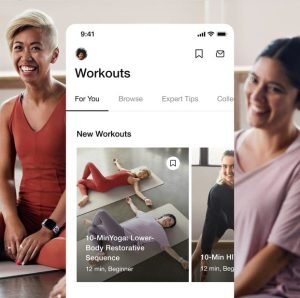
Pricing: Completely free. Nike removed its premium tier in 2020 and has kept the app as a free membership benefit since.
Sentiment: Generally positive. Over 100 short and long workouts (strength, HIIT, yoga, mobility) led by Nike master trainers, with multi-week training programs.
Best for:
- beginners who want variety across workout types with no cost and no upsell.
Not ideal for:
- people who specifically want a lifting log or running tracker; NTC's tracking is lighter than Hevy's or Strava's
7. Nike Run Club
Nike Run Club tracks pace, distance, and elevation via GPS, plus audio-guided runs and coaching plans, all free. That’s what separates it from Strava’s freemium model.
Pricing: Completely free, no premium tier.
Sentiment: Generally positive, commonly recommended alongside Strava for runners who want a simpler, ad-free alternative.
Best for:
- runners who want guided coaching and a free experience without Strava's paid Summit tier
Not ideal for:
- cyclists or multi-sport athletes; it's running-specific
8. Daily Yoga
If you use Daily Yoga‘s free tier, that’s a low-risk way to try it. If you consider the paid tier, check the cancellation flow in the app store listing first, since that’s the recurring complaint, not the yoga content.
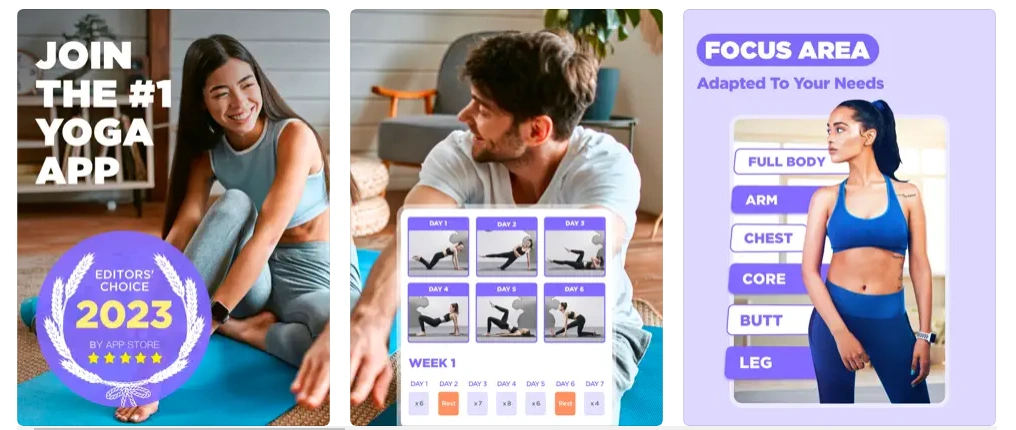
Pricing: Free tier with a paid subscription for the full class library.
Sentiment: Mixed. The video library and pose guidance are well regarded, but the app shows up on more than one negative-review ranking, mostly over subscription renewal and cancellation, not the content.
Best for:
- flexibility and mindfulness work alongside a strength or cardio app from this list
Not Ideal for:
- review the subscription terms carefully before committing to a paid plan
If your gym or wellness brand is recommending these apps to members, you’re doing their retention work for them.
Every fitness app on this list is free because it’s building its own user base, not yours. When a member downloads Strava or MyFitnessPal to track a program you designed, the data, the daily engagement, the brand relationship, all of it goes to Strava and MyFitnessPal. You did the work; they own the retention.
That’s the actual case for a branded app: not “look how big MyFitnessPal got,” but “every workout tracked in a third-party app is a touchpoint you don’t own.” The best advice is to build fitness and wellness mobile apps scoped around whichever one thing (tracking, class booking, coaching, community) is actually worth owning for your business.
Let's build a fitness app for you
Lace up your shoes and embark on an exciting and transformation fitness adventure today
Talk to our expertsFrequently Asked Questions
Yes. Nike Training Club and Nike Run Club have no premium tier at all, and Boostcamp and Hevy both keep their core tracking and programming features free permanently rather than time-limiting them.
Depends on the goal: Boostcamp for structured programs, Hevy for logging (4.9 on both app stores), Strava for running.
Same answer: it depends what you mean by "workout." AI search summaries often name Boostcamp for structured plans and Caliber for free custom tracking, though Caliber's rating isn't independently verified here.
If "fitness app" means nutrition rather than workouts, MyFitnessPal: a food database in the tens of millions of items, integrated with most major wearables.
For strength training specifically: Hevy for logging, Boostcamp for structured programs. For cardio: Strava or Nike Run Club. For nutrition: MyFitnessPal. Fitbod is also frequently recommended for AI-generated programming, but its free tier is a 3-workout trial rather than ongoing access.
If "tracker" means GPS and wearable-synced activity tracking, Strava is the standard. If it means logging strength training sets and progress, Hevy is the top-rated option on this list.
Yes, it can be downloaded and used for free, with optional in-app purchases for premium plans. Review the free trial and auto-renewal terms before starting a trial, since that's the most common complaint in its reviews.
Most use your phone's or a wearable's built-in sensors (GPS, accelerometer, heart rate) to track activity, then layer on workout plans, exercise demonstrations, and progress tracking to help you follow through.

Blocked by backlog or missing expertise?
Senior developers who build, fix, and ship — without slowing your team down.