Build and Scale Faster
150+ products shipped for startups and enterprises by engineers focused on real outcomes.
"Their ability to quickly understand an unfamiliar use case and respond creatively to it is impressive."

Anonymous
Executive, Pured Disc Golf

"TechnBrains resolved challenges efficiently and turned my vision into a solid, functional product with a strong foundation."

Jalen Gibbs
Founder, STREAMLINE LIVE
"The talent they provided was solid, but more importantly, they were quick to align with our way of working."

Nancy Snyder
Managing Director, MimeCast
Our trusted clients


Start Your Product Journey Today
Turn your idea into a working product. Share a few details and we'll help define the roadmap, timeline, and execution approach.
AI in PropTech 2026: Adoption, Impact, and Real-World Outcomes
Buildium’s 2026 report found that AI adoption in property management jumped from 20% in 2024 to 58% in 2025, but only 8% of companies had fully automated any process. That gap says a lot: property and real estate app development teams are testing AI fast, but most are still struggling to make it work inside daily operations. AI is not...


Updated Sep 30, 2026
Buildium’s 2026 report found that AI adoption in property management jumped from 20% in 2024 to 58% in 2025, but only 8% of companies had fully automated any process. That gap says a lot: property and real estate app development teams are testing AI fast, but most are still struggling to make it work inside daily operations.
AI is not the hard part in PropTech anymore. Making it work across leasing, maintenance, tenant communication, pricing, energy management, and portfolio reporting is where the real challenge begins.
Many PropTech and real estate software companies have strong AI ideas, but those ideas often break down when they meet messy data, user roles, approvals, integrations, and manual workflows. The real opportunity is building software where AI improves speed, accuracy, visibility, and decision-making across property operations.
TL;DR: What should you know about AI in PropTech in 2026?
- AI adoption among property management companies jumped from 20% to 58% in one year, according to Buildium’s 2026 industry trends report.
- In commercial real estate, around 92% of CRE firms have piloted AI, but only 5% say they have achieved all AI goals.
- 90.1% of companies expect AI to support corporate real estate functions within five years, and more than 60% had already started piloting AI use cases.
- AI adopters expect 31% portfolio growth in 2026, compared with 12% for non-adopters.
- AI/automation could unlock ~$430–550 billion in annual value across real estate, construction, and development.
- The biggest opportunity is workflow intelligence. AI creates the most value when it connects to maintenance, pricing, leasing, scheduling, tenant communication, reporting, and portfolio decisions.
How is AI adoption in PropTech growing worldwide?
AI adoption in PropTech software development is growing quickly worldwide, but most companies are still in the early maturity stage. The market is moving from AI-assisted tasks, such as property descriptions and tenant replies, toward AI-connected workflows for maintenance, pricing, leasing, reporting, and portfolio decisions.
Key adoption signals include:
- Property management AI adoption jumped from 20% to 58%.
This suggests property teams are becoming more comfortable using AI for communication, content, reporting, and admin support. - Around 700 of 7,000 global PropTech companies offered AI-powered real estate solutions by the end of 2024.
This means roughly 10% of the global PropTech ecosystem had moved beyond traditional software into AI-native or AI-augmented products. - More than 500 companies were already offering AI-powered services to real estate.
These include IoT data mining, portfolio analytics, price modeling, lease intelligence, document automation, and building operations.
What we have seen is that the first wave of AI in PropTech is productivity-driven. Teams use AI to write listings, respond to tenants, summarize documents, and reduce repetitive admin work. The second wave is more difficult because it requires clean data, structured workflows, role-based permissions, and deeper integrations.
Brendan Wallace, Founder & CEO of Fifth Wall (one of the largest PropTech investors globally), shared on LinkedIn:
“Real estate companies may now be in a better position to leapfrog directly into AI-native tools, workflows, and operating models.”
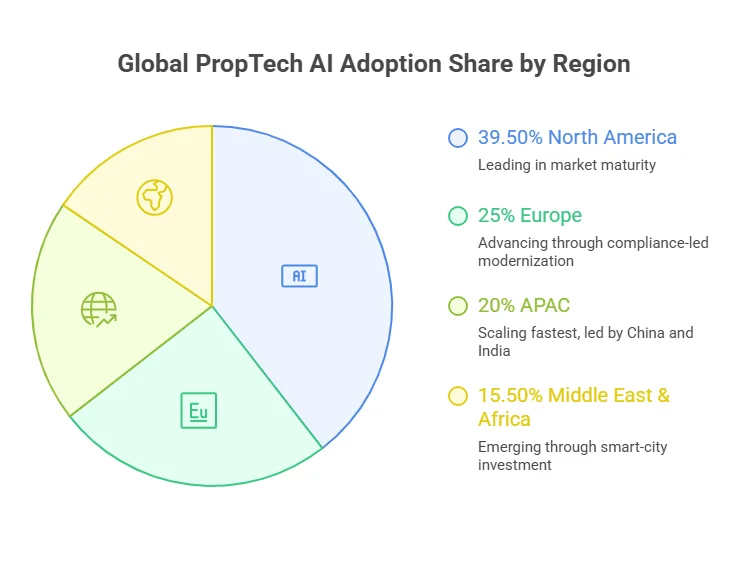
How is PropTech AI adoption changing across regions and countries?
PropTech AI adoption is not growing evenly worldwide. North America is leading in market maturity, Europe is advancing through compliance-led modernization, APAC is scaling fastest, and the Middle East is emerging through smart-city investment.
| Region | Adoption Signal |
| North America | Holds around 38% to 41% share in several PropTech and AI-in-real-estate estimates. |
| Europe | UK and Germany adoption among large developers exceeded 65%, while Nordic markets reached nearly 75%. |
| APAC | Asia-Pacific is one of the fastest-growing PropTech regions, led by China, India, Singapore, Japan, and Australia. |
| Middle East & Africa | MEA remains under 10% of global PropTech value in several estimates, but UAE and Saudi Arabia are growing quickly. |
Country-wise adoption patterns: Our Analysis
- United States:
U.S. property teams usually adopt AI to reduce staffing pressure, speed up leasing, automate resident communication, and improve portfolio growth. The focus is practical ROI. - United Kingdom and Germany:
These markets are more mature in enterprise adoption, especially among large developers and commercial real estate operators. AI is commonly tied to cloud systems, compliance, sustainability reporting, and operational visibility. - Nordic countries:
Nordic markets show strong digital readiness, with adoption levels reaching around 75% among large developers in some estimates. This makes the region well-positioned for energy management, smart buildings, and data-driven facility operations. - Singapore and Hong Kong:
These markets stand out for IoT-enabled commercial buildings and smart-office adoption. More than 40% of commercial-office portfolios had deployed IoT sensor networks by 2024, according to market analysis. - India and China:
India and China carry some of the highest growth potential because of urban expansion, residential demand, smart-city investment, and mobile-first property platforms. - UAE and Saudi Arabia:
GCC adoption is not only software-led. It is ecosystem-led. AI in real estate and PropTech is being shaped by urban planning, digital approvals, smart buildings, and connected infrastructure.
Saman Faegh, CBDO and Director of Business Strategy at PROPITO, working in AI-first PropTech in the UAE, shared:
“The biggest opportunity for AI in real estate, especially in markets like the UAE, is not a new concept but addressing human analytical limitations. Real estate decisions are often shaped by data complexity and emotional bias. AI helps by structuring scattered information into clearer insights for better decision-making.
Many assume AI is a plug-in tool, but in practice, success depends on strong local data infrastructure and workflows that integrate AI without adding complexity.”
How are SMBs, mid-market firms, and enterprises adopting AI?
SMBs use AI for simple productivity, mid-market firms use it for workflow automation, and enterprises use AI for portfolio intelligence, revenue management, and operational scale.
| Company Size | Typical AI Use | Adoption Pattern |
| SMB property managers | Listing descriptions, tenant replies, basic support automation | Low-cost, tool-based AI |
| Mid-market operators | Leasing assistants, screening support, workflow automation, owner reporting | AI bundled into property platforms |
| Enterprise portfolios | Revenue management, predictive maintenance, energy intelligence, fraud detection, portfolio dashboards | AI-native or custom integrated systems |
Through our work with Spruce, a multi-role property services platform, we noticed that mid-market platforms often have the biggest AI opportunity because their workflows span residents, providers, managers, admins, and owners.
Spruce proved that impact does not come from adding AI on top of disconnected workflows. It comes from connecting scheduling, provider capacity, pricing rules, admin visibility, and service coordination into one operational layer. That helped improve scheduling speed by 50–60% and reduced pricing inconsistencies by around 70%.
Ebenezer Aduramo, Product Manager specializing in Platform Strategy, AI Transformation, and PropTech solutions, believes many teams approach AI the wrong way from the start.
“Most treat AI as a standalone feature instead of designing it around real property data, compliance, and decision-making. In platforms like Spruce, data is rarely clean or standardized. Teams often build on idealized datasets and underestimate the work required for validation, governance, and transparent outputs.
When AI is introduced without feedback loops, human oversight, and compliance considerations, adoption often stalls regardless of how advanced the technology is.
How does AI adoption differ by property type?
AI adoption varies by property type. Multifamily leads in operational AI because its workflows are repeatable, CRE leads in experimentation but needs stronger data governance, industrial/logistics adoption depends on IoT and predictive maintenance, and smart-city projects use AI for digital twins, energy, and infrastructure intelligence.
| Property Type | Best AI Use Cases |
| Multifamily residential | Leasing bots, dynamic pricing, renewal prediction, maintenance triage |
| Single-family portfolios | Owner reporting, tenant communication, screening, vendor coordination |
| Commercial office | Energy optimization, occupancy analytics, lease abstraction |
| Industrial/logistics | Predictive maintenance, equipment monitoring, warehouse workflow automation |
| Urban/smart-city | IoT, digital twins, GIS mapping, energy and mobility systems |
Multifamily is the strongest operational proving ground. EliseAI’s 2025 State of AI in Multifamily report found that 77% of AI-using operators reduced operating expenses, while 85% improved lead-to-lease conversion rates.
In our research, we found that CRE is document-heavy. Lease abstraction, rent roll analysis, deal underwriting, and asset reporting are excellent AI use cases, but they require data governance and review workflows.
JLL’s 2025 Global Real Estate Technology Survey found that 92% of CRE companies are piloting AI, but only 5% have achieved most program goals. The issue is not interest. It is execution across lease data, approvals, governance, and legacy systems.
For industrial, logistics, and CRE operations, Visitt’s 2026 Series B announcement is a useful signal. The company is building an AI-native interface that consolidates property management functions and automates repetitive workflows, showing where AI is moving across work orders, inspections, tenant communication, and asset operations.
Why are property managers investing in AI now?
Property managers are investing in AI because costs are rising, portfolios are growing, residents expect instant service, and manual workflows no longer scale.
-
- Buildium reported that expenses increased for 93% of property management companies, while 50% of respondents planned to cut costs by adopting new tools or using current tools better.
-
- The market itself is also growing. Fortune Business Insights estimated the global PropTech market at $40.19 billion in 2025, growing to $104.57 billion by 2034.
-
- Precedence Research gives a different range, estimating $47.08 billion in 2025 and $209.43 billion by 2035.
Important insight: do not quote one PropTech market-size number as absolute truth. Reports define PropTech differently. Some include construction tech, smart-home hardware, fintech overlap, marketplace platforms, and building operations. The safer, more credible approach is to present a range.
Which AI applications deliver measurable value in PropTech?
The AI applications that deliver the clearest value in PropTech are the ones tied to measurable operational outcomes: faster maintenance response, fewer pricing errors, lower coordination work, quicker tenant support, and better asset visibility.
| AI Application | Measurable Impact | Best Fit |
| Predictive maintenance | 15–25% lower repair costs | Multifamily, office, industrial |
| Dynamic pricing | ~70% fewer pricing inconsistencies | Property services, rentals, short-term stays |
| Tenant engagement AI | Up to 90% of routine inquiries handled automatically | Multifamily, student housing |
| Workflow automation | 35–60% less manual coordination | Multi-role PropTech platforms |
| Capacity management | 50–60% faster scheduling | Service-heavy property platforms |
| Utility anomaly detection | 15–30% lower utility waste | Smart buildings, CRE, multifamily |
In one real estate app we built, the main challenge was maintenance coordination. Requests came from multiple user roles, managers had limited visibility, and vendors often needed manual follow-ups before work could move forward.
By restructuring the workflow around ticket priority, service category, approval rules, vendor availability, and status visibility, the platform reduced manual coordination by an estimated 35–40% and improved maintenance triage speed by around 25–30%.
What are the biggest AI mistakes property platforms make?
The biggest AI mistake in PropTech is deploying AI before the platform has clean data, connected workflows, governance, and human review. Most failed AI projects do not fail because the model is weak. They fail because the operating system around the model is not ready. The pattern is not unique to property: AI adoption statistics in construction show the same gap, with belief in AI running far ahead of adapted workflows for the same data-readiness reasons.
| Mistake | What Goes Wrong | Risk |
| Fragmented data | AI pulls from disconnected PMS, CRM, vendor, payment, and IoT systems | Inaccurate outputs and manual correction |
| Partial automation | One step is automated, but handoffs still depend on people | More exceptions and workflow delays |
| No governance | AI decisions are not explainable or auditable | Legal and compliance risk |
| Weak human review | AI outputs go live without checks | Tenant dissatisfaction and operational errors |
| Pilot-only thinking | AI works in demos but not in daily operations | Wasted spend and no measurable ROI |
Commercial real estate shows the broader pattern. Deloitte’s 2026 CRE outlook found that the share of executives reporting “transformative impact” from AI dropped to around 1%, from about 12% the prior year.
The SafeRent tenant screening case shows the risk in property workflows specifically. Its AI-based screening system led to a $2.3M settlement after allegations that the model unfairly affected applicants using housing vouchers.
But we believe that this is not proof that AI failed. It is proof that pilots are easier than production. Real value comes when AI can operate across permissions, data, exceptions, pricing rules, and human review.
How do experts apply AI successfully in PropTech?
Experts apply AI after workflow readiness, not before it. The strongest PropTech AI results usually come from platforms that first centralize data, stabilize role-based workflows, and define clear operational rules.

The best sequence is:
-
- Stabilize core workflows across residents, providers, managers, admins, and owners.
-
- Centralize data and permissions so every role works from the same source of truth.
-
- Automate predictable steps like scheduling, pricing, notifications, approvals, and reporting.
-
- Add dashboards and QA to track errors, exceptions, and operational bottlenecks.
-
- Layer AI into decisions, alerts, and exceptions once the workflow is measurable.
Tommaso Mariaricci, Real Estate AI Advisor, shared a 2026 mid-market brokerage case where the team first unified property data, then added AI for energy optimization, lease abstraction, and acquisition modeling.
The results were practical: 19% lower energy costs, lease abstraction reduced from $320 to $40 per lease, and 27% IRR on AI-flagged acquisitions. His key lesson was that large real estate investors capture the biggest AI returns only after fixing data foundations.
The same principle appears in multifamily. RXR Realty’s use of Vero, an AI-powered leasing and fraud screening tool, showed strong operational impact after better data foundations were in place, with delinquency rates reportedly falling from 4.16% to 0.02%.
What we have learnt from Spruce is thatmulti-role PropTech platforms, every event should update each role differently but consistently. A resident booking should update provider tasks, manager visibility, admin reporting, pricing logs, and notification triggers from one source of truth.
What AI features should PropTech platforms integrate first?
PropTech platforms should start with AI features that improve measurable operations before adding advanced agentic workflows.
| Feature | KPI to Measure |
| Predictive scheduling | Scheduling time, missed appointments, provider utilization |
| Rule-based dynamic pricing | Override rate, pricing consistency, revenue leakage |
| Automated tenant communication | Response time, inquiry resolution, support hours saved |
| Workflow anomaly detection | Exception rate, failed bookings, billing errors |
| Multi-role dashboards | Manager visibility, reporting time, decision speed |
| Energy optimization | Utility cost, usage spikes, carbon reduction |
For most property platforms, AI should not begin with a fully autonomous agent. It should begin with alerts, suggestions, anomaly detection, and structured automation. The same staged path shows up across industries in the AI automation maturity model, where approval-based automation is the largest tier at 48% of documented deployments. Agentic PropTech becomes powerful only when the system has reliable access to clean workflows and approved actions.
What should PropTech developers avoid when integrating AI?
PropTech developers should avoid building AI features that are disconnected from role logic, data quality, QA, and real operational constraints.
Avoid these patterns:
-
- Building a chatbot before fixing booking and maintenance workflows.
-
- Using AI-generated pricing without transparent rules.
-
- Automating provider assignment without capacity data.
-
- Showing managers too many AI insights without clear actions.
-
- Treating tenant, provider, manager, and admin workflows as separate products.
-
- Skipping regression testing across role-based workflows.
A practical rule: if a human team cannot explain the workflow clearly, AI should not automate it yet.
For PropTech software developers, the goal is not to make the interface look intelligent. The goal is to make the operation more reliable, measurable, and easier to scale.
What 2026 trends should PropTech teams watch?
The biggest PropTech AI trends are agentic workflows, AI-first dashboards, rule-based pricing, generative AI, digital twins, energy management, and regional adoption shifts.
| Trend | What It Means |
| Agentic PropTech | AI agents will move from summaries to task execution, such as lease review, scheduling, and portfolio analysis. |
| AI-first dashboards | Managers will expect dashboards that explain anomalies, risks, and next actions. |
| Rule-based dynamic pricing | Pricing engines will need transparency, audit logs, and admin controls. |
| Generative AI | Tenant engagement, lease summaries, contract drafts, and support workflows will expand. |
| Digital twins and IoT | Smart buildings will use live data for maintenance, occupancy, and energy decisions. |
| Energy optimization | CRE and multifamily operators will use AI to reduce utility spend and emissions. |
| Regional growth | APAC and GCC markets will grow faster through smart-city and infrastructure programs. |
Reddit discussion shows the same shift: AI is moving beyond surface-level features like search, listings, and virtual tours into harder real estate workflows such as underwriting, valuation accuracy, deal-flow bottlenecks, and governance.
That is where the next wave of PropTech AI will likely be judged, not by how impressive the AI looks, but by whether it can support high-stakes decisions safely and consistently.
Conclusion
AI in PropTech is moving from simple automation to real operational intelligence.
The biggest gains are no longer coming from chatbots or content generation alone. They are coming from platforms that can predict maintenance needs, improve scheduling, reduce pricing errors, automate tenant communication, and give managers clearer visibility across properties.
But the lesson is clear: AI works only when the platform is ready for it. Clean data, connected workflows, role-based permissions, QA, and measurable KPIs matter more than adding another AI feature.
For PropTech teams, the smartest path is to fix the workflow first, then apply AI where it can improve speed, accuracy, cost control, and decision-making. That is how AI moves from a trend to a real business advantage in property management and real estate operations.
Table of Contents
Frequently Asked Questions
AI in PropTech is the use of artificial intelligence to automate, predict, and improve real estate workflows such as leasing, maintenance, pricing, tenant communication, energy management, and portfolio reporting.
AI is used in property management for tenant replies, leasing automation, maintenance triage, rent reminders, owner reporting, dynamic pricing, scheduling, and workflow anomaly detection.
Examples of AI in PropTech include leasing chatbots, predictive maintenance, lease abstraction, AI-powered screening, dynamic pricing, energy optimization, digital twins, and AI dashboards.
AI in PropTech can be risky when it is used without clean data, audit logs, bias checks, explainable rules, and human review, especially in tenant screening, pricing, approvals, and eligibility workflows.
Agentic AI in PropTech refers to AI systems that can take workflow actions, such as routing maintenance tickets, reviewing lease terms, flagging pricing issues, scheduling providers, or generating portfolio alerts.
AI is changing real estate underwriting by helping teams review documents faster, compare assumptions, flag valuation risks, summarize deal inputs, and reduce analyst workload. The strongest underwriting AI tools still need clean data, human review, and explainable assumptions because investment decisions are high-stakes.
AI governance matters in PropTech because AI can affect tenant screening, pricing, approvals, lead qualification, communication, and investment decisions. Without audit trails, bias checks, human review, and explainable rules, AI can create legal, financial, and reputational risk.
Blocked by backlog or missing expertise?
Senior developers who build, fix, and ship — without slowing your team down.