
Build and Scale Faster
150+ products shipped for startups and enterprises by engineers focused on real outcomes.
"Their ability to quickly understand an unfamiliar use case and respond creatively to it is impressive."

Anonymous
Executive, Pured Disc Golf

"TechnBrains resolved challenges efficiently and turned my vision into a solid, functional product with a strong foundation."

Jalen Gibbs
Founder, STREAMLINE LIVE
"The talent they provided was solid, but more importantly, they were quick to align with our way of working."

Nancy Snyder
Managing Director, MimeCast
Our trusted clients


Start Your Product Journey Today
Turn your idea into a working product. Share a few details and we'll help define the roadmap, timeline, and execution approach.
13 Best Cash Advance Apps like Dave in 2026
Cash advance apps like Dave provide access to a small portion of your expected income before payday, often without charging traditional interest or running a hard credit check. They can help cover an urgent bill, grocery expense, or temporary cash shortfall when waiting for the next paycheck is not practical. Demand for these apps continues to grow, as 59% of...


Updated Aug 13, 2026
Cash advance apps like Dave provide access to a small portion of your expected income before payday, often without charging traditional interest or running a hard credit check. They can help cover an urgent bill, grocery expense, or temporary cash shortfall when waiting for the next paycheck is not practical.
Demand for these apps continues to grow, as 59% of Americans could not cover an unexpected $1,000 expense from savings in 2025.
However, cash advance apps are not all equally affordable. Some charge monthly subscriptions, percentage-based service fees, optional tips, or extra fees for instant transfers. Advertised limits can also be misleading because new users often qualify for much less than the maximum amount.
TL;DR: Best Cash Advance Apps like Dave
| App | Max advance | Cost model | Standard speed | Instant fee | No credit check | Direct deposit required |
| EarnIn | $150/day, up to $750/pay period | Optional tips | 1 to 2 days (free) | Fee for Lightning Speed | Yes | Yes (income verification) |
| Dave ExtraCash | $500 | Up to $5/mo + 5% per advance ($5 to $15) | Up to 3 days (free) | Free to Dave account; 1.5% to external | Yes | No, but needs recurring deposits |
| Chime MyPay | $500 | No fee | Within 24 hours (free) | Small fee | Yes | Chime account required |
| MoneyLion Instacash | $500 ($1,000 with RoarMoney) | No mandatory subscription | 1 to 5 days (free) | $0.49 to $8.99 | Yes | No, but unlocks higher limits |
| Brigit | $250 (Plus), $500 (Premium) | $8.99 to $15.99/mo | Free | $0.99 to $3.99 | Yes | No new account; needs recurring deposits |
| Current Paycheck Advance | $750 | No mandatory fee | Up to 3 days (free) | Optional instant fee | Yes | Payroll deposit into Current |
| Klover | $200 | Free base tier | 3 days (free) | $1.99 to ~$37 (scales) | Yes | Yes |
| Tilt (formerly Empower) | $300 | $8/mo after trial | ~1 day (free) | $1 to $8 to external | Yes | No |
| Cleo | ~$250 | Subscription (paid tier) | 3 to 4 days (free) | Fee for express | Yes | No |
| Varo Advance | $500 ($250 new users) | 8% to 16% of advance | Same day (free) | Included | Yes | Varo account required |
| Albert | Up to ~$250 | $14.99/mo Genius | 2 to 3 days (free) | Fee for instant | Yes | No, but deposits raise limits |
| Cash App Borrow | $200 | Flat fee | Varies | Varies | Yes | Cash App account |
| Gerald | $200 | $0 fees (purchase required) | Minutes (free) | Free | Yes | No, but needs recurring income |
What are Cash Advance Apps like Dave?
Cash advance apps like Dave give you a small advance against money you are about to earn, then collect it on your next payday. They are not payday lenders: no interest, no hard credit check, and low caps, usually $50 to $500.
Dave built the category most people recognize. The apps below split into three models: monthly subscription (Brigit, Tilt, Albert), per-advance fee (Dave), or free while earning another way, through tips (EarnIn), ads and data (Klover), or in-app commerce (Gerald). The model decides your real cost more than the headline limit does.
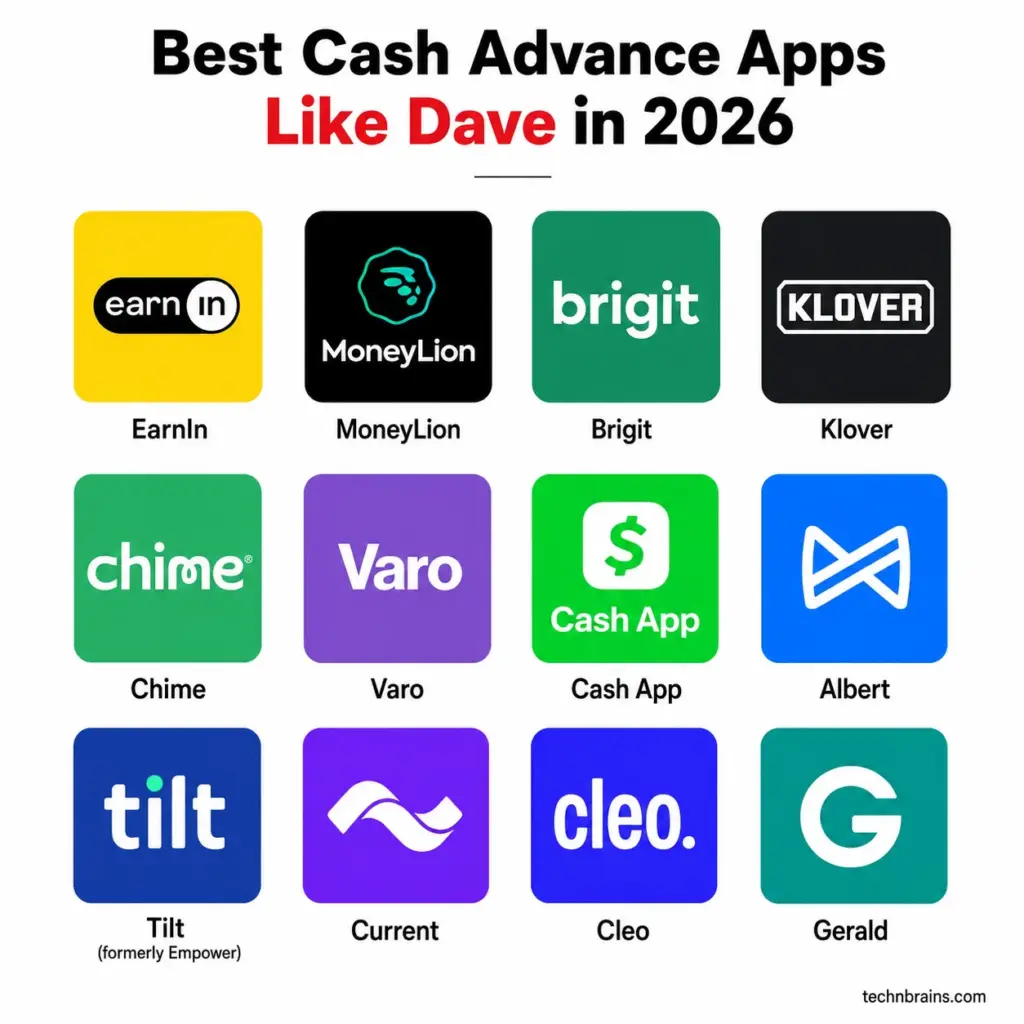
1. Earnin: Cash Advance App Like Dave With No Mandatory Fees

The closest thing to a truly free advance if you have steady hourly pay and can wait a day or two. EarnIn charges no subscription and no required per-advance fee. You access wages you have already earned, up to $150 per work day and typically up to $750 per pay period, rising toward $1,000 for established users and up to $1,500 with the EarnIn Card.
The catch is eligibility. EarnIn verifies your work and income through your timesheet or workplace location and needs a consistent direct deposit. If your hours swing or you change jobs often, your limit drops. Optional tips and the Lightning Speed instant fee are where costs creep in, so use standard delivery when you can.
2. Dave ExtraCash: Best for Predictable Pricing
A flat, knowable cost, which is rare in this category. Dave advances $25 to $500, though few users qualify for the full $500 and the average new-user advance is around $160. Pricing is a membership fee of up to $5 a month plus a 5% service fee per advance, with a $5 minimum and a $15 cap.
Instant transfers to a Dave checking account are free; sending to an external debit card costs 1.5%. Dave dropped its old optional-tip model in 2025.
The U.S. Department of Justice and FTC have brought a complaint against Dave and its CEO alleging deceptive practices, which Dave disputes. Few competitors have faced federal action, so it is worth weighing.
3. MoneyLion: Cash Advance Apps Like Dave

The most flexible option for gig workers and anyone without standard W-2 payroll, because Instacash reads 60 days of banking patterns rather than requiring pay stubs. Advances reach $500, or up to $1,000 if you route direct deposits to a RoarMoney account.
Two frictions: disbursements are capped at $100 each, so large advances take several transfers, and instant delivery runs $0.49 to $8.99.
4. Brigit: Money Lending Apps Like Dave

Good for people who want budgeting tools and a credit builder alongside advances, with no tipping pressure. Brigit runs two paid tiers: Plus at roughly $8.99 to $9.99 a month for advances of $25 to $250, and Premium at $14.99 to $15.99 for up to $500.
The average new-customer offer is about $73, and you do not need to open a new checking account, though you do need an active account with recurring deposits.
5. Klover: Instant Cash Advance App Like Dave With a Free Tier

A real free base tier, which is unusual. Klover advances up to $200 with no interest and no credit check, and standard delivery is free over about three days. Instant transfers cost $1.99 to roughly $37 depending on advance size.
6. Current: Cash Advance App Like Dave With the Highest Fee-Free Limit
The highest fee-free ceiling in the category. Current advances up to $750 with no membership, no subscription, no service fee, and no credit check.
If you can wait up to three business days for standard delivery, it is genuinely free; instant access carries an optional fee shown at request time. You need eligible payroll deposits of at least $200 into a Current account, and P2P transfers do not count toward eligibility.
7. Tilt (formerly Empower): Borrowing App Like Dave for Gig Workers

Empower rebranded to Tilt, so if you remember Empower, this is the same product line. Pricing is a flat $8 a month after a trial, with advances up to $300, no credit check, and no tipping. About 75% of applicants qualify, and the average offer is $98 for first-time users and $172 after.
Free standard delivery is fast, typically about one day. It works without switching banks or setting up direct deposit, which is why it suits variable income.
8. Chime MyPay: Cash Loan App Like Dave for Chime Users

If you already bank with Chime, MyPay is one of the cheapest ways to get up to $500 early. There is no monthly membership, funds arrive free within 24 hours, and on-time repayment can help your credit. Availability is the limit: MyPay operates in roughly 38 states plus D.C., so it is not usable everywhere.
Do not confuse MyPay with SpotMe. SpotMe is a separate, fee-free overdraft feature that covers you up to $200, not a cash advance. Both require a Chime account.
9. Cleo: Money App Like Dave With No Direct Deposit
Cleo is an AI budgeting app with a paid cash-advance feature and no minimum income requirement, which makes it one of the more accessible options for freelancers and gig workers.
Advances typically start around $20 to $70 and can grow toward $250 with consistent income. You are paying mainly for the budgeting layer, so it fits people who want spending help, not just a one-off advance.
10. Varo Advance: Money Advance App Like Dave With Longer Repayment

Useful if you bank with Varo and want more than two weeks to repay. Advances run $20 to $500, capped at $250 for new users, with up to 30 days to pay back and same-day delivery at no extra fee.
The cost is a percentage fee of roughly 8% to 16%, which can reach about $40 on a $500 advance, so it is not cheap at the top end. You need a Varo bank account.
11. Cash App Borrow: Instant Money App Like Dave for Cash App Users

If you already use Cash App, eligible users can take a short-term loan of up to $200 through Cash App Borrow. Note this is Cash App Borrow, not Cash Boost, which is a debit-card rewards feature and not an advance. Availability is limited and eligibility varies, so treat it as a convenience for current users rather than a primary option.
12. Gerald: Free Cash Advance App Like Dave
The one cash advance app like Dave that charges nothing at all, with a real condition attached. Gerald advances $40 to $200 with 0% APR and no subscription, interest, transfer, or late fees. To unlock the free transfer, you first have to spend part of the advance in Gerald’s in-app store or on its phone plan.
Gerald is venture-backed and legitimate, but it holds a poor BBB rating tied to that store-purchase requirement, and some users report slow or missing store orders. It works with Chime.
13. Albert: Money Borrowing App Like Dave With Saving Tools

A fit for people who want budgeting, automated savings, and investing in one app and take advances only occasionally. Albert’s instant advance requires an Albert Cash account, and the disclosed average offer is small, around $25 to $50, with few users reaching the maximum.
The Genius subscription starts at $14.99 a month, so the advance is best seen as one feature of a paid bundle rather than the reason to sign up.
How do Dave and Its Main Alternatives Compare Head to Head?
Dave, EarnIn, Brigit, and Varo are the four most-compared options, differing mainly on pricing model and repayment timing.
| Comparison | The practical difference |
| Dave vs EarnIn | Dave charges a flat per-advance fee plus a small membership; EarnIn has no required fee but stricter verification and optional tips. |
| Dave vs Brigit | Dave is pay-per-advance; Brigit is a subscription bundling budgeting and a credit builder. Brigit is cheaper only with multiple advances a month. |
| Dave vs Varo | Both cap around $500, but Varo gives up to 30 days to repay versus Dave’s next-payday pull. Varo needs its own bank account and a percentage fee. |
| Dave vs Albert | Albert wraps advances into a $14.99 saving-and-investing bundle with small offers; Dave is a more direct advance. |
How do Cash Advance Apps like Dave Work?

You link a bank account, request money, and the app auto-debits on payday. Standard delivery is free and slow; instant costs a fee.
- Link your bank. Most apps read income and spending through Plaid; a few verify payroll or work hours.
- Get an offer. Limits track your deposit pattern, and new users start low. Dave’s average new-user advance is about $160 against a $500 ceiling (LendEDU, 2026).
- Choose delivery. Standard takes one to three business days free; instant lands in minutes for a fee.
- Repay on payday. The app withdraws the advance plus any fee automatically.
Why instant costs money: instant transfers are debit-card push payments over the card networks, and the app pays a fee on each one. Standard ACH is slow but nearly free. Request three or four days early and the money is identical for $0.
What Do Real Users Say About Cash Advance Apps like Dave?
Across Reddit, app-store reviews, Trustpilot, the BBB, complaint boards, and TikTok, sentiment is split. People praise these apps for covering a real emergency at lower cost than an overdraft or payday loan, and warn that automatic repayment shrinks the next check and pulls them back into borrowing.
What users value:
- Real help in a pinch; lifetime ratings stay high, EarnIn about 4.8 on Trustpilot, MoneyLion about 4.7 on the app stores.
- Cheaper than the alternative; a $300 advance often costs $0 on standard delivery versus about $45 for a two-week payday loan.
- Budgeting and credit extras help a recurring minority need advances less often.
What users complain about:
- The cycle: repayment shrinks the next check, so this week’s fix is next week’s shortfall. Reddit and TikTok routinely call these emergency-only.
- Advertised versus real limits: many start at $20 to $100 despite $250 to $500 headlines, the basis of the cases below.
- “Instant” costs a fee that, on a small advance, can rival a payday rate.
- Hard-to-cancel subscriptions and charges after cancellation.
- Early or unexpected debits causing overdrafts, and bot-only support with account lockouts.
- Gerald specifically: the store-purchase requirement and some late or missing orders.
Documented cases: when the complaints became enforcement
Several apps have faced federal action over the exact issues users report. These are verified public cases, not sentiment.
| App | What regulators alleged | Outcome | The lesson for users |
| Brigit | “Instant” $250 advances most users never got, plus a hard-to-cancel $9.99 membership | FTC settlement, $18 million refunded to about 1.8 million users (FTC, 2024) | Only around 1% got the advertised $250. |
| Cleo | Promised hundreds in instant advances while most got far less, with difficult cancellation | FTC settlement, $17 million, 10-year consent order (FTC, 2025) | First-time advances capped internally near $100. |
| Dave | Deceptively advertised “up to $500,” charged undisclosed fees and non-consensual tips | FTC and DOJ complaint; Dave disputes it and changed its fee model | The headline limit is a ceiling few reach. |
| EarnIn | Whether its advances are regulated loans | Adverse federal court ruling in 2025; still contested | The category’s legal status is unsettled. |
Are Cash Advance Apps like Dave Safe to Use?
Safer than payday loans, with no triple-digit stated interest, but “no interest” is not free and the category is under active regulatory dispute. Occasional use repaid on time is a reasonable bridge; repeated use recreates the cycle these apps claim to prevent.
The CFPB measured a typical employer-partnered advance at 109.5% APR, with users taking 27 advances a year on average.
In December 2025 the CFPB said certain employer-partnered advances are not loans under the Truth in Lending Act, reversing a 2024 proposal to treat them and their fees as credit; the opinion is not binding, and several 2025 court rulings went the other way.
Important Considerations Before Using Cash Advance Apps Like Dave
While cash advance apps (like Dave) can be a lifesaver in a pinch, it’s important to use them responsibly. Here are some key factors to consider:
- Fees: Most apps charge fees for using their services. These can be a flat fee per advance, a subscription fee, or a percentage of the advanced amount.
- Limits: Each app has its own limit on how much you can advance. This limit is typically based on your income and spending history.
- Repayment Terms: The repayment period is usually until your next payday. Be sure you can comfortably afford the repayment on that date.
- Alternatives: Consider alternative solutions like budgeting apps, negotiating with bill providers, or selling unused items before relying on a cash advance app.
Finding the Cash Advance App That’s Right for You
With so many cash advance apps (like Dave) available, choosing the right one depends on your individual needs and financial situation. Here are some factors to consider when making your decision:
- Cost: Compare fees and subscription costs to find the most affordable option for you.
- Advance Limit: Ensure the app offers an advance limit that meets your short-term cash needs.
- Repayment Terms: Consider how long you have to repay the advance to ensure it aligns with your budget.
- Features: Look for features that complement your financial goals, such as budgeting tools, credit building options, or investment opportunities.
- Eligibility: Make sure you meet the app’s eligibility requirements, such as minimum income or direct deposit requirements.
- Budgeting: Creating a realistic budget and tracking your expenses can help you avoid needing cash advances in the future. Several budgeting apps are available to assist you with this.
- Negotiate with Bill Providers: If you’re facing a short-term financial hardship, contact your bill providers and explain your situation. They may be willing to offer a payment extension or waive late fees.
- Sell Unused Items: Consider selling unwanted items online or through a local consignment shop to generate some quick cash.
- Side Hustle: Explore money-making apps and other side hustles to increase your income and build a financial safety net.
What it Takes to Build a Cash Advance App Like Dave
These apps look identical from outside, a limit and a button. The differences that decide both user cost and build cost sit in four places: income verification (Plaid estimate versus payroll or hours), the funding rail (why instant costs money), repayment recovery on payday, and compliance, the moving part as lending-law classification shifts by state.
Across fintech software development, the interface takes weeks; the compliant money infrastructure takes far longer and decides whether the product succeeds. If you are weighing this category, TechnBrains can map what a compliant advance product needs beyond the UI and what to build versus buy, whether you start from an idea or extend an existing mobile app.
Table of Contents
Frequently Asked Questions
Yes. ExtraCash advances up to $500 with no interest or credit check, repaid on payday, for an up-to-$5 monthly membership plus a 5% per-advance fee.
Current and EarnIn reach up to $750, and MoneyLion up to $1,000 with RoarMoney. Most users start well below these.
EarnIn, Chime MyPay, MoneyLion, Current, Klover, Cash App Borrow, and Gerald do not require a monthly subscription. Dave charges a membership fee, while Brigit, Albert, and Tilt require a subscription. Current and Chime MyPay also offer some of the highest fee-free advance limits.
Most cash advance apps do not perform a hard credit check. Instead, they review your bank account activity to determine your advance limit, so applying does not affect your credit score. Chime MyPay also offers credit-building benefits for eligible users who repay on time.
Chime MyPay is built for Chime users, and Gerald also works with Chime accounts. Cash App users may qualify for Cash App Borrow. Many other apps support banks connected through Plaid, but instant transfers depend on your bank.
Cleo, Tilt, MoneyLion, and Albert can work without a traditional direct deposit by reviewing your banking activity. However, users with direct deposit often qualify for higher advance limits.
No. Branch is an employer-sponsored earned wage access app. You can only use it if your employer partners with Branch, while most other cash advance apps are available directly to eligible consumers.
Payday loans charge high interest and roll over; these charge no interest and cap low. A $300 payday loan can cost about $45 in two weeks; a $300 app advance often costs $0 on standard delivery.
Planning to Build a Cash Advance App?
Launch a secure fintech product with our experienced app developers.
