
Build and Scale Faster
150+ products shipped for startups and enterprises by engineers focused on real outcomes.
"Their ability to quickly understand an unfamiliar use case and respond creatively to it is impressive."

Anonymous
Executive, Pured Disc Golf

"TechnBrains resolved challenges efficiently and turned my vision into a solid, functional product with a strong foundation."

Jalen Gibbs
Founder, STREAMLINE LIVE
"The talent they provided was solid, but more importantly, they were quick to align with our way of working."

Nancy Snyder
Managing Director, MimeCast
Our trusted clients


Start Your Product Journey Today
Turn your idea into a working product. Share a few details and we'll help define the roadmap, timeline, and execution approach.
IT Staff Augmentation for Startups: Costs, Risks and Fit in 2026
A startup can add engineers without overspending by using staff augmentation only when the roadmap is clear, technical ownership remains in-house, and the partner is accountable for delivery quality. The blog explains the right use cases, expected costs, common failure points, and the checks founders should make before adding an external team.


Updated Aug 21, 2026
Every engineering decision spends runway. An unnecessary feature, missed launch, or technical shortcut can consume months a startup may not have. McKinsey estimates that technical debt can add 10% to 20% to project costs through rework and slower delivery. Staff augmentation can close capacity gaps quickly, but only when added engineers follow clear priorities, architecture standards, and release controls. Without that structure, more developers can create more coordination problems and less control. This guide explains when staff augmentation fits a startup, what it costs, where engagements fail, and how to choose a partner without losing control of your product or codebase.
TL;DR: IT Staff Augmentation for Startups
- IT staff augmentation for startups means adding vetted external engineers who work inside your team, under your direction, so you keep ownership of the product, the roadmap, and the IP.
- It fits best when the plan is clear and you need execution capacity fast. It fits worst before product-market fit, when the product itself is still being defined.
- Teams can usually be added in 2 to 4 weeks, versus 8 to 16 weeks for a full-time hire, which is why it suits product launches and Series A scaling.
- The risk is never the hourly rate. It is whether the partner owns architecture, releases, and cloud cost, or just supplies bodies.
- Founders’ most common complaints are juniors sold as seniors, code quality that needs constant rework, time-zone lag that stalls sprints, and cost that creeps up the longer the engagement runs.
What is IT staff augmentation for startups?
IT staff augmentation for startups is a model where you add external engineers to join your existing team as an extension of it, following your process, tools, and standards, while your company keeps full control of the codebase, the roadmap, and the IP. It is different from three things founders often confuse it with.
- Outsourcing hands a whole project to a vendor who delivers a result under their own management.
- Consulting buys advice and strategy, not delivery hours.
- Freelancing gives you individuals with no shared accountability for the system.
Staff augmentation sits between them: you direct the work, and the partner supplies people and takes responsibility for how they deliver. This model is used by early-stage startups, Series A companies scaling their first real engineering org, and scaleups that need a specific capability quickly.
When Is Staff Augmentation for Startups a Right Choice?
Staff augmentation fits when the roadmap is clear and you need engineering capacity faster than permanent hiring allows.
Product Launches and Fixed Deadlines
A small delivery pod can add coordinated capacity for a defined period, then scale down after launch. This gives startups clearer ownership than using several independent freelancers.
Series A Growth
After funding, startups need to turn capital into shipped product quickly. Augmentation helps add senior engineers while the long-term team structure is still taking shape.
Specialist Skill Gaps
It works well when a startup temporarily needs expertise in areas such as cloud, mobile, data engineering, or AI. The internal team stays focused while specialists handle the capability gap.
Time-Zone-Sensitive Collaboration
For US startups, working-hours overlap matters more than provider location. Daily access to the team reduces delays in reviews, decisions, and issue resolution. The 2-to-4-week ramp is real, but the first week is onboarding, not output. The engagements that go wrong are the ones where a founder expects shipped features on day three, so the team pushes unreviewed code to look busy and pays for it in week six. These onboarding demands are among the broader pros and cons of staff augmentation startups should consider before choosing the model.
When Should a Startup Not Use Staff Augmentation?
IT Staff augmentation for startups is a poor fit when the product is still being defined, the startup has not reached product-market fit, or no internal technical leader can direct the work.
When Product Direction Is Unclear
Augmentation adds execution capacity to a known plan. It does not decide what to build. If you are still validating the problem, users, workflow, or UX, adding developers can increase waste. The team may build faster, but much of that work could be discarded as the product changes.
When a Product Partner Is a Better Fit
For early 0-to-1 work, a product or design partner may be more useful. They can support discovery, prototyping, validation, and technical planning before major engineering investment. Staff augmentation becomes valuable once the direction is clear and the focus shifts to building and shipping.
When Technical Leadership Is Missing
Someone inside the startup must own architecture, backlog priorities, technical tradeoffs, and release decisions. Without that ownership, external engineers fill the gaps with assumptions. This often leads to inconsistent architecture, unclear priorities, and weak accountability.
Staff Augmentation Vs Hiring, Freelancers, Outsourcing, And Consulting For Startups
Choose staff augmentation when you need controlled execution capacity fast, hiring when you are ready for permanent ownership, outsourcing when you want to hand off a whole project, consulting when you need direction rather than delivery, and freelancers only for small, isolated tasks.
| Model | You direct the work? | Best for | Main risk |
| Full-time hiring | Yes | Long-term core ownership | Slow to fill, hard to reverse a bad hire |
| Staff augmentation | Yes | Fast, flexible capacity on a set plan | Partner discipline varies |
| Freelancers | Partly | Small, isolated tasks | Fragmented ownership, knowledge silos |
| Project outsourcing | No | A well-defined project with a fixed outcome | You do not own the how; harder to change mid-flight |
| Consulting | Advisory only | Strategy, architecture, direction | Advice without delivery capacity |
The distinction founders miss most is staff augmentation versus consulting. Consulting answers “what should we do.” Staff augmentation answers “we know what to do, help us build it.” Paying senior consulting rates for execution work, or expecting execution-focused engineers to set your strategy, is a common and expensive mismatch.
Pods, Managed Teams, Or Individual Augmentation: Which Model Scales Safest?
For most startups scaling engineering capacity fast, a pod (a small, self-contained team with its own lead and QA) scales the safest, because it keeps ownership in one place. Individual augmentation is fastest to start but fragments accountability. A managed team sits between the two.
| Model | How it works | Ownership | Risk profile |
| Individual augmentation | One or more developers join your team | Shared, often unclear | High: fragmented design, knowledge silos |
| Team augmentation | A small group joins with a lead and QA | Clear technical ownership | Moderate, better delivery discipline |
| Pod or squad | A self-contained team delivers features end to end | Single accountable unit | Lowest, strong continuity |
| Managed services | The partner runs a function and reports on outcomes | Held by the partner | Low delivery risk, less day-to-day control |
The trade-off is control versus overhead. Managed services remove the most delivery risk but also the most direct control, which suits a mature, stable function more than a fast-moving startup roadmap. Individuals give you the most control and the least structure. According to our experience, for a startup, the pod is almost always the right default. Individuals look cheaper and faster on day one, then the real cost surfaces later as three engineers writing in three styles with no one owning the whole system. ROI does not scale with headcount. It scales with how much useful software ships without creating future drag.
What do Founders actually Complain about Staff Augmentation?
In founder and engineering-leader discussions, the recurring complaints are not about the model itself. They are about juniors presented as seniors, code that needs constant rework, time-zone lag that stalls sprints, and cost that creeps up the longer the engagement runs. Public discussions on Quora, Blind, and engineering forums show a consistent pattern. The debate over whether augmentation is a good or bad experience is active and unresolved.
| Pain point | Community evidence | Key takeaway |
| Weak vetting | Developers described as senior sometimes performed at a junior level. | Interview every assigned engineer yourself. |
| Cost and retention | A Blind contributor reported steep rate increases to retain experienced developers. | Review renewal rates and retention terms upfront. |
| Time-zone delays | Limited overlap caused communication problems and slower decisions. | Require guaranteed working-hours overlap. |
| Missing leadership | External developers struggled when no internal owner could assess quality or direction. | Keep product and architecture ownership in-house. |
| Uneven ROI | Contractors varied widely in quality; lower rates did not always provide better value. | Compare output and rework, not hourly cost alone. |
| Mixed outcomes | Founders reported both strong and poor offshore experiences. | Vetting, integration, and management determine results. |
The lesson is that the headline rate tells you almost nothing about the two-year cost. On quality, the long-running complaint about offshore and agency contractors is inconsistency, not incapability: teams learned to expect code that needed rework unless the partner enforced review and testing themselves.
How Much Does IT Staff Augmentation Cost a Startup?
A startup should typically budget $5,000 to $12,000 per month for one full-time senior augmented engineer, depending on region and specialization. US-based experts may cost $11,000 to $24,000+ per month.
| Talent location | Estimated hourly rate | Estimated monthly cost* |
| South and Southeast Asia | $31–$41 | $4,960–$6,560 |
| Latin America | $60–$75 | $9,600–$12,000 |
| Central and Eastern Europe | $64–$76 | $10,240–$12,160 |
| US-based expert contractor | $70–$150+ | $11,200–$24,000+ |
Monthly estimates assume 160 billable hours. The regional figures reflect 2026 senior developer benchmarks from Accelerance, while the US range uses Upwork’s expert developer benchmark. The quoted rate is only part of the cost. Startups should also account for onboarding, internal management, security tooling, replacement time, and rework. A cheaper engineer who needs constant supervision can cost more than a senior developer who ships maintainable work with fewer revisions. Cloud discipline also affects the budget. Flexera’s 2026 State of the Cloud report estimates that 29% of cloud spending is wasted. An augmented team should track idle resources, infrastructure usage, and cost per customer rather than treating cloud spend as someone else’s responsibility.
How to Choose an IT Staff Augmentation Company for a Startup?
Choose the partner that takes ownership of delivery quality, architecture, and cloud cost, not the one with the lowest rate or the longest list of certifications. Experience with a tech stack is not the same as expertise running teams inside a growing product. The best IT staff augmentation partners for startups, including at Series A, ask how the product is expected to scale, where the data boundaries live, and how releases are protected before they commit to a sprint. They push back when a feature threatens stability or cost. Score prospective partners on the categories that predict delivery, weighted by what matters most:
| Category | Weight | What good looks like |
| Delivery ownership | 25% | A named lead owns releases and quality |
| Technical seniority and screening | 20% | Transparent vetting; you can interview the engineers |
| Engineering discipline | 15% | Code review, testing, CI built in, not left to you |
| Security, IP, and code ownership | 15% | Least-privilege access, clear IP terms |
| Communication and time-zone overlap | 10% | Regular reporting, real working-hours overlap |
| Retention and replacement policy | 10% | Documented process to replace an engineer without losing momentum |
| Pricing transparency | 5% | No hidden onboarding or offboarding fees |
Red flags that show up before the first sprint ends:
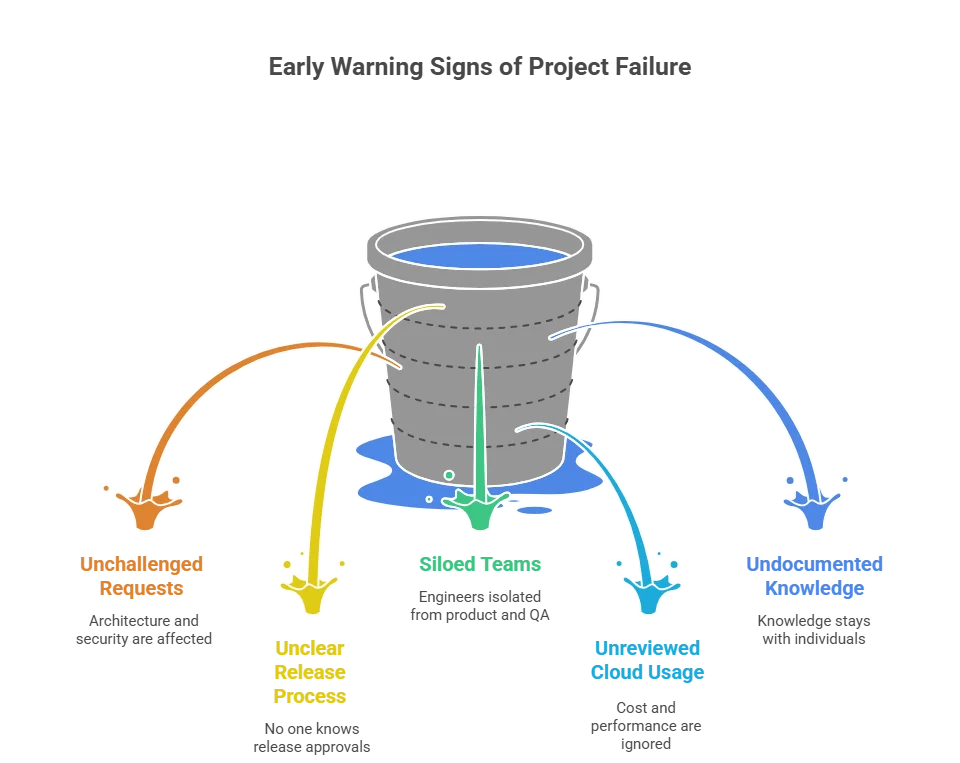
- Every request is accepted, even when it affects architecture or security.
- No one can explain how production releases get approved.
- Engineers work in isolation from product and QA, and only ask for tickets.
- Cloud usage is never reviewed against cost or performance.
- Refusal to let you interview the assigned developers, or vague seniority definitions.
- No documented replacement process, and knowledge that lives in private chats rather than docs.
Questions worth asking before you sign:
- Who has final authority over API and data-model changes?
- Who can block a release for an architectural or security risk?
- How is production access isolated and audited?
- What is your replacement process and notice period?
- How is knowledge transferred back to us at exit?
Skip the obvious questions; these expose delivery quality and risk. On contracts, get two layers right. IP and NDA coverage must ensure every line of code, design, and configuration legally belongs to your company, and that confidentiality covers source code, customer data, and infrastructure.
What ROI Timeline Should a Startup Expect from an Augmented Team?
Expect signals, not full ROI, in the first 30 days, visible capacity by 60 days, and measurable ROI by 90 days through shorter cycle times, fewer incidents, and more predictable releases. 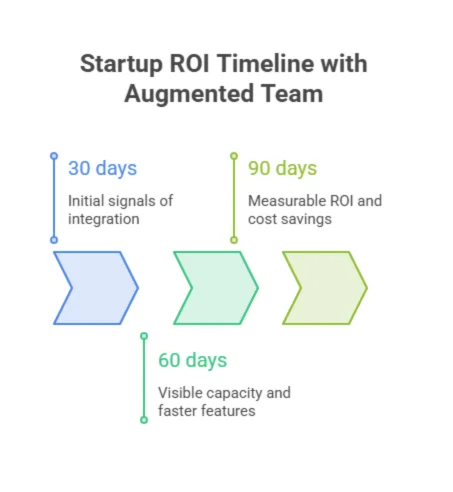 In the first 30 days, watch whether the engineers can work inside your codebase and follow release discipline without creating noise, not raw velocity. By 60 days, features should reach production faster and internal engineers should spend less time fixing rushed work. By 90 days, track time from commit to production, failed or rolled-back releases, defect volume, cloud cost per active user, and onboarding time for new engineers. When those move in the right direction, augmentation is paying for itself. In one TechnBrains engagement, the augmented team we provided helped the client complete the planned development work roughly 30% faster while cutting the expected delivery budget by around 25%. That came from clear ownership and a tightly defined scope, not from adding more people. It is one project’s outcome, not a guarantee: results depend on scope, team maturity, and how the engagement is run. The point is the mechanism, an accountable team inside a disciplined process, rather than the exact numbers.
What are the Most Common Staff Augmentation Mistakes Startups Make?
The costly mistakes are structural, not technical: using augmentation without internal technical leadership, choosing on hourly rate alone, and adding developers to an undefined backlog. The recurring ones, and why they hurt:
- No internal technical lead. External engineers fill the decision vacuum with their own assumptions, and ownership disappears.
- Selecting on rate. The cheapest team often produces the highest total cost through rework, instability, and year-over-year rate creep.
- Not interviewing the assigned developers. You get junior work at senior rates when seniority is never verified. This is the single most-reported complaint in founder discussions.
- Confusing augmentation with outsourcing. You direct augmentation; treating it as a hands-off project fails on both.
- Adding people to an undefined backlog. Capacity without a clear plan accelerates technical debt.
Conclusion
Staff augmentation is a way to extend engineering capacity without giving up ownership, architecture, or scalability. Startups that focus on those things, validate partners through a real pilot, and track delivery signals can grow their teams while keeping their products stable. If you already know what you need to build and want to move faster without losing control, TechnBrains staff augmentation services can help you map the missing roles, a realistic timeline, the right engagement model, and the security and time-zone requirements for your team.
Table of Contents
Frequently Asked Questions
Yes, when it is structured around ownership and delivery discipline. Startups benefit most when augmented teams take responsibility for quality, releases, and system stability, not just feature output.
A small pod with a defined end date. It gives you a lead, coordinated delivery, and capacity in weeks, then scales back after launch, without the cost of permanent hires you will not need later or the fragmentation of scattered freelancers.
Senior engineers with real startup delivery experience, a named lead who owns quality, and clear IP, replacement, and exit terms. Avoid partners who compete on headcount or the lowest rate.
IT staff augmentation for startups is faster and more flexible, with predictable engagement-based cost and no recruiting or benefits overhead. Whether it is cheaper long-term depends on how long you need the capacity and how disciplined the partner is. Watch for annual rate increases on long engagements.
Consulting provides strategy and direction. Staff augmentation provides execution capacity you direct. Use consulting to decide what to do, augmentation to build it.
Yes, if you select for overlap rather than location. Ask the partner to guarantee working-hours overlap with your team, whether the engineers are onshore, nearshore, or on a US schedule.
Insist on interviewing the assigned engineers yourself, ask for a clear seniority definition, and check the replacement policy so a swap does not quietly downgrade the team. This is the most common complaint founders report, so treat it as a gating check.
By tracking release stability, cycle time, defect rates, cloud cost trends, and how quickly new engineers become productive.
With a good partner, a documented replacement and knowledge-transfer process keeps delivery moving. Without one, you pay for overlap and lost context, which is why exit terms belong in the contract.
Know What to Build, but Need More Hands?
Add engineers who work inside your process, codebase, and release standards.
