


Pros and Cons of Staff Augmentation: Cost, Risk, ROI & Scalability Breakdown

Most software teams don’t fail because of bad technology; they fail because of bad delivery models. Many funded SaaS and enterprise teams miss launch windows, overspend on cloud, and accumulate technical debt simply by scaling engineering the wrong way. 

Nearly 70% of digital initiatives run over budget or behind schedule, and staffing decisions are one of the biggest hidden causes.

That’s where staff augmentation enters the conversation, and where it often gets misunderstood.

On paper, adding external engineers looks like a fast, flexible way to accelerate delivery. In reality, it can either unlock velocity and cost efficiency or quietly create long-term technical debt, IP risk, and dependency traps that cripple your roadmap.

In this guide, I’m breaking down the real pros and cons of staff augmentation, and what actually happens to architecture, velocity, risk, and ROI when you plug external talent into a live product.

Let’s get into it!

What Is Staff Augmentation in Modern Software Delivery?

Staff augmentation is not “outsourcing with a nicer name.” The global IT staff augmentation market is projected to reach $857.2 B by 2031. In modern software delivery, it means embedding external engineers directly into your product team, working inside your tools, your sprint cadence, your architecture, and your roadmap.

Instead of handing a vendor a spec and waiting months, you extend your in-house team with on-demand engineers who code, review, deploy, and own production work alongside your internal developers. 

Used correctly, staff augmentation gives you access to specialized talent (cloud, DevOps, mobile, data, security) exactly when you need it, without the overhead of recruiting, payroll, or layoffs when demand drops. Used incorrectly, it creates fragmented ownership and technical drift, which is why the model has a reputation problem.

How Staff Augmentation Differs From Project Outsourcing and Full-Time Hiring

Full-time hiring gives you long-term ownership and cultural alignment, but it’s slow, expensive, and risky when product priorities change. By the time a senior engineer is hired and onboarded, you’ve often already lost a release cycle.

Project outsourcing pushes delivery to a third party. You get predictable pricing, but you give up architectural control, sprint-level visibility, and real ownership of the codebase. It works for isolated projects, not for living products.

Staff augmentation sits in between.

You keep product control, architecture ownership, and roadmap authority, while adding elastic engineering capacity on demand. The augmented developers don’t work for a vendor, they work with your team.

Run a Delivery Model Reality Check

Not sure whether hiring, outsourcing, or staff augmentation actually fits your roadmap?
Get an outside view on your architecture, velocity, and delivery risks before you commit

What Are the Real Pros and Cons of Staff Augmentation vs Hiring Full-Time Engineers?

On the surface, hiring full-time engineers feels safer. You get loyalty, cultural alignment, and long-term ownership. But in fast-moving SaaS, fintech, healthcare, or platform businesses, speed and adaptability matter more than headcount.

Industry hiring benchmarks show the average technical hire takes 40–50 days and costs thousands of dollars before the person even writes a line of code (recruiters, ads, onboarding, lost opportunity).

During that time, your roadmap doesn’t pause. Features slip. Revenue slips.

Staff augmentation flips that equation. You can add senior engineers in days or weeks, not months, and scale up or down as product priorities shift. 

But that flexibility comes with trade-offs: you must manage integration, ownership, and technical alignment deliberately.

The real comparison isn’t “cheap vs expensive.” It’s fixed risk vs variable control.

Cost Efficiency, Hiring Speed, and Flexibility

Full-time hiring is a fixed cost bet. Once someone is on payroll, you’re paying them whether the product needs that skill set next quarter or not. That’s fine in stable enterprises, but dangerous in scaling or pivoting companies.

Staff augmentation is a variable cost model. You pay for output, not idle time. When you need more backend capacity for a release, you add it. When the push is done, you scale back. That alone can save hundreds of thousands per year for growing teams.

For modernization projects, cloud migrations, mobile builds, or compliance-driven rewrites, that difference can be the line between hitting a market window or missing it.

Cultural Fit, Control, and Long-Term Ownership Tradeoffs

This is where hiring still wins, if you can afford the time.

Full-time engineers naturally absorb your domain, your architecture, and your product intuition. Over years, that compounds into deep institutional knowledge.

Augmented engineers can reach that level too, but only if you treat them like team members, not vendors. When they’re excluded from design decisions, roadmap context, or ownership, you get exactly what skeptics fear: short-term velocity with long-term drift.

If you keep architecture, DevOps, and product direction inside your core team, staff augmentation gives you speed without surrendering control. If you don’t, it quietly becomes outsourced engineering, with all the same downsides.

And that’s the difference most teams learn too late.

How Does Staff Augmentation Impact Delivery Speed, Code Quality, and Technical Debt?

Staff augmentation almost always increases short-term velocity. You add engineers, more tickets move, more features ship. But software doesn’t fail because of how fast you code, it fails because of what you leave behind.

Low-quality codebases can have 15× more defects and require ~124% more time to fix issues, showing why velocity without quality costs more. 

In large-scale systems, every new developer introduces context loss. They don’t know why certain shortcuts exist, why parts of the architecture are brittle, or which systems are sacred. 

If augmented engineers are treated like “task executors,” they will deliver output, and quietly increase technical debt.

On the other hand, when they are embedded into architecture reviews, sprint planning, and CI/CD workflows, they behave like any strong internal engineer. In that model, augmentation doesn’t dilute quality, it multiplies it.

Velocity Gains vs Onboarding Drag

Here’s the truth most vendors won’t say:
You never get instant productivity.

Even senior engineers take time to understand a live codebase, especially in regulated or distributed systems. But staff augmentation still beats hiring because the clock starts sooner.

The danger comes when leadership assumes augmentation is plug-and-play. If onboarding, documentation, and sprint rituals are weak, every new engineer, internal or external, slows the team down.

Augmentation doesn’t fix broken delivery. It amplifies whatever system you already have.

Risk of Architecture Drift and Technical Debt

This is the quiet killer.

When augmented engineers aren’t tied to architecture ownership, code reviews, and deployment standards, you get fragmentation: different patterns, inconsistent APIs, duplicated logic. Over time, that turns into a codebase that “works”, but only the people who built it understand it.

That’s how technical debt explodes.

The fix is simple but non-negotiable:
Your core team must own architecture, DevOps, and technical standards. Augmented engineers execute inside that guardrail.

What Hidden Risks and Long-Term Costs Should CTOs Evaluate?

Staff augmentation looks like a clean operating expense: add capacity, hit deadlines, reduce hiring overhead. In reality, the biggest costs are invisible at first, and they compound over time.

I’ve seen organizations spend less on engineering in the first six months, only to pay it back later in rework, security audits, and architectural cleanup. Why? Because when external engineers are added without strong governance, small shortcuts turn into systemic risk.

The long-term cost isn’t the hourly rate.
It’s what happens when code ownership, security posture, and architectural consistency slowly erode.

That doesn’t mean staff augmentation is unsafe. It means it must be managed like a production system, not a staffing shortcut.

Security, IP Protection, and Compliance Exposure

The moment external engineers touch your production code, your threat surface changes.

They now have access to:

  • source code
  • credentials
  • customer data
  • deployment pipelines

In regulated industries, like healthcare, fintech, enterprise SaaS, that’s not optional risk, that’s compliance exposure.

I’ve seen teams bring in augmented developers without proper access controls, audit trails, or data segregation, only to get stuck during SOC 2, HIPAA, or GDPR reviews months later. 

The fix is boring but critical:
role-based access, VPNs, secure credential management, code review enforcement, and clear IP ownership clauses. If those aren’t in place, you’re not augmenting staff, you’re expanding your attack surface.

Vendor Dependency and Knowledge Leakage

This is the quiet, long-term risk.

When key systems are built primarily by external engineers, knowledge leaves with them. Over time, your internal team becomes dependent on people who don’t sit inside your organization, and that’s when negotiating power, velocity, and roadmap control start slipping.

The safeguard is simple:
your core team must own architecture, documentation, and critical paths. Augmented engineers contribute, but they should never be the only ones who understand how the system works.

Can Staff Augmentation Support Microservices, Cloud-Native, and Regulated Systems?

Staff augmentation works extremely well in microservices, cloud-native, and regulated environments, but only when the control plane stays internal.

Modern architectures aren’t just code. They’re:

  • CI/CD pipelines
  • infrastructure-as-code
  • service meshes
  • monitoring and alerting
  • security and compliance layers

If those are owned by your core team, augmented engineers can plug in safely and deliver real value. 

I’ve used this model to scale Kubernetes-based platforms, mobile backends, and compliance-heavy systems because it lets me add specialized capacity without fracturing the architecture.

Where teams fail is when they outsource not just development, but DevOps, deployment rights, and architectural authority. That’s when cloud spend spikes, security drifts, and nobody knows who really owns production.

Staff augmentation doesn’t weaken complex systems. Weak governance does.

DevOps, CI/CD Ownership, and Cloud Cost Control

Every high-performing engineering organization I’ve worked with shares one rule:
the people who own the pipeline own the product.

Augmented engineers can commit code, but your team should own:

  • infrastructure
  • deployments
  • secrets
  • monitoring
  • cost controls

When that boundary is clear, cloud-native development stays clean. When it isn’t, you get runaway AWS bills, broken pipelines, and deployment chaos.

Staff augmentation scales delivery. DevOps ownership keeps it sane.

That’s the difference between using external engineers to accelerate your platform, and accidentally giving away the keys to it.

How Does Staff Augmentation Affect ROI, Team Velocity, and IP Ownership?

This is where the decision stops being technical and becomes financial.

Every delivery model answers one question:
How much output do we get for every dollar and every week we invest?

In my experience, staff augmentation usually delivers the highest ROI in fast-moving product environments because it converts fixed engineering cost into elastic capacity. You’re not paying for benches, recruiting downtime, or mismatched skill sets. You’re paying for engineers who are shipping right now.

That directly impacts velocity. When I can add or remove capacity based on roadmap pressure, I stop making tradeoffs like “delay this feature” or “rush this release.” Instead, I match the team size to the work.

IP ownership also stays clean. Unlike outsourcing, augmented engineers build inside your repos, your cloud, your CI/CD, under your legal and security framework. The code belongs to you from day one, no licensing ambiguity, no vendor lock-in.

That combination, like speed, flexibility, and ownership, is what makes the model financially attractive when governed correctly.

Cost-Benefit vs Project Outsourcing and Internal Hiring

A mid-level full-time engineer in North America typically costs $140k–$180k per year fully loaded once you include salary, benefits, recruiting, payroll tax, and management overhead. That’s $12k–$15k per month whether the roadmap needs that skill or not.

Project outsourcing looks cheaper, often $40–$70/hour, but you pay for project management layers, change requests, delays, and rework. Over a 6–9 month build, I’ve seen outsourced projects quietly cost 30–50% more than expected once scope and coordination friction are added.

Staff augmentation usually sits in the $60–$120/hour range for senior engineers, but you only pay when they’re producing. No recruiting lag. No bench. No long-term payroll drag.

That’s why, for scaling products and modernization programs, the real cost advantage isn’t the hourly rate. It’s how quickly dollars turn into shipped, production-grade software.

Wrapping it Up

When used with strong architecture ownership, DevOps discipline, and clear governance, staff augmentation gives teams the speed and flexibility modern products demand without sacrificing control or IP. When used carelessly, it quietly creates technical debt, security risk, and vendor dependency.

The difference isn’t the talent. It’s how you run the system around them.

If you’re scaling a product, modernizing a platform, or racing a market window, staff augmentation can be one of the most powerful tools in your delivery stack, as long as it’s treated like a strategic engineering decision, not a staffing hack.

Pressure-Test Your Scaling Strategy

If you’re planning to scale your engineering team, migrate to the cloud, or modernize a legacy system, a small misstep can cost months.
Talk through your options with engineers who’ve seen what breaks — and what works.

On-Demand IT Experts for Enterprise Initiatives | Speed, ROI & Risk Control

When speaking with CIOs, CTOs, and business leaders, the challenge is rarely vision, it’s speed. Enterprise initiatives move fast, but hiring the right talent often doesn’t. On-demand IT experts fill this gap by providing specialized skills exactly when needed, without the long delays of traditional hiring. An IT staff augmentation company offers businesses the ability to quickly access the specialized skills necessary for enterprise-level projects.

Traditional hiring can leave senior IT roles unfilled for months, while critical initiatives like platform upgrades and security programs can’t wait. I’ve seen strong teams lose momentum because the right expertise wasn’t available at the right time.

That’s why more enterprises are turning to on-demand IT specialists to support high-impact initiatives. These experts strengthen internal teams by providing focused skills and fast delivery without committing to long-term headcount. In this guide, I’ll explain how organizations use flexible staffing models to stay in control while accelerating project delivery.

Key Takeaways

  • 74% of employers report difficulty finding qualified technical talent, with specialized IT roles being hardest to fill.
  • AI and cybersecurity skills are in high demand, with 60% of HR departments struggling to find candidates with the right expertise.
  • On-demand IT experts accelerate time-to-productivity by 75% compared to permanent hires.
  • Enterprises using on-demand specialists can achieve 1.5x faster development speed and 30-50% faster time-to-market.
  • Staff augmentation reduces hiring costs by 40-60% compared to full-time employment.
  • On-demand IT experts enable teams to integrate seamlessly and align with internal goals, improving project delivery by up to 90% more flexibility compared to traditional hiring.

Why Enterprises Turn to On-Demand IT Experts at Critical Moments

Enterprises are under immense pressure to meet deadlines and maintain high-quality outcomes with limited resources. How enterprise-level projects are executed using IT staff augmentation has become a key strategy for companies that need fast and efficient access to top-tier technical talent without the bottlenecks of traditional hiring.

Delivery Performance Stats

  • What goes wrong in the first 30 days with external hires? On average, 40% of IT projects fail to meet initial milestones due to onboarding delays, poor understanding of internal systems, and misalignment on objectives.
  • What typically triggers executive escalations? 45% of escalations occur within the first three months of an external hire’s engagement, mainly due to miscommunication, lack of integration, or missed deadlines.
  • Scaling from 5 to 25 external engineers: Scaling from a small team to a larger, integrated unit often introduces 25-30% additional coordination complexity. Clear project management tools and effective knowledge transfer can minimize this risk.

Our Team’s Performance

  • Our on-demand experts hit 90% of deadlines within the first 3 months on average, ensuring a smooth integration into your existing teams and faster time-to-productivity.

Where On-Demand IT Expertise Breaks Down in Practice

On-demand IT experts can bring invaluable skills and speed to enterprise-level initiatives, but like any solution, the approach is not without risks. Understanding what can go wrong is critical for enterprise leaders who need to weigh the full picture before making a decision.

Here are some common pitfalls that organizations experience when integrating on-demand IT expertise, and how they can impact your initiatives:

  1. Missed Sprint Deadlines: External engineers may lack a full understanding of your internal systems, which can result in missed sprints and delays in product releases. This is especially risky when speed is critical.
  2. Security Review Delays: Security assessments are often delayed when external experts don’t fully integrate into your internal security protocols, pushing back crucial product launches by weeks.
  3. Knowledge Loss After a Contractor Rolls Off: When contractors leave, knowledge transfer is often incomplete, causing gaps in the institutional knowledge. This can be disruptive, especially for complex projects that require continuity.
  4. Two Vendors Stepping on the Same Code: Poor coordination between vendors can lead to overlapping work or conflicts in code, delaying timelines and increasing the risk of bugs and performance issues.
  5. PMO Having No Visibility into Deliverables: If there’s a lack of transparency in the delivery process, the PMO may not be fully aware of what’s actually being shipped or when. This can lead to missed deadlines, uncoordinated work, and a lack of alignment with organizational goals.

How to Avoid These Pitfalls:  It’s important to establish strong governance practices and structured processes to mitigate these risks. Here’s how:

  • Clear Integration Plans: Align external resources with internal systems, and ensure they are embedded in your sprint cycles, security processes, and documentation standards.
  • Knowledge Transfer Plans: Formalize knowledge handover procedures so that critical information is transferred smoothly when contractors roll off.
  • Vendor Coordination: Establish regular check-ins and communication channels to prevent overlaps and ensure clear ownership of code and responsibilities.
  • PMO Involvement: Involve the PMO early in the integration process to ensure full visibility and accountability from all parties involved.

By acknowledging these potential failures upfront, enterprises can better prepare themselves and avoid common mistakes when using on-demand IT talent. Remember, the key is not to avoid failure but to control and manage it effectively when it occurs.

Where Specialized IT Talent on Demand Creates Immediate Leverage

On-demand IT experts don’t just fill talent gaps; they accelerate delivery, enhance productivity, and reduce risk in high-stakes initiatives. Here’s how:

Speed to Productivity

  • External IT specialists typically reach full productivity within 2-3 weeks, compared to 14-32 weeks for full-time hires. In one recent case, a healthcare client saw a 75% reduction in ramp-up time, improving development speed and reducing time-to-market by 50%.

Team Integration

  • Over 85% of projects with on-demand IT specialists report smoother integration into existing teams, thanks to clear documentation, knowledge transfer, and close alignment with internal processes.

Market Acceleration

  • Enterprises using on-demand specialists can achieve up to 50% faster time-to-market compared to traditional hiring methods due to the immediate deployment of highly specialized resources. For example, IT Staff Augmentation Agencies Specializing in Cybersecurity help companies ensure robust security while accelerating development timelines. 

How On-Demand Enterprise IT Specialists Strengthen, Not Disrupt, Existing Teams

When external experts are brought in, they are expected to integrate seamlessly with internal teams without causing disruptions. Successful integration doesn’t just happen; it’s the result of careful planning, communication, and proper onboarding. Here’s how we ensure that on-demand experts add value, not chaos:

Knowledge Transfer & Onboarding Metrics

  • Companies that use a structured onboarding process for external experts see a 30% reduction in knowledge transfer delays and a 25% improvement in overall project velocity. Our team ensures that every engagement has a formal knowledge transfer plan, which has been shown to eliminate knowledge gaps 95% of the time.

PMO & Delivery Visibility

  • 70% of executive escalations happen due to a lack of visibility into the delivery process. At TechnBrains, we ensure that PMOs are involved from day one, with weekly updates, sprint reviews, and real-time performance dashboards.

Working Alongside Internal Teams, PMOs, and Architecture Leadership

Successful integration goes beyond tools, it’s about human collaboration and structure.

PMO Integration

  • External PMO consultants bring objective perspectives to ongoing projects.
  • They strengthen change management processes and help internal teams adopt best practices.
  • Start with quick wins and provide mentoring to internal staff to build trust and confidence.

Collaboration Models

  • Use panel interviews rather than multiple sequential rounds to onboard faster.
  • Assign an internal buddy or engineering manager to guide each augmented team member.
  • Include external staff in daily stand-ups, sprint reviews, and planning sessions to maintain cohesion.

When PMO and engineering leadership collaborate with on-demand experts, internal teams gain structure, speed, and shared accountability.

Preserving Continuity, Accountability, and Institutional Knowledge

One of the biggest risks executives worry about is knowledge loss. On-demand teams can deliver specialized skills while preserving institutional memory.

Knowledge Transfer Mechanisms

  • 58% of augmented teams face delays due to incomplete knowledge transfer, this is preventable.
  • Create comprehensive documentation and structured onboarding processes.
  • Implement knowledge transfer plans to bridge the gap between external expertise and internal capability.

Institutional Knowledge Preservation

  • Maintain detailed records of architecture, systems, and processes to retain organizational memory.
  • Plan for exit strategies with 2–4 weeks advance notice for knowledge handover.
  • Use knowledge retention strategies to ensure continuity even when senior staff or experts leave.

Proper integration and knowledge management ensure that augmented teams strengthen rather than disrupt, leaving internal teams smarter and more capable for future initiatives.

Handling Enterprise-Scale Complexity with On-Demand Expertise

Enterprise initiatives aren’t just large, they’re complex, multi-layered, and highly regulated. From legacy systems to strict compliance standards, leaders must manage multiple moving parts while keeping delivery on track. That’s where on-demand IT experts provide immediate leverage, bringing the right skills to navigate both scale and complexity.

Operating Across Legacy Platforms, ERPs, and Regulated Environments

Legacy systems are often the backbone of enterprise operations, but they come with hidden costs and risks.

Legacy System Challenges

  • Most legacy software is custom-built to fit unique business processes.
  • Hidden costs include custom code maintenance, lack of vendor support, and security vulnerabilities.

Legacy ERP systems often introduce outdated software security risks and complicate compliance efforts.

Specialized Expertise Requirements

  • Healthcare IT projects demand rapid access to specialized staff, with staffing growth projected at 18% CAGR.
  • Financial services initiatives require deep knowledge of regulatory frameworks, including RBI and SEBI guidelines.
  • Telecommunications and 5G development are driving a 22% CAGR in IT staff augmentation for highly specialized technical roles.

External specialists bring industry-specific expertise that internal teams often lack, enabling enterprises to move forward without disrupting critical operations.

Security, Compliance, and Audit Considerations Leaders Must Plan For

Bringing in external IT experts introduces risk if security and compliance aren’t carefully managed.

Third-Party Risk Management

  • Conduct proactive assessments to identify cybersecurity, operational, financial, and reputational risks.
  • 65% of businesses report concerns about data protection, privacy, and compliance when outsourcing projects.
  • Structured risk evaluation ensures that external teams don’t compromise enterprise security posture.

Compliance Frameworks

  • Align third-party work with NIST SP 800-53, SP 800-161, and CSF 2.0 frameworks.
  • Vendors must demonstrate ISO 27001, SOC 2, HIPAA, or GDPR compliance depending on the project scope.
  • Maintain centralized documentation to ensure audit readiness and continuous compliance tracking.

Security Standards

  • Every engagement should include IP ownership, data privacy practices, and secure remote protocols.
  • Vendors must maintain SOC 2, ISO 27001, PCI DSS, and GDPR certifications to reduce risk.
  • Continuous monitoring ensures external resources meet enterprise security expectations.

When these standards are implemented, on-demand IT experts can operate confidently within regulated environments without adding risk to the organization.

Key Security Questions to Ask Your IT Vendor

  1. What security certifications do you hold?
  2. How do you manage access controls and user permissions?
  3. What is your incident response plan?
  4. How do you ensure data privacy compliance?
  5. What are your policies for handling intellectual property (IP) and confidentiality?
  6. How do you monitor and audit your systems for security vulnerabilities?
  7. What is your approach to secure remote work and collaboration tools?
  8. Do you have a business continuity and disaster recovery plan?
  9. How do you handle third-party vendor risk?
  10. Can you provide references or case studies demonstrating your security track record?

Enterprise-Scale IT Resource Augmentation vs Targeted Expert Deployment

Not all external support is created equal, choosing the right model matters.

Staff Augmentation vs Managed Services

  • Staff Augmentation: Resources work under your direction, giving full control, but requiring internal oversight.
  • Managed Services: Provider assumes ownership of outcomes and delivery, reducing internal workload but sacrificing some control.

Model Selection Criteria

  • Short-term initiatives (6–18 months): Staff augmentation is more cost-effective and agile.
  • Ongoing support or maintenance: Managed services ensure continuity without burdening internal teams.
  • Project-specific expertise: Staff augmentation allows targeted deployment of specialists exactly where needed.

Selecting the right engagement model ensures that enterprises maintain control, meet compliance, and accelerate project delivery while leveraging external expertise.

The Real Cost, ROI, and Risk Profile of On-Demand IT Experts

When evaluating IT talent, executives often focus on hourly rates, but the real cost goes far beyond salaries. In my experience, hidden factors like recruitment, onboarding, infrastructure, and risk exposure often exceed initial estimates. Understanding the full cost, ROI, and risk profile is critical when leveraging on-demand IT experts for enterprise-level initiatives.

Understanding Cost beyond Hourly Rates and Headcount

Full-time hiring brings predictable pay, but it also comes with long lead times, infrastructure needs, and compliance obligations. On-demand IT experts, in contrast, consolidate many of these costs into a single, predictable rate.

Full-Time Senior Developer (Year 1 Costs)

  • Base compensation: $277k – $494k
  • Mandatory compliance: $43k – $73k
  • Benefits: $17k – $43k
  • Recruitment: $87k – $273k
  • Onboarding: $71k – $158k
  • Infrastructure: $52k – $151k
    Total Year 1: $572k – $1.26M

Staff Augmentation Senior Developer (Annual All-Inclusive)

  • Monthly rate: $39k – $77k
  • Annual cost: $461k – $924k, including salary, benefits, compliance, and management
  • Additional minimal costs: $15k – $38k annually
  • Hidden Cost Savings
  • Recruitment: save $87k – $273k
  • Onboarding: save $71k – $158k
  • Infrastructure: save $52k – $151k
  • Total immediate savings: $210k – $582k

Using on-demand IT experts provides senior-level expertise faster and at a lower total cost, avoiding the long-term commitments of full-time hiring.

Comparing On-Demand Experts, In-House Teams, and Traditional Staff Augmentation

Enterprises need a clear understanding of comparative value. On-demand IT experts offer faster deployment and more predictable costs, while traditional full-time hiring can be slower, riskier, and more expensive. 

Understanding ROI helps executives make informed decisions about which approach suits specific initiatives.

Cost Efficiency & ROI Delivery

  • On-demand IT experts reduce the total cost of ownership (TCO) for IT projects by 35–50%, largely by eliminating recruitment delays, onboarding inefficiencies, and infrastructure costs.
  • Example ROI: A technology startup saw 317% ROI in year one by using on-demand IT talent, saving $33.7k compared to full-time hires.

Avoiding Hidden Costs

  • Onboarding delays are one of the biggest hidden costs of full-time hires. Staff augmentation helps companies save $210k – $582k annually in recruitment, infrastructure, and onboarding costs, ensuring that projects stay on track and within budget.

Risks Executives Often Underestimate, And How to Mitigate Them

Even with on-demand IT experts, risk exists, but it’s far lower than full-time hiring when managed properly.

Hiring Risk Factors

  • Wrong hire replacement cost: $181k – $422k
  • Average hiring mistake: $276k – $640k
  • Exit costs (severance, knowledge transfer, legal): $92k – $428k

Staff Augmentation Risk Mitigation

  • Provider performance risk: 5–10% vs 15–25% for traditional hiring mistakes
  • Easy replacement without additional hiring costs
  • Performance guarantees and SLAs protect enterprise outcomes
  • Backup resources ensure continuity during critical initiatives

Financial Risk Considerations

  • Total Cost of Ownership (TCO) for full-time hires can be 35–50% higher than quoted rates when hidden costs are included
  • Staff augmentation introduces only minimal annual management overhead ($300–$480 per resource)

With proper structuring, on-demand IT experts minimize financial and operational risk, while maximizing speed, flexibility, and value delivery.

Governance Models That Keep Enterprise Leaders in Control

It’s crucial to ensure that on-demand IT experts don’t just meet deadlines, they need to deliver results within an agreed-upon framework that protects your enterprise’s interests. Here’s how we help leaders manage the integration process effectively:

Performance Tracking & Governance

  • 75% of enterprises report a lack of clear performance tracking as a major contributor to failed projects. TechnBrains includes performance KPIs, such as on-time delivery (95%+ of milestones) and quality ratings (4.5/5 average satisfaction), in every engagement to ensure external experts align with your goals.

Security & Compliance Monitoring

  • We implement robust security and compliance frameworks to ensure external teams meet industry standards like ISO 27001 and SOC 2 certifications. This is critical for mitigating security risks, which 65% of enterprises identify as a top concern when integrating external teams.

Choosing the Right Engagement Model for Enterprise Initiatives

Selecting the right engagement model is critical for aligning IT talent with project needs. Enterprises must balance speed, flexibility, cost, and risk to determine whether short-term augmentation, long-term transformation, or a hybrid approach works best.

Short-Term IT Expertise for Enterprises and Initiative-Driven Programs

Short-term engagements are ideal for defined projects, pilots, or seasonal demands, giving enterprises rapid access to specialized talent without long-term commitments.

Advantages:

  • Project duration: 3–36 months
  • Cost savings: 35–65% for 6–18 month projects
  • Rapid start: 2–3 weeks vs 14–32 weeks for full-time hiring

Typical Use Cases:

  • Projects with clearly defined deliverables
  • Proof-of-concept or pilot program development
  • Seasonal demand fluctuations (e.g., retail/e-commerce sees 15% increase in seasonal scaling)
  • Short-term IT experts deliver speed, flexibility, and immediate capability for mission-critical initiatives.

Long-Term Transformation and Flexible Enterprise Staffing Models

For ongoing transformation programs, a hybrid or long-term model balances cost efficiency with strategic flexibility.

Benefits:

  • Cost parity with full-time hiring achieved around 36–42 months
  • Ongoing flexibility offsets any premium
  • Risk mitigation remains significant over the long term

Hybrid Approach:

  • Maintain a small core full-time team
  • Augment with specialized experts for specific projects
  • Scale augmentation team according to demand
  • 55% of organizations are restructuring IT models to future-proof operations

Long-term engagement models ensure sustainable expertise while retaining adaptability for evolving enterprise needs.

Knowing When and How to Transition On-Demand Experts Out

Planned exit strategies prevent knowledge gaps and operational disruptions when on-demand experts conclude their engagement.

Exit Planning:

  • Notify roll-offs 2–4 weeks in advance
  • Structured handover plans to ensure smooth transitions
  • 58% of augmented teams face delays due to incomplete knowledge transfer—preventable with documentation

Knowledge Transfer Process:

  • Document responsibilities, workflows, and critical insights
  • Record key contacts, resources, and passwords
  • Assign project ownership, next steps, and deadlines

Transition Best Practices:

  • Include termination and transition procedures in contracts
  • Plan overlap periods for knowledge sharing
  • Offer post-transition support for the new owner of responsibilities

With clear transition planning, enterprises can maximize value from on-demand experts while protecting continuity and institutional knowledge.

How Enterprise Leaders Should Vet On-Demand IT Experts

Vetting on-demand IT experts is crucial for ensuring alignment with your organization’s goals, culture, and security standards. Here’s a streamlined framework for selecting, managing, and assessing external talent:

Trial Sprint Structure: Assess Performance Before Full Engagement

A trial sprint lets you test an expert’s capabilities before committing.

  • Define Objectives & Scope: Set clear goals and measurable outcomes for a 2-4 week pilot.
  • Key Metrics: Track sprint velocity, code quality, and team integration.
  • Outcome: After the sprint, decide whether to extend the engagement or make changes.

Code Review Rules: Maintain Consistent Quality

Ensure external experts follow your internal coding standards.

  • Set Standards: Define coding practices, tools, and frameworks in advance.
  • Daily Code Reviews: Ensure code meets internal standards through regular reviews and automated checks.
  • Outcome: Catch issues early and maintain high code quality.

Security Access Gating: Protect Sensitive Data

Limit access to internal systems to protect data while onboarding.

  • Role-Based Access: Restrict external access to necessary resources only.
  • MFA & Security Policies: Use multi-factor authentication and ensure the vendor complies with your security policies.
  • Outcome: Mitigate security risks and protect sensitive data.

Replacement Process: Handle Underperformance Swiftly

Have a clear process for replacing underperforming experts.

  • Set Expectations: Define success criteria upfront.
  • Feedback & Replacement: Use regular feedback loops and a clear protocol for replacing experts who don’t meet standards.
  • Outcome: Minimize disruption and keep the project on track.

Ownership of Release Approvals: Define Accountability

Clarify who makes final decisions on product releases.

  • Internal Ownership: Assign an internal release manager to have the final say.
  • Collaborative Reviews: Ensure both internal teams and external experts contribute to the release decision.
  • Outcome: Ensure alignment on quality, timing, and readiness before releases.

The vendor vetting playbook is essential for ensuring that external IT experts contribute to your enterprise initiatives without causing disruptions. By setting clear expectations, maintaining quality control, and managing security, you’ll maximize the value of on-demand IT talent.

Conclusion

Enterprises can’t afford to slow down in today’s fast-moving landscape. Traditional hiring processes create bottlenecks that jeopardize critical initiatives. By leveraging on-demand IT experts, businesses can stay agile, reduce risk, and accelerate delivery. 

TechnBrains has helped organizations like yours break through talent gaps and meet ambitious timelines, without sacrificing quality or security. We understand the high stakes, and we’re here to ensure your enterprise thrives with the right talent when it matters most.

How Enterprise-Level Projects Are Executed Using IT Staff Augmentation

Hiring the wrong IT staff augmentation company can cost you weeks of lost sprints, blown budgets, and frustrated engineers. I’ve seen startups rush to fill skill gaps, only to realize months later that the “experienced team” couldn’t integrate, delivered buggy code, or inflated hours.

As the global IT staff augmentation market grows rapidly, valued at $299.3 billion in 2023 and projected to reach $857.2 billion by 2031, businesses are increasingly seeking flexible, skilled teams to meet their dynamic needs.

When done right, staff augmentation is powerful: you get specialized talent that plugs directly into your team, accelerates delivery, and keeps your internal engineers focused on core product strategy. Done wrong, it becomes a costly distraction.

In this guide, I’ll show you how to separate vendors that talk well from those who deliver, avoid the traps that derail projects, and make confident, informed decisions when scaling your engineering team.

Key Takeaways:

Choose with Caution: Picking the right IT staff augmentation partner is critical, getting it wrong can lead to wasted time, blown budgets, and team frustration.

  • Flexibility is Key: Staff augmentation offers rapid access to specialized skills without the overhead of full-time hiring, ideal for short-term projects or skill gaps.
  • Evaluate Vendor Transparency: Look beyond glowing references, ask vendors about past failures and how they handled them to assess their ability to deliver.
  • Onboard and Integrate Well: Effective onboarding and seamless integration with your internal team are essential for avoiding bottlenecks and maximizing productivity.
  • Understand Pricing Models: Be mindful of pricing traps like padded hours and scope creep; clear contracts and transparent billing are essential for managing costs.
  • Cultural Fit Matters: Cultural alignment can make or break an engagement, ensure that your augmented team fits well with your existing culture and communication styles.

Why Staff Augmentation Can Outperform Hiring or Full Outsourcing

Augmentation is ideal when you want control and flexibility but don’t want the overhead of hiring full-time specialists. Done right, it can cut hiring cycles by 50–70% and bring niche skills like AI/ML, DevSecOps, or blockchain into your team immediately, especially with IT Staff Augmentation Agencies Specializing in Cybersecurity who can offer maximum protection and risk management. Done wrong, it becomes a nightmare.

Before diving into vendor evaluation, let’s clarify where augmentation shines:

Approach When it Works Key Trade-offs
Staff Augmentation You need specific skills fast, maintain project control, and want integration with your internal team. Requires active management and clear processes; vendor quality varies.
Dedicated Hiring You’re building long-term core teams. Slow to hire, higher cost, longer ramp-up.
Full Outsourcing You want a hands-off approach with defined deliverables. Less control, limited visibility into day-to-day decisions, risk of scope misunderstandings.


What Are The Key Factors To Consider When Choosing An IT Staff Augmentation Company?

The key to choosing the right IT staff augmentation company is assessing how they handle failure, validate engineers in real projects, ensure pricing transparency, and prevent delivery risks like poor onboarding or knowledge loss.

I’ve seen augmented teams fail for reasons that no checklist could predict. Here’s how to evaluate vendors in a battle-tested way:

1. Look beyond References

Most vendors will happily give you references, but they cherry-pick their happiest clients. Instead, ask:

  • “Can you connect me to a client where the engagement hit roadblocks and how you resolved them?”
  • “Have you ever lost a sprint due to misaligned skill sets?”

Real answers here show transparency, and reveal how vendors handle failure.

2. Detect Skill Gaps Early

It’s easy for vendors to overstate capabilities. I always insist on:

  • Live coding tests on real-world tasks, not generic algorithms.
  • Portfolio walkthroughs with your internal engineers. Ask them to critique the code.
  • Trial assignments before committing to long-term engagements.

You can certainly spot low-quality engineers in trial tasks much faster than in an interview.

3. Watch Out for Cost Manipulation

Augmentation pricing isn’t always straightforward. Common traps I’ve seen:

  • Padded hours: Vendors inflate time estimates for easy tasks. Track progress carefully.
  • Scope creep: Without clear deliverables, hourly or retainer models can spiral costs.
  • Overlapping roles: Two engineers billed for similar work? Verify responsibilities.

A good vendor is transparent about how hours and roles are allocated.

4. Understand Real-World Failure Modes

From my experience, common problems in augmented teams include:

  • Incomplete onboarding: Augmented staff unsure of internal workflows or tech stack.
  • Cultural misalignment: Engineers clash over communication styles, causing delays.
  • Knowledge transfer gaps: When augmented staff leave abruptly, the project stalls.
  • Hidden dependencies: Engineers assigned without understanding system interdependencies, causing production incidents.

Ask vendors: “Tell me about your worst engagement and what you learned.” If they dodge, that’s a red flag.

What Should I Know About The Contract Models And Pricing For Staff Augmentation?

The right contract model depends on how predictable your scope is: use hourly for short-term or urgent work, retainers for steady product development, and fixed-price only when requirements are locked. Cost and delivery risks emerge not from the model itself, but from weak tracking, unclear accountability, and contracts that don’t allow early validation.

Decision-makers often ask, ‘which contract model ensures I get skills on demand without hidden costs or delays?’ Here’s what I’ve seen in real projects:

1. Hourly Model: When Is It Worth It?

Scenario: Your team needs immediate, short-term expertise for a spike in work or urgent bug fixes.

Pros:

  • Pay only for time spent, giving flexibility for fluctuating workloads.
  • Scale up/down quickly without long-term commitments.

Cons / Red Flags:

  • Vendors may pad hours or overstate effort on tasks. Watch for vague time logs or unclear task breakdowns.
  • Without strict tracking and daily reporting, projects can balloon in cost without visible progress.

Pro Tip: Assign small, measurable tasks with clear acceptance criteria. If your vendor can’t commit to short, testable deliverables, consider another partner.

2. Monthly Retainer: Is Dedicated Attention Worth the Commitment?

Scenario: Ongoing development for your product with steady, predictable work.

Pros:

  • A fixed monthly cost helps with budgeting.
  • Team focus is entirely on your project, improving continuity.

Cons:

  • Risk of paying for underutilized hours if work slows.
  • Long-term commitment may trap you with a team that isn’t performing.

Pro Tip: Include KPIs and sprint goals in the contract. Treat the first month as a probation period to validate skill, integration, and pace.

3. Fixed-Price: Can I Avoid Budget Overruns?

Scenario: Clear scope with defined deliverables, like building a small MVP.

Pros:

  • Predictable budget; minimal risk of hourly surprises.

Cons / Red Flags:

  • Vendors may rush tasks or cut corners to stay within budget.
  • Any change in scope triggers negotiation, which slows delivery.

Pro Tip: Only use fixed-price when scope is unambiguous and immutable. For evolving products, combine with trial assignments to gauge capability.

How to Build an Effective Partnership with Staff Augmentation Teams?

Bringing external engineers on board isn’t just about filling skill gaps, it’s about avoiding friction, ensuring accountability, and keeping projects on track. However, when onboarding external teams, ensure you’re working with On-Demand IT Experts for Enterprise-Level Initiatives who can quickly integrate with your internal team and maintain high standards of performance

Too often, augmented staff operate in isolation, leading to duplicated work, missed dependencies, or delays that stall sprints. To get the most value from staff augmentation, integration needs to be intentional and structured from day one. Here’s how to do it right, and the red flags to watch for along the way:

1. Onboarding: What Really Works

  • Week 1: Introduce company culture, tools, and processes. Assign a small but complete task to test understanding.
  • Week 2: Include them in daily stand-ups and pair them with internal engineers.
  • Weeks 3–4: Gradually give ownership of modules, hold weekly check-ins, and start formal feedback sessions.

Red Flags:

  • Vendor resists giving engineers access to internal tools or knowledge bases.
  • Delays in onboarding cause sprint slippage.

2. Ownership & Accountability: Preventing “Shadow Work

  • Assign clear responsibilities and avoid fragmenting tasks into pieces too small for engineers to see end-to-end outcomes.

Red Flags:

  • Multiple engineers working on overlapping tasks.
  • No one accountable for final delivery, silent sprint failures often start here.

3. Knowledge Transfer: Avoid Losing Critical Knowledge

  • Enforce code reviews, documentation, and pair programming.
  • Ensure augmented staff not only complete tasks but document decisions, dependencies, and rationale.

Red Flags:

  • Vendor avoids formal handovers.
  •  Internal team struggles to pick up work if an augmented engineer leaves unexpectedly.

Red Flags That Signal Trouble: How to Spot a Vendor Before They Cost You Weeks

Not all staff augmentation vendors are created equal. Some deliver, some underperform, and some quietly drain your time and budget. The challenge is identifying trouble before it derails your project.

With extensive experience helping teams scale quickly through staff augmentation, we’ve seen the patterns that can stall progress, like unclear roles, delayed onboarding, or opaque reporting, and built strategies to address them upfront.

Here’s what to watch for:

  • Vague or evasive references: A vendor unwilling to discuss failed projects is likely hiding recurring issues.
  • Overly polished portfolios: Look beyond the surface, ask for messy sprints, refactors, and how they resolved problems.
  • Unclear roles and responsibilities: Overlaps or gaps in accountability almost always lead to scope creep and missed deadlines.
  • Delayed small trial tasks: If minor assignments take longer than expected, larger sprints will suffer.
  • Poor integration willingness: Resistance to onboarding, access to tools, or participation in retrospectives signals disengagement.
  • Opaque reporting: Lack of daily updates, unclear time tracking, or no visibility into progress is a recipe for surprises.

Pro Tip: Treat the first 2–3 weeks as a trial period. Early red flags are cheaper to address than weeks of stalled sprints or quality issues.

Maximize Your Project’s Success with TechnBrains

Our IT staff augmentation services integrate seamlessly with your team, ensuring smooth communication, cultural compatibility, and technical excellence. Let’s scale your startup together!

Benefits of Staff Augmentation: What You Actually Gain When It’s Done Right

Choosing the right staff augmentation partner gives you speed, flexibility, and access to expertise, without the overhead and risk of hiring full-time or outsourcing the project.

Here’s what startups and growing teams actually get when augmentation works as it should:

1. Speed: How Quickly Can I Get Skilled Engineers Onboard?

The right partner can ramp up engineers in days, not months. Startups with tight timelines can bring in specialists immediately for critical tasks, whether it’s fixing a production bug, implementing a complex feature, or launching a new module.

Startups I’ve advised have accelerated MVP launches by 40–60% using augmentation. By contrast, hiring internally can take 8–12 weeks from posting a job to getting someone fully productive.

2. Flexibility

Unlike full-time hires, staff augmentation allows you to scale up or down quickly based on project needs, without the burden of recruitment, benefits, or severance. Companies have reported 30-50% acceleration in time-to-market through rapid team scaling. 

For example, during a product launch, one startup increased its team from 3 to 8 engineers in under two weeks, then scaled back once the core features were complete, all without affecting internal HR operations.

3. Access to Niche Skills

Need AI/ML, blockchain, DevSecOps, or domain-specific expertise? Augmentation gives you on-demand access to specialists who would be expensive or slow to hire full-time.

For example, one of our fintech clients needed a blockchain security review. By augmenting their team with a single specialist, they avoided months of internal learning curve and prevented potential compliance issues.

4. Reduced Risk

Trial periods allow you to validate skills and collaboration before committing long-term. This protects your budget, your timelines, and your product quality.

5. Focus on Core Product

By offloading specific tasks to augmented engineers, your internal team can focus on high-value work such as, strategy, architecture, innovation, and critical decision-making.

For example, a SaaS client using augmentation freed their internal engineers from maintenance work, allowing them to focus on launching a new revenue-generating feature, which increased adoption by 25% within the first quarter.

When done right, staff augmentation doesn’t just fill seats, it accelerates delivery, reduces risk, brings in rare expertise, and keeps your core team focused on what really matters. The difference between a good and great augmentation engagement comes down to choosing the right partner, integrating them properly, and monitoring red flags from day one.

Scale Your Startup with the Right IT Team

Ready to build a flexible, skilled team? Let’s help you find the best fit.

What’s the Difference between IT Staff Augmentation and Other Staffing Models like RPO?

Staff augmentation plugs skilled engineers directly into your team for hands-on project delivery, while RPO focuses on outsourcing the hiring process itself, choose based on whether you need control over execution or just a steady talent pipeline.

Though it’s a difficult choice, the final decision comes down to whether your priority is immediate project impact or long-term recruitment efficiency.

Comparing IT Staff Augmentation with RPO

Aspect Staff Augmentation RPO
Control You manage day-to-day work, sprints, and deliverables Vendor manages hiring; limited influence over processes
Integration Engineers integrate with your team, working alongside internal staff Vendor handles recruitment; minimal integration with your team
Duration Temporary or project-based Long-term recruitment partnership
Management You oversee execution, timelines, and quality Vendor oversees hiring, not project delivery
Flexibility High—scale up/down quickly based on project needs Medium—focused on hiring outcomes, not immediate project agility
Risk Sharing Performance risk is yours, but you retain control Shared—vendor accountable for hires, not daily execution
Best For Short-term projects, product sprints, or niche skill gaps Ongoing hiring pipelines, scaling teams over time
Cost Model Per resource/hour Per hire or recruitment fee

When to Choose Staff Augmentation vs. RPO

  • Staff Augmentation: Bring in engineers on-demand, maintain control over quality, and integrate them into active projects. This approach lets you accelerate delivery, fix bottlenecks, and fill niche skill gaps without long hiring cycles.
  • RPO: Hand off recruitment to a vendor for long-term hiring needs. This works if your priority is building a steady talent pipeline, but it doesn’t solve immediate project delivery challenges.

If your goal is speed, accountability, and seamless project execution, staff augmentation is the better fit. RPO is for teams focused on building talent pipelines over months or years—but it won’t fix a delayed sprint tomorrow.

What Are the Common Mistakes to Avoid When Choosing an IT Staff Augmentation Partner?

Avoid miscommunication, unclear roles, and poor cultural alignment, these missteps cost more than money; they cost weeks of productivity.

Scaling with external engineers isn’t plug-and-play. I’ve seen promising teams derail due to simple, preventable mistakes. Here’s what to watch for:

1. Poor Communication

Miscommunication can silently kill sprints. Startups often assume that skilled engineers alone are enough, without structured channels, even the best talent flounders.

Top Communication Pitfalls

  • Undefined goals: Teams jump into work without clarity on priorities or measurable success.
  • Isolation of augmented staff: Excluding them from decisions slows progress and breeds resentment.
  • Weak onboarding: Engineers unsure of tools or processes produce subpar work.
  • Cost-first mentality: Choosing the cheapest vendor without evaluating long-term value often backfires.
  • Lack of oversight: Irregular check-ins and missing progress tracking cause silent delays.

Pro Tip: Establish daily stand-ups, shared tracking tools, and a central communication hub from day one.

2. Undefined Roles and Expectations

Vague roles lead to overlapping tasks, scope creep, and frustration. Clear expectations prevent wasted cycles and missed deadlines.

Key Elements to Define Upfront

  • Role Definition: Specify skills, experience level, and responsibilities.
  • Deliverables & Standards: Clarify output quality, testing, and review processes.
  • Work Structure: Set hours, meeting routines, and response expectations.
  • Success Metrics: Agree on KPIs, timelines, and measurable outcomes.

Pro Tip: Draft a concise project brief covering all of the above before engagement—it serves as a reference to prevent misalignment.

3. Underestimating Cultural Compatibility

Culture matters as much as skills. Misalignment can slow projects, frustrate teams, and increase turnover.

Why It Matters:

  • Reduces friction and improves collaboration.
  • Boosts morale and productivity.
  • Encourages innovation through aligned work styles.

Cultural Assessment Checklist:

  • Values Alignment: Shared mission, work ethic, and decision-making style.
  • Communication Style: Preference for direct feedback, meeting cadence, and conflict resolution.
  • Work Structure Compatibility: Balance autonomy vs. guidance, collaboration norms, and work-life expectations.
  • Problem-Solving Approach: Analytical thinking, speed vs. thoroughness, and tolerance for ambiguity.

Pro Tip: Validate cultural fit through behavioral interviews, trial assignments, and early team interactions. Share a culture deck and hold informal check-ins during onboarding to ensure alignment.

Avoid these common mistakes, and you’ll transform staff augmentation from a risky short-term fix into a strategic lever for speed, quality, and team cohesion. Clear communication, well-defined roles, and cultural alignment are as important as technical skill, overlook them, and even the most expensive talent will underperform.

Find the Perfect IT Staff Augmentation Partner

Avoid common mistakes in choosing an IT partner. Our expert team at TechnBrains ensures seamless collaboration and expert integration with your internal staff.

Conclusion

Staff augmentation is more than just filling skill gaps, it’s a strategic way to accelerate delivery, access specialized expertise, and keep your core team focused on high-value work. The key to success lies in choosing the right partner, validating skills early, and integrating augmented staff as part of your team from day one.

At TechnBrains, we offer IT staff augmentation services designed to help you scale with confidence, reducing risks and accelerating product delivery. With a focus on clear communication, defined roles, and cultural alignment, we ensure your augmented team drives growth without the chaos.

Ready to Scale Your Engineering Team?

Whether you’re looking for flexibility or technical expertise, TechnBrains provides the perfect IT staff augmentation solutions for your startup. Scale efficiently and cost-effectively.

How To Choose An IT Staff Augmentation Company For Startups

When I speak with CTOs and product leaders about staff augmentation, the same concern comes up again and again. Teams are shipping more features than ever, but their systems are becoming harder to change, slower to deploy, and more expensive to run. 

In 2026, that usually shows up as rising cloud bills, fragile releases, and a codebase that no one fully owns. Many companies reach for IT staff augmentation to solve this, only to find that the wrong partner makes the problem worse, not better.

I see these failures when delivery teams grow without clear architectural and ownership boundaries. Engineering capacity increases, but accountability disappears. If scaling the team feels risky because quality, cost, or control might slip, those concerns are justified. 

This guide is designed to show how to add outside engineers without giving up stability, ownership, or long-term scalability.

Staff augmentation works when it is treated as an extension of engineering leadership, not a way to rent developers. Choose teams and pods over individuals, enforce ownership and governance, and use pilots, contracts, and KPIs to manage risk.

How do startups choose an IT staff augmentation company without ruining their architecture?

Startups protect their architecture by choosing partners who take responsibility for how the system is built, not just how quickly features are delivered. A strong augmentation partner owns API contracts, data models, release quality, and cloud cost discipline as the team scales. 

A weak one only adds developers, which almost always leads to technical debt and unstable delivery.

Cloud waste typically accounts for nearly one-third of total cloud spend, a risk that grows when external teams are not aligned on cost control.

In practice, this difference becomes visible within the first few months. Teams initially move faster, then deployments start breaking, cloud bills creep up, and no one is quite sure who is allowed to change core parts of the system. 

At that point, engineering velocity drops even though more people are writing code.

That is why I never evaluate IT staff augmentation for startups based on resumes or rates alone. I look for technical ownership. 

The right startup-focused tech staffing partners ask how the product is expected to scale, where the data boundaries live, and how releases are protected before they commit to a single sprint. They push back when a feature threatens stability or cost control. 

That pushback is not friction. It is what keeps the product healthy.

Tactical hire versus architecture-safe partner

Area Tactical hire Architecture-safe partner
Backlog intake Works through tickets Reviews scope and flags design or scaling risks
APIs and data Adds endpoints as needed Protects contracts and schema stability
Cloud usage Focuses on short-term speed Tracks cost per user and growth paths
Releases Often rushed Controlled with testing, monitoring, and rollback
Ownership Unclear Explicit technical and domain ownership

Architecture safety checklist

Architecture safety checklist

These questions should be answered clearly before any engagement starts:

  • Who has final authority over API and data model changes
  • Who can block a release that introduces an architectural or security risk
  • What automated checks must pass before anything reaches production
  • How secrets, credentials, and environments are isolated and audited
  • Who monitors cloud spend and performance trends
  • How refactoring is scheduled when requirements evolve
  • How knowledge is transferred back to the internal team

When these controls are in place, staff augmentation increases delivery capacity without eroding the product. When they are missing, every additional developer increases long-term cost and operational risk instead of reducing it.

Review Your Staff Augmentation Setup

Use the evaluation, pilot, and contract checks from this guide to assess whether your current or planned partner is safe to scale with.

What are the key criteria and red flags for choosing IT staff augmentation at scale?

When staff augmentation moves beyond a few contractors and becomes part of how a product is delivered, the risks change. At scale, the wrong partner does not just miss deadlines. They introduce instability into hiring, delivery, and system ownership. 

Organizations with heavy technical debt can spend 20%–40% of their IT budget on maintenance, making architectural ownership and quality controls essential considerations in augmentation decisions.

That is why experience in a stack is not the same as expertise in running teams inside a growing product.

Strong IT staff augmentation for startups and scaleups is built around delivery accountability. The partner must be able to take responsibility for output, quality, and continuity, not just provide resumes. Teams that scale safely have clear technical leadership, predictable release cycles, and engineers who understand the product context, not just their assigned tickets.

Experience versus expertise

Experience answers the question, “Has this person used the tools before?”
Expertise answers a different one: “Has this team delivered real products under pressure?”

A startup-focused tech staffing partner should be able to show how they have handled:

  • codebase handovers without slowing delivery
  • releases during peak usage
  • refactoring while features were still being shipped
  • incidents and rollbacks when something broke in production

Vendors who only talk about certifications or years in a language rarely know how to operate inside a live product.

Red flags that show up early

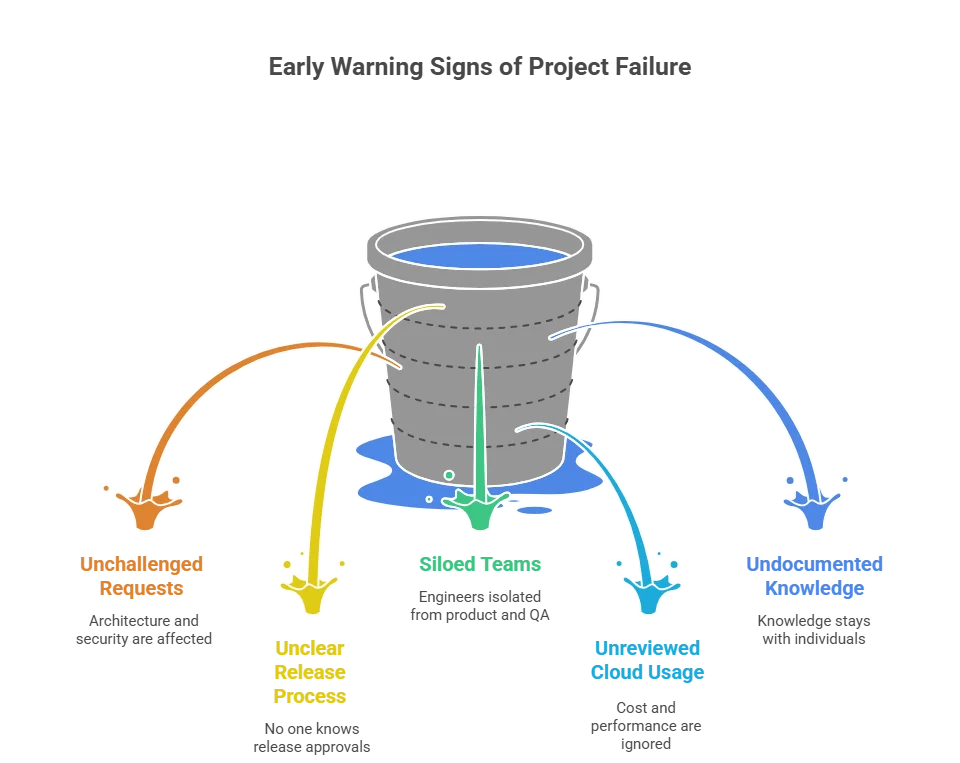
Signs of project failures

The warning signs usually appear before the first sprint ends. Some of the most common are:

  • Every request is accepted without challenge, even when it affects architecture or security
  • No one on the team can explain how production releases are approved
  • Engineers work in isolation from product and QA
  • Cloud usage is never reviewed against cost or performance
  • Knowledge stays inside individual developers instead of being documented

These are not minor issues. They are signals that the vendor is optimizing for short term output, not long term system health.

Red flags scoreboard

Area Healthy partner Red flag
Technical leadership A named tech lead owns design and quality No one is accountable for architecture
Delivery process Releases are planned, tested, and monitored Code is pushed when it seems ready
Product understanding Engineers ask about users and workflows Engineers only ask for tickets
Cloud and cost Usage and spend are reviewed regularly No one tracks what the system costs
Knowledge sharing Documentation and handover are built in Knowledge lives in private chats

When teams ignore these signals, the cost usually shows up later as unstable releases, rising infrastructure spend, and a growing gap between what the product should do and what it safely can do.

The goal of staff augmentation at scale is not to add more people. It is to add capacity without losing control. Partners who demonstrate real delivery expertise, not just technical experience, are the ones who make that possible.

What is the safest early-stage IT staff augmentation model for SaaS and scaleups?

The safest early stage model is the one that transfers execution risk away from the startup instead of pushing it back onto the internal team. In SaaS and scaleups, that usually means avoiding pure individual augmentation and moving toward small, accountable delivery units. 

Individual developers can add short term velocity, but they also fragment ownership. Teams and pods, when structured correctly, preserve continuity, code quality, and delivery rhythm.

For IT staff augmentation for startups, this distinction matters. A startup focused tech staffing partner that provides a stable team or pod takes responsibility for how features are built, tested, and released. That creates a single line of accountability. A collection of individuals does not.

Comparison matrix

Model How it works Risk profile Ownership
Individual augmentation One or more developers join an existing team High risk of fragmented design and knowledge silos Shared and often unclear
Team augmentation A small group joins with a lead and QA Moderate risk with better delivery discipline Clear technical ownership
Pod or squad model A self contained team delivers features end to end Lowest risk with strong continuity Single accountable unit

The model that scales most safely is the pod or squad approach. It protects the codebase from becoming a patchwork of styles and assumptions, and it makes it much easier to manage quality, releases, and knowledge transfer.

Why model choice matters for ROI

Return on investment in staff augmentation is not measured by how many developers are added. It is measured by how much useful software ships without creating future drag. 

Teams that rely on individual contractors often see early progress followed by rising rework and support costs. Pods and well structured teams cost more on paper, but they usually deliver higher ROI because they reduce downtime, stabilize releases, and limit technical debt.

In real SaaS environments, this shows up as fewer rollbacks, faster onboarding of new engineers, and lower cloud and support costs over time. 

That is why early-stage IT staff augmentation models that prioritize ownership and continuity tend to outperform cheaper but fragmented approaches.

Staff augmentation for Startups vs hiring: what offers better ROI and timelines?

Staff augmentation for startups works differently. When structured with a startup focused tech staffing partner, teams can be added in weeks, not quarters. That means features reach customers sooner, and revenue, retention, or cost savings begin earlier. 

The risk is not the rate. The risk is whether the augmented team can deliver without increasing technical debt.

Only around 31% of software projects deliver on time and on budget, meaning decisions about augmentation or hiring have a significant impact on delivery confidence

Long term velocity also matters. A poorly chosen hire can slow a team for years. A well structured augmentation pod can be adjusted or replaced if it is not working. That flexibility is often what protects ROI in fast moving products.

Decision matrix

Factor Hiring Staff augmentation
Time to first production release Often 8 to 16 weeks Often 2 to 4 weeks
Upfront cost Recruiting, onboarding, benefits Engagement based, predictable
Flexibility Hard to reverse a bad hire Teams can be adjusted or rotated
Impact on architecture Depends on seniority Depends on partner discipline
Long term velocity High if hire is strong High if ownership and governance exist

In practice, cost-effective staff augmentation for startups wins when speed, flexibility, and risk control matter more than headcount. 

Hiring wins when a company is ready to lock in long term ownership and can afford the time and uncertainty that comes with it.

How to evaluate startup-focused tech staffing partners beyond CVs and rates

What actually determines success is how much delivery ownership the team is willing to take. A strong startup-focused tech staffing partner treats production stability, release quality, and architectural health as part of their responsibility, not something to be handled by the client after the fact. 

They should be able to explain who approves changes, how incidents are handled, and how quality is enforced once work is underway.

One who can plan, adapt, and communicate inside that reality will keep delivery moving without sacrificing control.

Vendor scorecard

Area What to look for Warning sign
Delivery ownership Named lead accountable for releases and quality No clear owner for production
Process fit Comfortable with evolving scope and priorities Needs fixed requirements to start
Engineering discipline Code reviews, testing, and CI built in Quality checks left to the client
Communication Regular, transparent reporting Work happens out of sight

This kind of evaluation reveals far more than any CV ever will.

How do you structure a low-risk pilot with a staff augmentation partner?

You should start a pilot by giving the team work that actually touches shared code, data, and the release pipeline. That is where real behavior shows up. I have evaluated many partners, and the ones that look good on simple tickets often fall apart once their changes have to go through code review, staging, and production. Those are the moments that reveal whether a team can really be trusted.

What I have found works better is assigning a feature that requires coordination with product, QA, and operations. When a team can move that kind of work through without breaking other parts of the system, it shows they understand more than just their own code.

Here is something to avoid. Do not build a pilot around small, isolated tasks. I have seen those pass almost every time, even with weak partners, because they never test architecture, ownership, or delivery discipline.

A pilot is only worth continuing when releases stay predictable, quality does not drop, and the team can clearly explain what they changed and why.

What contract terms matter most for cost-effective staff augmentation for startups?

The first layer to get right is IP and NDA coverage. Every line of code, design, and configuration produced by an augmented team must legally belong to the company, not the vendor or the individual developer. 

Strong NDAs also matter because augmented engineers usually touch production data, customer information, and proprietary systems. Weak or missing confidentiality language is one of the fastest ways to create legal and compliance risk.

The next layer is exit, knowledge transfer, and continuity. This is where most cost overruns happen. A contract should clearly state how much notice is required to end or change an engagement, how documentation is delivered, and how replacement engineers are ramped up. 

Without these clauses, startups end up paying for months of overlap just to keep systems running.

Contract checklist

Use this to evaluate whether a staff augmentation agreement is actually startup safe:

  • All IP, code, and deliverables automatically belong to the company
  • NDA covers source code, customer data, and infrastructure details
  • Clear notice periods for reducing or ending the team
  • Mandatory knowledge transfer and documentation before any exit
  • Defined process for replacing engineers without losing momentum
  • No hidden fees tied to onboarding or offboarding
  • Access rights and credentials remain under company control

Cost-effective staff augmentation for startups is not about finding the cheapest rate. It is about avoiding contracts that make it expensive to change direction, recover knowledge, or regain control of the product. 

When these terms are in place, teams can scale up or down without putting their business at risk.

How do augmented teams align with agile, security, and delivery processes?

Augmented teams only work when they operate inside the same operating model as the internal engineers. When they do not, velocity may increase for a few weeks but quality, security, and predictability quickly decline. 

Real alignment is not about attending standups. It is about sharing the same definition of done, release gates, and risk controls.

Security and compliance guardrails matter just as much. Augmented teams should never have broader access than internal staff. Production credentials, customer data, and infrastructure controls must follow least privilege rules, with audit trails and environment separation. 

When these controls are enforced, external engineers can contribute safely without increasing regulatory or operational risk.

Operating model table

Area Aligned team Misaligned team
Sprint planning Participates in estimates and scope Receives tasks after planning
Code and QA Uses the same review and testing gates Pushes code outside normal checks
Releases Follows shared release and rollback process Deploys independently
Security Least privilege with audit trails Broad or unmanaged access
Compliance Works inside required controls Bypasses governance

When these patterns are in place, augmented teams behave like part of the company rather than a disconnected vendor.

What’s a realistic ROI timeline for augmented teams?

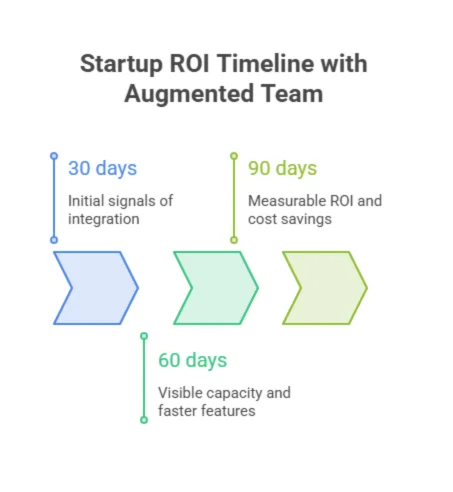
Return on investment from staff augmentation does not show up all at once. 

In the first 30 days, the signal to watch is not velocity. It is whether the augmented engineers can work inside the existing codebase, follow release discipline, and ship without creating noise. 

By 60 days, useful capacity should be visible. Features start reaching production faster, support tickets drop, and internal engineers spend less time fixing problems created by rushed work.

By 90 days, ROI becomes measurable through shorter cycle times, fewer incidents, and more predictable releases.

ROI Timeline for IT Staff augmentation

When these signals move in the right direction, augmentation is paying for itself. When they do not, scaling the team only increases cost without increasing value.

How do CTOs know they chose the right IT staff augmentation company?

The right IT staff augmentation company proves their value after the contract is signed, not before. Early signals show up in delivery behavior, not in status reports. When releases stay stable, cloud costs stay predictable, and engineers take responsibility for what they ship, the partnership is working. When velocity looks high but incidents, rework, and handoffs start increasing, something is wrong.

The safest way to judge success is to combine technical and operational indicators. A strong partner should improve delivery without creating new risk. That means fewer production issues, faster turnaround on changes, and better visibility into what is happening across the codebase.

Final decision checklist

  • A named technical lead owns architecture and release quality
  • API and data model changes are reviewed and approved, not pushed ad hoc
  • Builds, tests, and deployments follow the same gates as the internal team
  • Cloud usage and cost are tracked and discussed regularly
  • Knowledge is documented and shared instead of staying with individuals
  • The team can explain what they shipped and why

Post-selection KPIs

  • Time from code commit to production
  • Number of failed or rolled back releases
  • Volume of defects and support tickets
  • Cloud cost per active user
  • Onboarding time for new engineers

When these indicators stay healthy, the augmentation partner like TechnBrains is not just adding people. They are strengthening the way the product is built and delivered.

Wrapping it Up

Staff augmentation is not a shortcut to faster delivery. It is a way to extend engineering capacity without losing control, when done with the right structure, partners, and safeguards. 

Teams that focus on ownership, architecture, and governance avoid the instability that often follows rapid growth. 

By choosing the right model, validating partners through pilots, and tracking real delivery signals, startups and scaleups can grow their teams while keeping their products stable and scalable.

Validate Before You Scale

Apply the ROI and pilot framework in this article to test real delivery behavior before committing more budget or expanding your augmented team.