Build and Scale Faster
150+ products shipped for startups and enterprises by engineers focused on real outcomes.
"Their ability to quickly understand an unfamiliar use case and respond creatively to it is impressive."

Anonymous
Executive, Pured Disc Golf

"TechnBrains resolved challenges efficiently and turned my vision into a solid, functional product with a strong foundation."

Jalen Gibbs
Founder, STREAMLINE LIVE
"The talent they provided was solid, but more importantly, they were quick to align with our way of working."

Nancy Snyder
Managing Director, MimeCast
Our trusted clients


Start Your Product Journey Today
Turn your idea into a working product. Share a few details and we'll help define the roadmap, timeline, and execution approach.
App Store Optimization for iOS Applications
App store optimization for iOS applications directly determines how often your app appears in search results and how effectively it converts page views into installs. Since nearly 65% of App Store downloads happen after a search, weak ASO means lost growth before users even evaluate your product. The same discipline applies on Android, where play store optimization drives the equivalent...

Updated Aug 13, 2026
App store optimization for iOS applications directly determines how often your app appears in search results and how effectively it converts page views into installs. Since nearly 65% of App Store downloads happen after a search, weak ASO means lost growth before users even evaluate your product. The same discipline applies on Android, where play store optimization drives the equivalent gains on Google Play
I’ve worked with technically strong apps – clean Swift architecture, stable releases, solid retention curves that still hit growth plateaus. The issue wasn’t engineering or product-market fit. It was discoverability and conversion inside the App Store.
If your listing doesn’t align with search intent and convert fast, users never reach onboarding, and growth stalls at the storefront.
TL;DR
- Metadata precision: Apple indexes the title, subtitle, and 100-character keyword field. Structured, relevant metadata directly impacts rankings.
- Conversion mechanics: Average iOS CVR is ~25%, but top-performing listings achieve 35%+. Strong visuals, messaging, and iterative screenshot testing amplify install velocity and keyword momentum.
- Apple Search Ads can accelerate growth, but strong ASO maximizes efficiency and lowers acquisition costs.
- Predictive keyword modeling, LLM-powered review clustering, behavioral cohort analysis, and AI-driven screenshot iteration improve targeting accuracy and conversion outcomes.
What App Store Optimization for iOS Applications includes
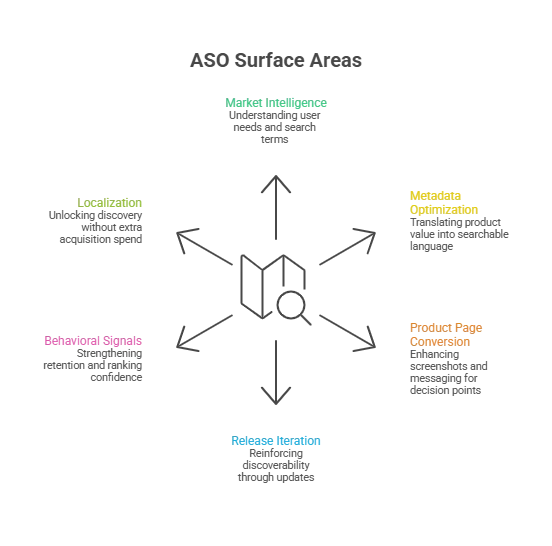
ASO improves visibility, conversion, and ranking stability through precise metadata, behavioral signals, and conversion-focused creatives. Beyond listing tweaks, ASO functions as a repeatable growth system:
- Market & intent intelligence: Understand user language, needs, and search behavior.
- Metadata & positioning: Translate your product’s value into searchable, intent-aligned language.
- Product page conversion: Optimize screenshots, icons, videos, and messaging for decision points.
- Release-aligned iteration: Reinforce discoverability with updates and launches.
- Behavioral signals: Retention, engagement, reviews, and crash stability sustain ranking.
- Localization: Expand discovery internationally without extra paid acquisition.
Case Insight: We helped a 5-person iOS team recover 25% of lost visibility in 30 days without delaying releases, showing how ASO compounds growth quickly.
How ASO Differs from Traditional SEO
Many executives assume SEO expertise transfers directly to ASO. It doesn’t. Both optimize for search, but mechanics, constraints, and ranking physics differ:
| Dimension | SEO (Web) | iOS ASO (App Store) |
| Indexable Surface | Full-page content, headings, schema | Title (30), Subtitle (30), Keyword Field (100) |
| Keyword Depth | Virtually unlimited | Strict character limits |
| Ranking Signals | Backlinks, authority, content depth | Install velocity, CVR, retention |
| Behavioral Signals | CTR, dwell time, bounce rate | Page-to-install CVR, engagement stability |
| Update Mechanics | Continuous crawling | Manual updates via App Store Connect |
| Optimization Cycle | Rolling | Structured 3–4 week cadence |
| Visual Impact | Supportive | Core driver: screenshots often determine installs |
| User Intent | Informational | Immediate problem-solving + install intent |
| Geography | hreflang, subfolders | Native storefront localization |
Platform architecture also influences App Store performance. Native iOS experiences enable smoother onboarding, faster load times, and stronger retention signals, reinforcing ranking durability.
Understanding the differences between native and cross-platform development can clarify how technical decisions influence growth outcomes.
App Store metadata and ranking factors: what moves the needle in 2026
High-performing ASO teams treat discoverability, metadata, conversion, and behavioral signals as a single growth system. Each layer compounds the next: eligibility → visibility → conversion → velocity → ranking → impressions → retention → algorithm confidence.
| Layer | Purpose | Optimization Focus | Priority |
| Intent Architecture | Search eligibility | Keyword portfolio, intent mapping, competitive positioning | Critical |
| Metadata Engineering | Precision & coverage | Title, subtitle, keyword field, category | Critical |
| Conversion Mechanics | Install momentum | Screenshots, icon clarity, preview video, first-screen messaging | Strategic |
| Behavioral Reinforcement | Ranking stability | Retention curves, review velocity, crash signals | Strategic |
| Compounding Differentiation | Durable advantage | Custom pages, in-app events, localization, visual iteration | Advanced |
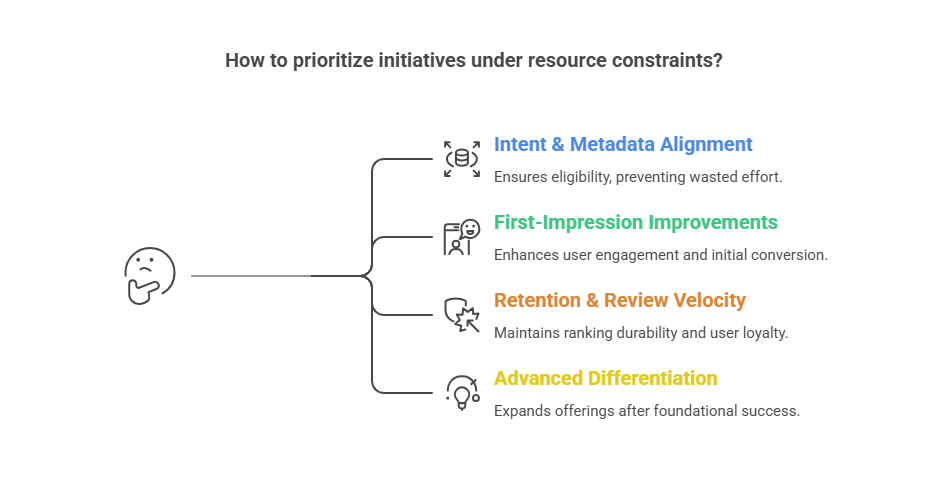
Prioritization for limited resources:
- Intent + metadata → eligibility & accurate positioning
- First-impression conversion → screenshots, icon, subtitle clarity
- Retention & reviews → stabilize ranking
- Advanced differentiation → custom pages, localization, in-app events

AI & Predictive Layer: The Modern ASO Advantage
AI is transforming ASO from reactive optimization to predictive decision-making:
- Predictive Keyword Modeling: Forecast high-volume, high-conversion terms before competitors.
- LLM-Powered Review Clustering: Identify emerging pain points and feature trends from user feedback at scale.
- Behavioral Cohort Analysis: Determine which keywords and features drive retention in different user segments.
- AI-Driven Screenshot Iteration Testing: Predict which visual assets maximize install conversion and iterate faster.
Strategic Impact: AI reduces experimentation risk, accelerates iteration, and allows lean teams to compete with larger organizations.
What Changed in ASO from 2023–2026
The App Store landscape has shifted significantly in the last few years, making traditional ASO tactics less effective:
- Behavioral signals dominate rankings: Install velocity, retention, and engagement stability now outweigh keyword stuffing.
- Visual conversion is critical: Screenshots, preview videos, and icon clarity have a larger impact on installs than ever.
- Metadata constraints tightened: Apple continues to enforce strict character limits and indexing rules, requiring more precise keyword strategies.
- AI & predictive insights emerging: Predictive keyword modeling, LLM-powered review clustering, and behavioral cohort modeling are enabling teams to anticipate trends and optimize proactively.
- Localization drives incremental growth: Country-specific storefront optimization is now a major lever for discovery and installs.
Execution Insight
Strong strategy alone isn’t enough. Many teams stall due to bandwidth: iterative updates, visual experiments, and localization require consistent execution.
Staff augmentation and hiring ASO specialists or iOS developers can maintain release cadence while running optimization cycles, reducing risk, and accelerating compounding growth.
Real-World Scenario: Sudden 30–60% Organic Install Drop
Even apps with strong ratings (4.3–4.6), low crashes, and unchanged metadata can lose 30–60% of impressions in 2–4 weeks. Causes include:
- Ranking compression: Small keyword position shifts can cut traffic 40%+.
- Competitor momentum: Paid campaigns, feature releases, or seasonal spikes.
- Search demand shifts: Keyword volumes fluctuate, affecting installs.
- Algorithm updates: Retention, review recency, or engagement changes impact visibility.
- Browse/recommendation changes: Loss from “Similar Apps” slots or collections.
Mitigation: Audit keyword positions, refresh screenshots, optimize metadata, and align paid campaigns. Staff augmentation can accelerate these responses without pulling internal engineering off core development.
iOS keyword field optimization tips that teams get wrong
The 100-character iOS keyword field is one of the most impactful and technically demanding elements of App Store Optimization (ASO). Optimizing it correctly drives visibility, ranking, and ultimately installs.
Core Rules
- Total Characters: Max 100 (English; varies by language)
- Comma-Separated: No spaces after commas
- Avoid Duplication: Don’t repeat words in title, subtitle, or category
- Singular/Plural: Automatically indexed
- Case Insensitive: Lowercase works fine
Keyword Portfolio Approach
Instead of a random list, build a portfolio aligned with core value and user intent. This allows targeting different competition levels while reflecting search intent:
| Bucket | Focus | Examples |
| Core category | Primary ranking surface | budget tracker, invoice, fitness plan |
| Feature | Capability-driven discovery | scan receipts, expense alerts, meal planner |
| Use-case | Situational relevance | freelancer invoices, student budget |
| Audience | Conversion alignment | small business, new parents |
Optimization Strategy:
- 2–4 from Core category (high-value, competitive)
- 6–10 from Feature + Use-case (mid-competition, relevant)
- 2–4 from Audience (improves conversion and ICP alignment)
Common Mistakes
| Mistake | Impact | Fix |
| Keyword Duplication | Wastes space; Apple ignores repeats | Audit all fields; use unique terms |
| Brand Name in Keyword Field | Already in title; no added value | Replace with high-value keywords |
| Overusing Broad Terms | Generic keywords have minimal ranking impact | Focus on intent-driven, specific terms |
| Ignoring Localization | Limits market relevance | Prioritize country-specific keywords |
App Store Metadata Execution: Title, Subtitle, and Hidden Tradeoffs
Your app’s title and subtitle are primary ranking and conversion assets. The challenge is balancing recognition with discoverability.
- Brand clarity: Makes the app memorable and easy to recognize.
- Intent clarity: Aligns metadata with real search queries to improve visibility.
Category Positioning That Drives Conversion
In competitive or trust-sensitive categories (fintech, health, identity), early impressions shape both installs and credibility:
- Differentiation: Communicate your unique value immediately.
- Conversion-focused visuals: The first screenshots often determine install decisions.
- Credibility cues: Ratings, reviews, press mentions, and compliance signals reinforce trust and ranking stability.
Strong title, subtitle, and first-impression alignment make your listing discoverable, persuasive, and defensible, reducing acquisition friction while supporting long-term growth confidence.
Your High-Investment App Deserves Maximum Visibility
If your app’s discoverability, retention, and ranking rely on ad hoc efforts instead of specialized expertise, growth stalls and acquisition costs rise. We help teams augment engineering capacity with ASO-aware iOS experts to ensure your app gets found, converts, and scales.
Visual ASO: Screenshots & Video Previews That Drive Conversion
In the Apple App Store, visuals aren’t just design—they’re your primary acquisition interface. Icons, screenshots, and preview videos directly impact tap-to-install conversion.
Screenshot Narrative Framework:
High-performing listings reduce decision friction:
Hook → Proof → Feature → Outcome → Differentiator → Trust → CTA
Icon Strategy:
Avoid icons that are overly abstract, too similar to competitors, or unreadable at small sizes. Icons should instantly communicate category; creativity belongs inside the app.
Preview Video Tips:
- Show the core action immediately
- Highlight the “after” result
- Keep understandable without sound
- Audio-dependent previews often reduce conversion.
CRO Focus: Funnel Decisions
- Impression → Tap: Optimize search visibility & first impression
- Tap → Install: Persuade via page clarity and visuals
- Install → Activation: Ensure the app fulfills its promise
Highest-Impact CRO Levers (Priority):
- First 2 screenshots — convey value instantly
- Subtitle clarity — remove ambiguity around core benefit
- Trust signals — ratings, credibility, compliance
- Preview video — only if faster/more effective than screenshots
Testing & Paid/Organic Strategy in the Apple Ecosystem
Structured testing: Use Apple Product Page Optimization to run iterative experiments on screenshots, icons, and metadata. Treat it as a repeatable process, not a one-off, to sustain conversion gains and ranking momentum.
Paid vs Organic: Many teams overspend on Apple Search Ads (ASA) assuming it substitutes for weak ASO. In reality, paid amplifies strong ASO but cannot fix poor metadata or low-converting visuals.
Decision Guide:
- Lean on ASA when launching, entering new regions, or validating keywords quickly.
- Lean on organic ASO when retention/referrals are strong, building category positioning, or reducing long-term paid dependency.
- Combine both to refine keywords from paid insights, scale installs, and support 6–12 month compounding growth.
Key takeaway: Paid is an acceleration and insight layer; ASO is the foundation for sustainable, cost-efficient acquisition.
Staff Augmentation: When to Bring in ASO Experts
For many teams, internal bandwidth or expertise isn’t enough to maintain high-performing ASO. Structured staff augmentation provides specialized skills, accelerates results, and sustains growth without premature full-time hires.
When to Augment vs Hire In-House
Augment When:
- ASO is critical but not a full-time function.
- Rapid audits, metadata updates, or experiments are needed.
- Product/growth teams lack deep App Store expertise.
- High release velocity requires optimization alongside development.
Hire In-House When:
- ASO is a permanent growth channel with predictable workload.
- Tight cross-team collaboration and long-term ownership are required.
- Continuous experimentation and institutional knowledge are priorities.
Skill Profile for Success
An effective ASO specialist should combine:
- Metadata & keyword strategy: structured targeting, portfolio management.
- Conversion-focused marketing: persuasive messaging and visual experimentation.
- Data & experimentation: analyze results to guide iteration.
- App Store Connect familiarity: seamless implementation with release cycles.
Red Flags for Failed Engagement:
- Focuses only on metadata, ignoring conversion.
- Reports rankings without linking to installs, retention, or revenue.
- Slow experimentation or poor collaboration with product/design teams.
Budget & Engagement Models
| Model | Focus | Duration | Cost |
| Project-Based | Audits, repositioning, localization | ~3 months | $5k–$15k |
| Fractional Specialist | Ongoing optimization, part-time (~10–20 hrs/wk) | 6–12 months | $3k–$7k/mo |
| Embedded Contributor | Integrated with releases & growth sprints | Ongoing | $8k–$15k/mo |
Budgets depend on iteration speed: faster testing → faster ranking recovery & compounding growth.
Delivery & Success Metrics
Delivery Risk Considerations:
- Frequent, actionable reporting vs. slow updates.
- Ability to influence design/product/release workflows.
- Clear success metrics: visibility, conversion lift, retention, install growth, ranking recovery.
- Knowledge transfer to reduce dependency.
KPIs for Success:
- Install lift: % increase in organic installs.
- Conversion rate improvement: Tap-to-install CVR, especially first 2–3 screenshots.
- Keyword ranking recovery: Core category & feature terms.
- Retention impact: 7–30 days post-install.
- Revenue effect: In-app purchases/subscriptions (if applicable).
Takeaway: A structured, buyer-focused augmentation plan clarifies costs, engagement models, and expected outcomes, helping teams accelerate ASO growth while minimizing internal risk.
The 90-day ASO plan you can execute
If you want an execution blueprint for app store optimization for iOS applications, here is a plan I’ve used across multiple launches and relaunches.
Days 1-15: Audit and intent mapping
- Pull baseline: impressions, taps, installs, CVR
- Identify top 10 competitors and their positioning
- Map your keyword portfolio (A/B/C/D buckets)
- Rewrite title/subtitle/keyword field with intent clarity
- Define your screenshot narrative (Hook → Proof → Outcome)
Deliverable: ASO strategy doc + metadata draft + visual storyboard
Days 16-45: Ship the first conversion upgrade
- Create new screenshot set (start with the first 3)
- Update subtitle and first screenshot headline to match top intent
- Improve trust cues (reviews prompts inside app, support clarity)
- Launch Product Page Optimization test if you have enough traffic
Deliverable: Conversion-focused listing v1 + active test
Days 46-90: Scale what works and stabilize
- Apply winning assets from tests
- Expand into localization targets if justified
- Align ASA keyword learnings with organic metadata
- Build a quarterly refresh rhythm tied to releases
Deliverable: ASO operating system (repeatable cadence)
Conclusion: Optimizing App Visibility and Conversion for Business Success
Across multiple launches, I’ve seen that visibility rarely improves through isolated ASO efforts. It compounds when discoverability evolves with the product and becomes part of how releases are planned, not something addressed after launch.
The apps that sustain organic growth are usually the ones where eligibility, first impressions, and post-install experience are refined continuously. That consistency improves acquisition stability and strengthens trust within the Apple App Store.
In most cases, the challenge isn’t strategy but execution bandwidth. I’ve found that extending teams with specialists like TechnBrains helps maintain optimization momentum without pulling focus away from core engineering priorities.
Table of Contents
Frequently Asked Questions
Apple ASO (App Store Optimization) is the practice of optimizing your App Store listing to increase visibility in search and improve conversion from page views to installs.
It depends on your workflow: Early-stage teams: prioritize keyword discovery, competitor tracking, and review insights. Mature teams: add testing, localization management, and iteration tracking to sustain growth.
Conversion improvements can appear within weeks if traffic is sufficient. Ranking changes typically take longer and depend on competition, relevance, and behavioral performance signals.
No. Paid campaigns accelerate learning and visibility, but organic ASO remains the foundation for sustainable installs, compounding growth, and more efficient paid acquisition.
Blocked by backlog or missing expertise?
Senior developers who build, fix, and ship — without slowing your team down.