
Build and Scale Faster
150+ products shipped for startups and enterprises by engineers focused on real outcomes.
"Their ability to quickly understand an unfamiliar use case and respond creatively to it is impressive."

Anonymous
Executive, Pured Disc Golf

"TechnBrains resolved challenges efficiently and turned my vision into a solid, functional product with a strong foundation."

Jalen Gibbs
Founder, STREAMLINE LIVE
"The talent they provided was solid, but more importantly, they were quick to align with our way of working."

Nancy Snyder
Managing Director, MimeCast
Our trusted clients


Start Your Product Journey Today
Turn your idea into a working product. Share a few details and we'll help define the roadmap, timeline, and execution approach.
Best Warehouse Inventory Management Software in 2026: 11 Tools Compared
Zoho Inventory is a cost-effective choice for small warehouses, Cin7 Core suits multichannel inventory management, and Katana supports manufacturing operations. Extensiv, ShipHero WMS, and Logiwa IO are better suited to 3PL and high-volume fulfillment, while Odoo and ERPNext offer free or open-source alternatives.


Updated Oct 22, 2026
87% of warehouse operators surveyed used a WMS in 2025, yet 51% reported using manual data collection to measure productivity. The 2025 Warehouse/DC Operations Survey surveyed 101 professionals; these separate findings do not prove WMS failure.
Software selection comes down to workflows, costs and post-launch reliability. Even identical order allowances can have different prices: Zoho Inventory Standard lists 6,000 orders per year for $348, while Cin7 Core Standard has been listed at approximately $4,188. The products have different capabilities.
This comparison draws on vendor documentation, independent user feedback, and TechnBrains’ firsthand experience building an inventory and fulfillment platform for a US corporate merchandise operator. The project reflects our broader work in logistics software development, where inventory visibility, procurement, warehouse fulfillment, and reporting need to work together.
TL;DR: Which Warehouse Inventory Management Software Is Best in 2026?
| Software | Best for | Starting price (Oct 2026) | Key advantage | Important limitation |
| Zoho Inventory | Low-cost multi-location stock control | $29/mo annual (500 orders/mo) | Lowest cost per order | Reporting gaps; tier gating |
| Cin7 Core | Multichannel retail, light manufacturing | $349/mo (6,000 orders/yr, 5 users) | Channel and accounting integrations | 12-month no-downgrade terms reported |
| Katana | Make-to-order manufacturing | Free to 30 SKUs; paid plan custom | Real-time materials and production | No published paid price |
| Fishbowl Advanced | QuickBooks-linked manufacturing | $595/mo Advanced Warehouse; mandatory implementation extra | Manufacturing and warehouse depth | Deployment and QuickBooks sync require validation |
| inFlow Inventory | Small teams, fast barcode workflows | $99/mo annual (Lite, 2 users, 1 location); $499 onboarding required from Core | Usability, label printing; unlimited orders | Shopify location routing complaints |
| Sortly | Item and asset tracking only | Free to 100 items; $49/mo for 500 | Fastest to set up | Renewal increases reported; no fulfillment |
| Extensiv 3PL Warehouse Manager | Multi-client 3PL billing | Custom quote | Client billing and on-ramp | Per-client fees; scanning complaints |
| ShipHero WMS | High-volume DTC fulfillment | About $1,995/mo, 5 users (unconfirmed by vendor) | Scales to millions of parcels | Weak for B2B and bulk picking |
| Logiwa IO | 3PL operations, unlimited users | Custom quote, volume-based | No per-seat charges | 8-week setups, mandatory services reported |
| Odoo Inventory | Free inventory app in an ERP suite | Free (one app); $31.10/user/mo for the suite | No license cost | Complex floor workflows require configuration |
| ERPNext | Open-source ownership | Free; Frappe Cloud from $5/mo | Documented REST API | Needs a dedicated maintainer |
Not Sure Which Warehouse Software Fits Your Business?
Get expert guidance on choosing, integrating, or extending inventory software based on your warehouse workflows, existing systems, and fulfillment requirements.
Discuss Your RequirementsWhat Is Warehouse Inventory Management Software?
Warehouse inventory management software tracks what stock you hold, where it sits across locations, and how it moves through purchasing, orders and fulfillment. A full warehouse management system (WMS) also directs the physical work on the floor: putaway, pick paths, labor assignment, dock and yard scheduling.
Inventory-first applications focus on stock and orders. The 3PL platforms also manage warehouse execution and client billing. Verify exact capabilities by product and plan.
What Do Warehouse Inventory Management Statistics Reveal in 2026?
Warehouse management software adoption is widespread, yet manual reporting, increasing inventory complexity, and cost pressures remain significant challenges. Industry surveys highlight these operational demands, while TechnBrains’ analysis of 11 warehouse inventory software products identifies pricing, support, usability, and integration reliability as recurring concerns in user feedback.
Warehouse Inventory Management Industry Statistics
- 87% of warehouse professionals surveyed used a WMS in 2025, according to the Warehouse/DC Operations Survey, highlighting widespread adoption without guaranteeing operational efficiency.
- 51% still collected warehouse productivity data manually, reinforcing the need for automated reporting and reliable inventory records.
- 22.8% was the increase in average SKU counts, from 7,790 in 2024 to 9,565 in 2025, emphasizing scalable inventory tracking and reconciliation.
- 76% measured inventory accuracy in 2025, highlighting the importance of cycle counting, discrepancy resolution, and audit trails.
- 48.6% prioritized cost reduction, according to the separate WERC 2026 DC Measures research, reinforcing the need to assess total software ownership costs.
At TechnBrains, we analyzed 75 user feedback records across 11 warehouse inventory software products, examining operational challenges reported on Reddit and software review platforms.
- 28% of the feedback records mentioned pricing concerns, including renewal increases, subscription costs, and unexpected fees.
- 17.3% of the feedback records identified customer support problems, including delayed responses and unresolved technical issues.
- 17.3% of the feedback records described usability challenges, including complicated workflows and difficulties with everyday warehouse tasks.
- 16% of the feedback records mentioned integration reliability issues, including failed synchronization, incorrect inventory mapping, and disconnected systems.
Our research prioritized software-related complaints, so these percentages reflect the feedback we analyzed rather than overall customer satisfaction.
What This Means for Buyers: Beyond features and starting prices, evaluate renewal terms, reporting accuracy, support quality, and integration reliability before purchasing.
About Our Research: We prioritized feedback describing software problems, so these findings identify potential risks rather than overall customer satisfaction. Our sample contained 3-10 records per product and does not represent the wider market. The industry statistics come from separate surveys.
How Did We Evaluate These Warehouse Inventory Management Tools?
We assessed inventory accuracy, locations, scanning, fulfillment, integrations, implementation, support and total cost. Comparisons respect each product’s intended operating model.
We examined 76 coded research records, including 75 sentiment-bearing records and 62 first-hand accounts, gathered from Reddit and software review platforms. Just 39% had verifiable dates; complaint-focused searches biased the 3–10 records per product. The sample does not measure market-wide satisfaction.
Pricing appeared in 21 records, support and usability in 13 each, and integrations in 12. Vendor documentation determines documented capabilities. We mark undocumented capabilities not verified rather than claiming they are unavailable.
What Is the Best Warehouse Inventory Management Software in 2026?
The best warehouse inventory management software depends on your warehouse’s operating model. The 11 tools are grouped below by their primary use cases, pricing models, documented capabilities, and operational limitations reported by users.
Which Tools Fit Multi-Location Inventory Operations?
Compare Zoho for low-cost inventory, Cin7 Core for multichannel sales, Katana and Fishbowl for manufacturing, inFlow for scanning, and Sortly for asset tracking.
-
Zoho Inventory: Best for Low-Cost Multi-Location Stock Control

Why it fits: Standard covers 2 locations and 500 orders a month; higher tiers add traceability, bin features and stock counting, while Enterprise reaches 10 locations and 15,000 orders. Verify the precise plan needed for batch and serial tracking before purchase.
Pricing: Standard starts at $29/month billed annually ($39 monthly), with Enterprise listed at $249/month on annual billing. Order, user and location charges also apply.
What users report: Limited evidence (G2 4.4, 92 reviews; our 6 records were all negative, reflecting complaint-weighted collection). The theme is reporting: an operator with 2,700 SKUs found no report for component consumption inside assemblies without Zoho Analytics.
Verdict: Shortlist it for order-driven inventory where subscription cost matters. Verify component reporting and batch scanning in your selected plan.
-
Cin7 Core: Best for Multichannel Retail with Light Manufacturing

Why it fits: Cin7 Core is the former DEAR Systems product; Cin7 Omni is separate. Standard includes 5 users, 2 app integrations and 6,000 orders a year; Pro adds manufacturing and 24,000 orders. Some users praised its connected sales and accounting workflows.
Pricing: Standard is listed at $349/month on G2, with Pro reported at $599/month. Confirm Advanced pricing directly. Costs vary with users, integration slots and order allowance; one operator reported a $2,600 integration charge.
What users report: Positive with recurring concerns (Capterra 4.3, 734 reviews; 5 of our 8 records negative). An e-commerce operations lead described orders auto-dispatched without stock and integrations failing with no alert; two TrustRadius reviewers described a 12-month lock with no downgrade and a sharp price rise within a year.
Verdict: Shortlist it when multichannel and accounting workflows justify its higher entry cost. Zoho costs less for the same order allowance, but offers different capabilities. Review integration health, downgrade restrictions and renewal terms before signing.
-
Katana: Best for Make-to-Order and Small-Batch Manufacturing

Why it fits: Katana combines real-time inventory, materials planning and manufacturing workflows. Its warehouse capabilities include bin locations, receiving and pick-and-pack, with traceability tools for relevant workflows.
Pricing: The pricing page, updated 20 October 2026, publishes no paid price. Free (all features, up to 30 SKUs, unlimited users and locations) and Advantage, a custom annual contract bundling the subscription with implementation, are the only plans listed, and the page’s FAQ tells existing Standard, Professional and Core customers they will be contacted about changes to their plans. Earlier $299 Core pricing is not displayed.
What users report: Mixed (SoftwareConnect reviews 2019 to September 2026; 5 of our 9 records negative). A September 2026 reviewer rated real-time inventory and BOMs strong for an SMB. A shop-floor operator reported stock allocated to the wrong work orders, which an implementer attributed to poor setup, and a small manufacturer reported the price doubling because revenue grew rather than usage.
Verdict: Shortlist it for manufacturing operations that value guided setup. If you require a self-service paid tier with a published price, the current Advantage offer will be less suitable.
-
Fishbowl Advanced: Best for QuickBooks-Linked Manufacturing and Warehousing

Why it fits: Fishbowl Advanced covers manufacturing and warehouse workflows, with cloud-hosted deployment included in its current offers and self-managed options for some teams. Fishbowl Inventory is a separate cloud-native product; confirm the edition and deployment discussed in any review.
Pricing: Advanced Warehouse starts at $595/month and Advanced Manufacturing at $675/month, with final pricing based on users and deployment. Implementation is mandatory; the QuickBooks App Store listing lists implementation from $6,000. Get an all-in quote.
What users report: Mixed (Software Advice summaries are favorable; 9 of our 10 records negative). The repeated failure is the QuickBooks link: an MSP supporting several Fishbowl clients wrote that it “breaks constantly,” and a consultant reported manufacturers switching the sync off. One manufacturer reverted to QuickBooks Enterprise after spending over $50,000; a long-term user in the same thread reported no issues.
Watch out for: Implementation scope, deployment requirements and ongoing QuickBooks synchronization. Test these together before purchase.
Verdict: Shortlist it if your operations depend on QuickBooks integration and manufacturing or warehouse depth, with a written deployment and implementation plan. Avoid it if the total implementation cost or technical upkeep is beyond your capacity.
-
inFlow Inventory: Best for Small Teams That Want Barcode Workflows Fast

Why it fits: Barcode and label workflows are what users praise: a three-person team rated label printing 9 out of 10 and called onboarding simple.
Pricing: inFlow Inventory starts at $99/month billed annually. The researched tier prices are Lite $99, Core $299, Pro $499 and Max $699 per month on annual billing; verify the selected tier’s current user, location and add-on allowances. Most plans require $499 onboarding; training costs $199/hour.
What users report: Positive with recurring concerns (Software Advice 4.6, 504 reviews; 5 of our 6 records negative). The same team reported that the Shopify integration ignored location mapping and picked stock from an arbitrary location, and that a new product category became visible to every B2B Showroom customer.
Watch out for: Multi-Location Shopify routing.
Verdict: Shortlist it when barcode workflows and usability are central. If Shopify location routing or accounting sync is critical, demonstrate the exact integration and its error alerts before purchase.
-
Sortly: Best for Item and Asset Tracking, Not Order Fulfillment

Why it fits: Sortly is a visual inventory and asset tracker: barcode and QR capture, photos and folders. It is not a purchase-to-ship fulfillment platform.
Pricing: Free to 100 items, $49 a month for 500, $149 for 2,000, $299 for 5,000. The bill rises with item count.
What users report: Pricing-heavy negative feedback in this sample, alongside usability praise (Trustpilot 18 reviews, June 2025 to July 2026, almost all negative; Capterra 957 reviews, sampled). Three Trustpilot reviewers described renewal increases of two to nine times, and a five-year customer on r/smallbusiness reported a jump from $1,400 to $5,800 a year with two weeks’ notice.
Verdict: Shortlist it for tools, equipment or sample tracking. Choose a system with documented order and picking flows if fulfillment is essential, and check renewal and downgrade terms before buying.
Which Tools Fit 3PL and Fulfillment Operations?
Extensiv is oriented to multi-client billing, ShipHero WMS to parcel fulfillment, and Logiwa IO to volume-based 3PL operations with broad user access. Extensiv and Logiwa use custom quotes; ShipHero’s publicly cited software price remains independently unconfirmed.
-
Extensiv 3PL Warehouse Manager: Best for Multi-client 3PL Billing and Operations

Why it fits: Extensiv 3PL Warehouse Manager is the former 3PL Central product, and its differentiator is billing: client profiles, Billing Manager and a Small Parcel Suite alongside SmartScan mobile scanning.
Pricing: Custom quote. Users describe the bill rising per client after the first five ($25 per customer in one account), per EDI connection and per custom report (about $350 for one, per a COO). Descartes acquired Extensiv for $120 million in September 2026, so buyers should confirm roadmap and contract terms rather than infer immediate changes.
What users report: Mixed (G2 4.0, 40 reviews, through April 2026; a low-confidence aggregator sample shows 3.4). 4 of our 7 records concern pricing and add-ons. The most serious is an April 2026 report from a mid-market logistics director: weak scanning and label generation, poor pick path, and staff who “would prefer to just pick to paper.”
Verdict: Shortlist it if multi-client billing is central. If scan-based picking speed or self-service reporting is critical, require a live workflow test and a complete price for reports and add-ons.
-
ShipHero WMS: Best for High-Volume Direct-to-Consumer Fulfillment
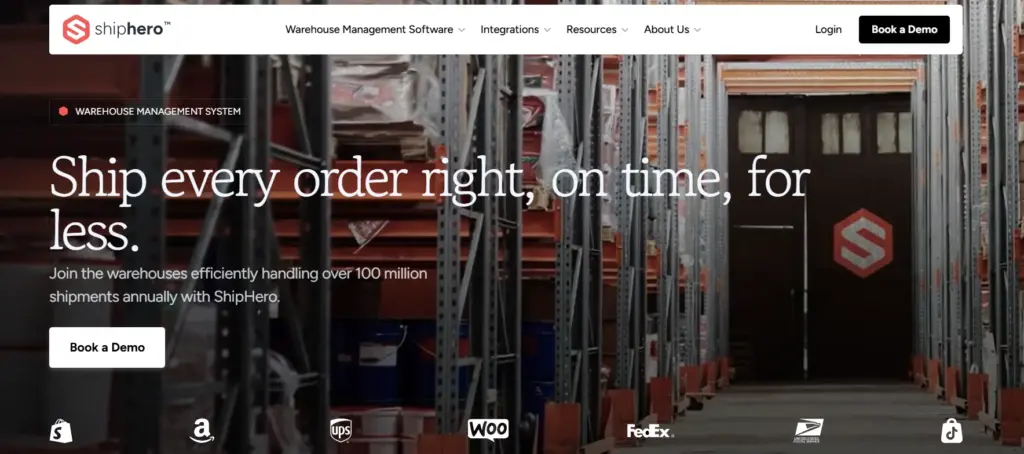
Why it fits: ShipHero WMS is the software; ShipHero Fulfillment is its separate outsourced service. A 3PL founder reported scaling from 15,000 parcels/month to 2.5 million/year, an unverified user-reported outcome.
Pricing: ShipHero’s pricing page blocked retrieval. An independent 2026 compilation lists $1,995 a month for 5 users, $150 per extra user and $30 per extra store; treat these as unconfirmed.
What users report: Positive with recurring concerns (G2 4.4, 205 reviews; 2 of our 5 WMS records negative). 3PL operators in a June 2024 r/logistics thread said the DTC workflow is strong and B2B weak, and one account went 6 to 8 months without an account manager. Complaints about a $500 tech fee relate to the fulfillment service, not the WMS.
Watch out for: Validate B2B, LTL and bulk-picking workflows in a demo rather than assuming parcel capabilities transfer directly.
Verdict: Shortlist it for substantial parcel volumes where its picking and shipping flows match the operation. At a hypothetical 1,000 orders/month, the unconfirmed $1,995 base price alone is about $2 per order before other costs. Confirm the quote and demonstrate B2B or bulk workflows if those are central.
-
Logiwa IO: Best for 3PL Order Operations with Unlimited Users

Why it fits: Logiwa IO is a cloud WMS for e-commerce fulfillment. One operator reported 85 clients and 1,000 daily orders.
Pricing: Custom quote, volume-based, unlimited users. An operator who has run it at two 3PLs reported that cost creeps with volume and professional services are effectively mandatory.
What users report: Mixed (2 of our 5 records negative; no aggregate rating captured). The same operator reported that “setup took 8 weeks not the 4 they promised.” A former employee described it as configurable but dated and inflexible for unusual clients.
Verdict: Shortlist it if many warehouse or client-portal users make per-seat pricing unattractive. For unusual workflows or a fixed go-live date, require implementation milestones and acceptance tests in writing.
Which Free or Self-Managed Inventory Tools Are Worth Running?
Odoo Inventory is free as a single app with unlimited users; ERPNext is free to self-host. Both move the cost to configuration, hosting and a maintainer, and neither offers WMS-grade bin control in the reports we reviewed.
-
Odoo Inventory: Best for a Free Inventory App Inside an ERP Suite

Why it fits: The One App Free plan makes Inventory free forever with unlimited users, subject to the plan conditions. Using additional paid apps moves the deployment to a paid plan; check the current per-user pricing and hosting requirements.
Pricing: Free for Inventory alone; the suite is per user per month, plus hosting, partner fees and customization.
What users report: Limited evidence (3 collected records, all negative in this complaint-focused sample). A consultant discussing a particular deployment cautioned about bin and rack management; another described a failed implementation. These reports do not negate Odoo’s documented putaway, location and picking capabilities, but they underline the importance of configuration.
Watch out for: Free covers the license, not the project; budget configuration and hosting.
Verdict: Shortlist it if someone owns configuration and you may expand into other ERP functions. For demanding bin-directed warehouse work, require a live demonstration of the exact routes, scanning and picking flows before choosing it.
-
ERPNext: Best for Open-Source Ownership with Developer Capacity

Why it fits: ERPNext is open source on the Frappe framework, with documented warehouses, serial and batch tracking and barcodes. One operator praised the REST API for supporting a custom portal.
Pricing: Free to self-host; Frappe Cloud starts at $5 a month. Hosting, developer time and ongoing maintenance add cost.
What users report: Mixed in a very small sample (1 of 4 records negative, all from r/selfhosted). One user criticized its interface and efficiency.
Verdict: Shortlist it if you have development capacity and want the API and the data. Avoid it if nobody will own upgrades and configuration.
How Much Does Warehouse Inventory Management Software Cost?
Warehouse inventory management software can cost anywhere from free to several thousand dollars per month, depending on order volume, users, warehouse locations, integrations and required features. Implementation, training, add-ons and renewal fees can increase the total cost beyond the advertised subscription.
Comparable allowances hide large gaps. Zoho Inventory Standard costs $348/year, while Cin7 Core Standard has been listed at $4,188/year. Both include 6,000 annual orders, a 12× subscription difference. However, Cin7 offers more users, integrations and manufacturing capabilities, so the price gap does not measure overall value.
Implementation costs affect affordability. Fishbowl requires an implementation package, with Advanced implementation listed from $6,000. inFlow requires a $499 onboarding package on most plans and lists additional training at $199/hour. Katana includes guided implementation in its Advantage contract.
If a custom build is your preferred option, costs will depend on workflow complexity, integrations, user roles, automation requirements and deployment scope. Unlike subscription-based tools, custom development requires an upfront investment and ongoing maintenance, but gives you greater control over how inventory, procurement, logistics and fulfillment work together. Review the custom software development approach alongside commercial alternatives to determine which offers better long-term value.
When Do You Need a Full Warehouse Management System?
A full WMS is necessary when warehouse operations require more than inventory visibility, including directed putaway, optimized picking paths, wave picking, labor management, and dock scheduling.
Enterprise platforms such as Manhattan Active Warehouse Management, Blue Yonder, and SAP EWM support complex distribution centers with advanced automation and robotics.
A WMS manages movements inside the warehouse, while route optimization software addresses vehicle routing and delivery planning beyond it.
What Can Custom Warehouse Inventory Software Handle Beyond Standard Tools?
Custom warehouse inventory software can connect predictive fulfillment, procurement, departmental ordering, warehouse logistics, and reporting in one system, especially when standard platforms require extensive integrations or customization.
TechnBrains built an inventory and fulfillment platform for a US promotional merchandise operator managing corporate clients, event giveaways, and stock across multiple warehouses and outlets. The system connected client requests with inventory planning, procurement, packing, shipping, and departmental spending.
The platform included:
- Predictive Fulfillment: Anticipated inventory requirements to support timely stock availability, replenishment planning, and upcoming client demand.
- Automated Procurement and Ordering: Connected departmental requests with stock availability, procurement requirements, and order processing when requested products were unavailable.
- Multi-Location Logistics and Fulfillment: Provided warehouse and outlet-level stock visibility, supported nearest-warehouse selection, and coordinated packing, shipping, and deliveries.
- Role-Based Client Portals: Enabled corporate departments to place orders, monitor inventory consumption, and access information based on assigned permissions.
- Department-Level Spend Analytics: Tracked merchandise consumption and spending through graphical reports, providing visibility into departmental inventory costs.
- Mobile Field Reporting: Captured product placements, outlet-level availability, and personnel involvement through a dedicated mobile application.
Illustrative Workload Scenario: Consider an operator serving 10 corporate clients, each with 4 ordering departments submitting 15 merchandise requests monthly. That creates 600 departmental requests per month. If 20% require procurement, 120 requests would also involve sourcing before fulfillment.
The challenge is maintaining visibility across each request, inventory allocation, procurement requirement, warehouse shipment, and departmental expense.
What Buyers Should Check: Ask vendors to demonstrate this complete request-to-delivery workflow. If essential processes require repeated data entry, disconnected tools, or substantial customization, compare the total cost of integration with a purpose-built platform.
Need Inventory Software Built Around Your Business?
From predictive fulfillment and procurement automation to multi-warehouse logistics and departmental reporting, TechnBrains builds connected software for requirements standard platforms struggle to accommodate.
Discuss a Custom SolutionWhat Should You Test Before Buying Warehouse Inventory Management Software?
Before buying warehouse inventory software, test inventory synchronization, stock accuracy, fulfillment workflows, reporting, and contract terms using your own operational scenarios. TechnBrains’ analysis of user feedback identified recurring concerns that standard feature comparisons may overlook.
Here are five practical tests:
- Integration Failure Test: Disconnect Shopify, QuickBooks, or another critical integration temporarily. Does the system alert administrators, preserve failed transactions, and recover without duplicating orders? Cin7 Core and inFlow users reported synchronization and location-mapping problems.
- Inventory Accuracy Test: Move stock between locations, process a return, and adjust quantities. Check whether inventory reports, audit logs, and available-to-promise quantities remain consistent.
- Fulfillment Exception Test: Place an order containing unavailable items. Verify whether the system handles stock reservations, replenishment requirements, partial fulfillment, and warehouse selection.
- Reporting Test: Request a report showing inventory consumption, stock adjustments, and fulfillment activity by location. Zoho users reported limitations in component-consumption reporting, while Extensiv users described additional charges for custom reports.
- Total Cost and Exit Test: Request a written three-year cost breakdown covering subscriptions, implementation, integrations, renewal increases, and data export. Our research identified pricing concerns in 28% of reviewed feedback records.
The Buying Rule: A product should demonstrate your mandatory workflows with the exact plan, integrations, and implementation scope you intend to purchase. A successful sales demo alone is insufficient evidence of operational fit.
Which Tools Did We Exclude, and Why?
We excluded discontinued, outdated and out-of-scope products.
- QuickBooks Commerce was discontinued by Intuit yet still appears in ranking articles.
- RightControl appears in free-WMS lists that describe it as no longer updated.
- Cin7 Omni is a separate product from Cin7 Core; prices and capabilities are not interchangeable.
- ShipHero Fulfillment is an outsourced service, not software.
- Manhattan, Blue Yonder, SAP EWM and Oracle WMS were out of scope as enterprise systems.
Final Verdict: Which Warehouse Inventory Management Software Should You Choose?
The best warehouse inventory management software depends on your operating model. Zoho Inventory suits cost-conscious businesses, Cin7 Core supports multichannel operations, and Katana fits manufacturing. Extensiv, ShipHero WMS, and Logiwa IO serve different 3PL and fulfillment needs, while Odoo and ERPNext offer free or open-source alternatives.
Our analysis also highlights a recurring concern: software costs and operational reliability extend beyond the initial subscription. Buyers should verify renewal terms, implementation expenses, integration reliability and support before committing.
The final decision should come from a live demonstration of your actual workflows, followed by a comparison of total ownership costs, implementation requirements and long-term flexibility. Choose the system that handles your essential processes reliably, rather than the one with the longest feature list.
Table of Contents
Frequently Asked Questions
Inventory software tracks quantities, locations and orders. A WMS directs the physical work: which bin, which pick path, which worker.
Yes. Structured spreadsheets can serve small operations and multiple users, but concurrent updates, transaction history and location-level controls become harder to maintain without disciplined processes or connected tools.
Many of these systems document barcode workflows, but availability and functionality depend on the edition or add-ons. The gap is in what the scan can carry: Zoho users reported batch barcodes that would not scan on a sales invoice, and Extensiv users reported staff reverting to paper picking.
Compare Zoho Inventory for order-driven stock management and inFlow for scanning and ease of use; consider Odoo Inventory if someone can own configuration. Verify each plan against your SKUs, locations, orders and tracking requirements.
Evaluate Extensiv for client billing, ShipHero WMS for parcel fulfillment and Logiwa IO for volume-based contracts and broad user access. Test B2B, bulk picking and unusual client workflows instead of assuming every 3PL platform handles them equally.
Zoho supports 2 to 10 locations across the cited paid tiers, while inFlow Lite starts at one and higher plans increase the allowance. Cin7 Core, Odoo and Katana also document multi-location capabilities. Check each product’s location limits, stock ownership and fulfillment rules on the exact plan you would buy.
Yes. Tools like Cin7 Core, Zoho Inventory, Fishbowl, and inFlow offer integrations with Shopify or QuickBooks, depending on the product and plan. However, TechnBrains' research found integration issues in 16% of reviewed feedback records. Verify synchronization accuracy, error alerts, and recovery options before purchasing.
Blocked by backlog or missing expertise?
Senior developers who build, fix, and ship — without slowing your team down.
