Build and Scale Faster
150+ products shipped for startups and enterprises by engineers focused on real outcomes.
"Their ability to quickly understand an unfamiliar use case and respond creatively to it is impressive."

Anonymous
Executive, Pured Disc Golf

"TechnBrains resolved challenges efficiently and turned my vision into a solid, functional product with a strong foundation."

Jalen Gibbs
Founder, STREAMLINE LIVE
"The talent they provided was solid, but more importantly, they were quick to align with our way of working."

Nancy Snyder
Managing Director, MimeCast
Our trusted clients


Start Your Product Journey Today
Turn your idea into a working product. Share a few details and we'll help define the roadmap, timeline, and execution approach.
20+ Best Money-Making Apps in 2026 (That Actually Pay You)
Here are the best money-making apps in 2026, sorted by how you actually earn, plus a clear look at how these apps make money, which monetization models earn the most, and what it costs to build one.

Updated Aug 20, 2026
Money-making apps can start paying within days, and the best ones put real cash in your account, not just points. How much you earn varies widely: gig delivery drivers take home a median of roughly $12 to $21 an hour before expenses depending on the platform (Gridwise, 2025), while most survey and cashback apps pay far less.
That gap is why this guide has two halves. First, the apps worth your time in 2026 and what they realistically pay. Then how these apps make money, the app monetization strategies that earn the most, and what it costs to build one.
TL;DR
- The best money-making apps fall into seven groups: gig and delivery, freelancing, selling, cashback and rewards, surveys and microtasks, investing and round-up, and passive or creator apps.
- The most reliable earners for users are gig, delivery, and freelancing apps, because pay is tied to work done, not to watching ads.
- The app earns through in-app purchases, subscriptions, ads, and commissions, not the download. Around 97% of apps are free to download.
- Subscriptions and in-app purchases are the highest-value monetization models. Ads are the easiest to add and the lowest paying.
- The hard part of a money-making app is never the screens. It is payments, payouts, fraud handling, and the backend that moves money safely.
- A simple money-making app typically starts in the low tens of thousands to build. A marketplace or payout-heavy app runs well into six figures.
What are the best money-making apps in 2026?
The best money-making apps for users in 2026 are gig, delivery, and freelancing apps, because they pay for real work rather than small rewards. Cashback, survey, and passive-income apps add income at the margins but rarely replace a paycheck.
Here is how the main categories compare for someone trying to earn.
| Category | Example apps | How you earn | Realistic for | Watch for |
| Gig and delivery | Uber, Lyft, DoorDash, Instacart | Per trip or per delivery | Steady side income | Vehicle and fuel costs eat into pay |
| Freelancing | Upwork, Fiverr, Toptal, FlexJobs | Client projects and hourly work | Skill-based income | Platform fees and slow ramp-up |
| Selling | Poshmark, eBay, OfferUp, Facebook Marketplace | Selling items you own or make | Clearing out or reselling | Shipping and listing fees |
| Cashback and rewards | Rakuten, Ibotta | Cash back on purchases you already make | Small, passive savings | Only pays when you spend |
| Investing and round-up | Acorns | Invests the spare change from rounded-up purchases | Slow, hands-off growth | Flat fees can outweigh small balances; returns follow the market |
| Surveys and microtasks | Swagbucks, Survey Junkie, InboxDollars | Points for surveys and tasks | Spare-minute earnings | Low hourly value, payout thresholds |
| Passive and creator | Honeygain, YouTube, Shutterstock | Bandwidth, ad share, content royalties | Long-term or upfront effort | Slow to pay, needs scale |
The apps people call money-making apps are really three products wearing one label. A delivery app is a logistics and payments system, closer to on-demand app development than a simple utility, a survey app is an ad and rewards ledger, a selling app is a marketplace. They feel similar to a user and are completely different to build.
How do you choose the best app to make money?
To choose the best app to make money, match it to your time, skills, and how fast you need cash. There is no single best app, only the best fit for how you want to earn.
- Quick cash or long-term: gig and delivery apps pay within days, while freelancing and creator apps pay more but take time to build.
- Skill or no-skill: freelancing rewards a specific skill, while surveys and cashback need none but pay less.
- Active or passive: driving and tasks trade time for money, while cashback, round-up, and bandwidth apps earn quietly in the background.
- Upfront cost: the best apps to make money are free to join, so avoid any that charge you to start.
Which money-making apps are actually legit?
A legit money-making app pays real cash or gift cards, states its payout threshold clearly, and does not ask for permissions unrelated to its function. If an app promises high earnings for almost no effort, treat it as a red flag.
Use this quick check before installing any earning app:
- Payout proof. Look for recent reviews that mention actually receiving money, not just earning points.
- Threshold and fees. Check the minimum cash-out and any withdrawal fees. Some apps set the bar high enough that most users never reach it.
- A survey app does not need your contacts or background location. Mismatched permissions signal data harvesting.
- Payment method. Legit apps pay through known rails: PayPal, direct deposit, or major gift cards.
A widely upvoted Reddit Discussion, on apps that actually work is mostly skeptical. The recurring view is that most earning apps pay too little to matter and work best as pocket money, not income.
The apps users trusted were the transparent ones: Prolific, UserTesting, Google Opinion Rewards, Branded Surveys, and FreeCash. Distrust went to big easy-money claims and to apps requesting heavy personal data for little payout. Several noted cashbacks are cost reduction, not income.
That pattern matches what makes an earning app credible: transparency about the task and payout beats any promise of easy money. If you are building one, trust is the product, and users judge you on the payout flow, not the sign-up flow.
Best gig and delivery apps to make money
The best gig and delivery apps to make money are DoorDash, Uber, Lyft, and Instacart, because they have the demand volume to keep you working. Same-day pay and no-car options widen who can use them.
- DoorDash and Instacart pay per delivery and work well in dense areas with steady order flow.
- Uber and Lyft pay per ride and suit anyone with a qualifying vehicle and flexible hours.
- No-car options exist through bike and scooter delivery in many cities, and through task apps like TaskRabbit.
This is the category most people can start earning from quickly, which is also why it is crowded. Pay per hour drops when too many drivers chase the same orders. Earnings follow order volume, so the food delivery apps with the biggest share of US orders tend to keep drivers busiest, and DoorDash alone accounts for roughly two thirds of third-party delivery sales.
These apps feel instant to a driver because of a lot of invisible engineering. Real-time dispatch, tracking, surge pricing, and same-day payouts each carry real backend cost. When a client asks us to build an app like DoorDash, the map screen is the cheap part.
What are the best passive income apps?
The best passive income apps earn with little ongoing effort once they are set up: Honeygain, Acorns, Rakuten, and Fetch Rewards. The payouts are small and slow, so treat these as background income, not a paycheck.
- Honeygain pays you for sharing unused internet bandwidth in the background.
- Acorns rounds up your purchases and invests the spare change automatically.
- Rakuten and Fetch Rewards return cash or points on spending you already do.
- Stock platforms like Shutterstock pay royalties on photos or clips you upload once.
Passive here means low effort, not high return. Most of these pay in small increments, and the investing apps depend on the market, so the earnings build slowly rather than arriving fast.
How do money-making apps actually make money?
Money-making apps earn through a small set of revenue models, not the download. Around 97% of apps are free to install (Statista, 2025), so the revenue comes from in-app purchases, subscriptions, ads, and commissions charged after the user is inside.
The app is free to remove friction; the business model sits underneath it. A delivery app takes a cut of each order, a survey app sells attention to advertisers, a freelancing app charges a fee on every contract.
This is why building a money-making app is really building a monetization system with an app attached. If you design the app before you pick the model, you usually rebuild it once the model becomes real.
What are the main app monetization models?
The six main app monetization models are in-app advertising, in-app purchases, subscriptions and freemium, paid one-time, affiliate or commission, and marketplace take-rate. Subscriptions and in-app purchases earn the most per user; ads earn the least but are easiest to add.
This table compares each model on how it earns, what it suits, how predictable the revenue is, and how hard it is to build.
| Monetization model | How the app earns | Best for | Revenue predictability | Build complexity | Example apps |
| In-app advertising | Paid impressions and clicks | Free apps with large usage | Low, traffic-dependent | Low | Free games, news, utilities |
| In-app purchases | Selling items or features | Games, content, tools | Moderate | Moderate | Mobile games, editing apps |
| Subscription / freemium | Recurring fee for premium access | Ongoing-value apps | High | High | Streaming, fitness, productivity |
| Paid (one-time) | Upfront purchase price | Niche premium tools | Low, no recurring | Low | Specialist utilities |
| Affiliate / commission | Cut of a referred sale | Cashback, rewards | Moderate | Moderate | Rakuten, Ibotta |
| Marketplace take-rate | Percentage of each transaction | Two-sided platforms | High at scale | High | Uber, DoorDash, Etsy |
Ads scale with usage but pay little per user, so they need volume to matter. Subscriptions carry the highest lifetime value but need billing, entitlement, and renewal logic that has to be right every time. Marketplace take-rate powers most gig apps and only works with both sides of the market plus a payments system.
The model you choose decides most of your backend before a single screen is designed. An ad-supported app can ship lean, a subscription app needs billing and renewal handling, and a marketplace needs payments in, payouts out, and disputes in between.
Which monetization model earns the most, and which is hardest to build?
Subscriptions and marketplace take-rates earn the most at scale, and they are also the hardest to build, because both depend on moving money reliably and repeatedly. Ads earn the least and are the simplest to add.
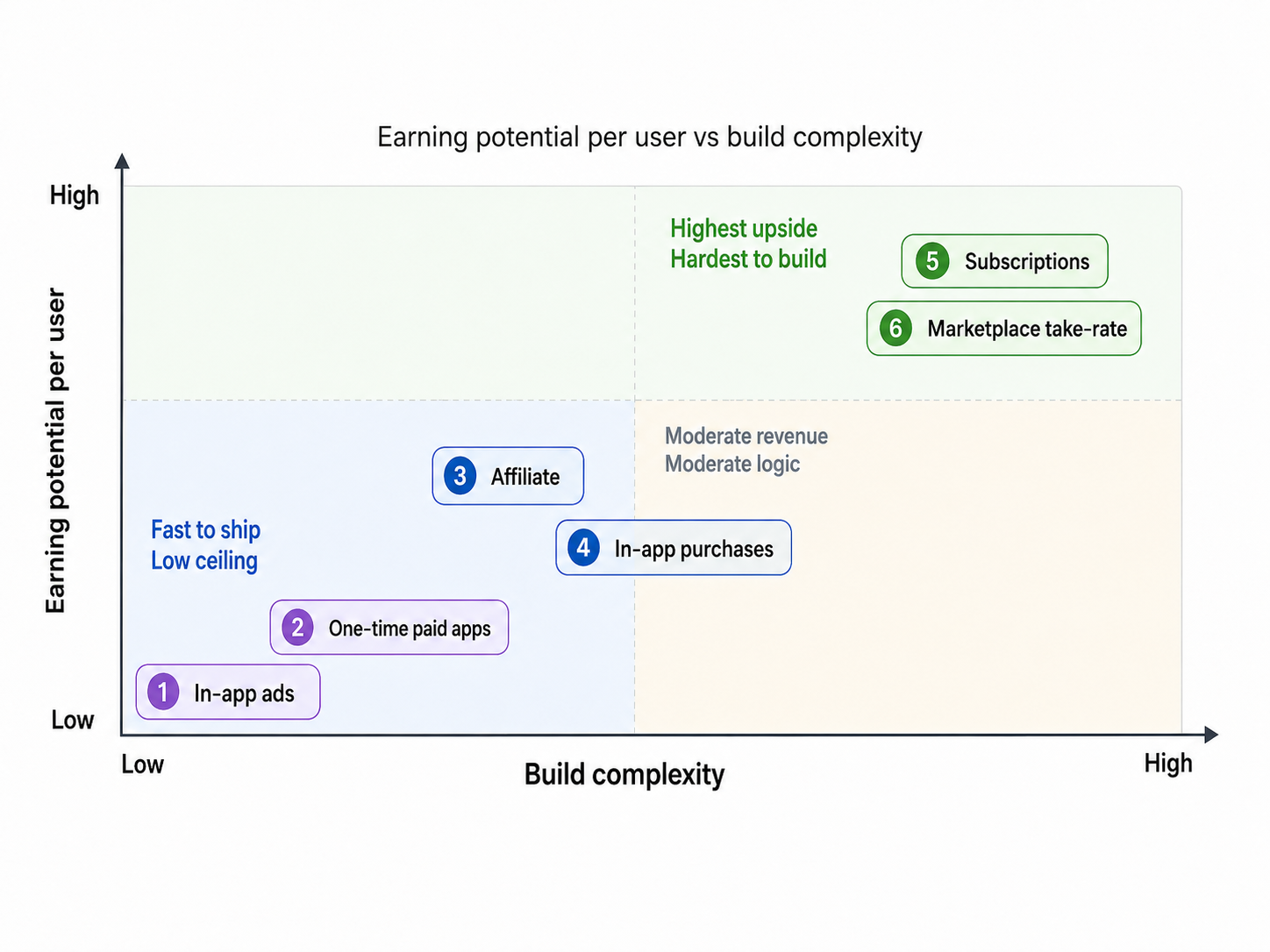
Here is the honest tradeoff by model, from a build perspective.
- Easiest to build, lowest paying: in-app ads and one-time paid apps. Fast to ship, low ceiling.
- Moderate on both: in-app purchases and affiliate models. Real revenue, real logic, well-trodden ground.
- Highest paying, hardest to build: subscriptions and marketplace take-rate. Payments, security, and reliability decide whether the app survives real users.
The hard part of the high-earning models is not the payment button. It is verifying who gets paid, handling refunds and chargebacks, preventing fraud, and reconciling balances without losing a cent.
That money-movement backend is what separates a subscription or marketplace app from a simple ad-supported one, and it is where most of the build cost goes. A monetized app can look finished and still be missing it, so before launch check payment handling, payout logic, fraud controls, refund and chargeback flows, and reconciliation.
How much does it cost to build a money-making app?
A simple money-making app with one earning mechanic typically starts in the low tens of thousands of dollars. A mid-complexity app with accounts, payments, and subscriptions runs higher, and a marketplace or payout-heavy app moves into six figures. The monetization model is the biggest cost driver.
The table below gives typical ranges by app type. Cost depends on complexity, platforms, and how much of the money-movement is custom.
| App type | What it includes | Typical build range | Rough timeline | Main cost drivers |
| Simple earning app | One mechanic, ads or basic in-app purchase | Low five figures | 6 to 10 weeks | Design, one platform, light backend |
| Mid-complexity app | Accounts, payments, subscriptions, 2 roles | Mid five figures | 3 to 5 months | Billing, auth, subscription logic |
| Marketplace or gig app | Two-sided, payouts, dispatch, multi-role | Six figures and up | 6 to 12+ months | Payments in and out, fraud, real-time features |
The number that surprises founders is not the design cost, it is the money-movement cost. Adding “users can get paid” turns a straightforward app into a system that handles payouts, tax data, holds, and disputes, and that one line can double a budget.
The number moves with complexity, the platforms you support, and how much custom payment work is involved. Native builds cost more per platform, while cross-platform apps cover iOS and Android from one codebase for less. Our app development cost guide breaks down the full range by platform and feature.
Should you build it yourself, use an AI app builder, or hire a team?
Use a no-code tool or AI app builder to validate the idea and build the front end, then move to custom software development before the app handles real payments, payouts, or user data. The more money the app moves, the sooner you need a team.
| Factor | Build it yourself (no-code) | AI app builder | Hire a development team |
| Best for | Testing a simple idea | Fast front end and idea validation | Apps that handle money, data, or multiple roles |
| Handles well | Basic screens and flows | Screens and basic data, quickly | Data model, payments, payouts, security, monitoring |
| Where it breaks | Anything beyond templates | Payments, auth, role-based access, payout logic | Higher upfront cost and time |
| Handling real money | Not really | Generated backend rarely holds up | Built and maintained properly |
| Time and cost | Lowest | Low, fast to a demo | Highest, weeks to months |
| Production ready | No | No, needs engineering review | Yes |
Build a money-making app that can handle real money
TechnBrains builds the payment, payout, and security layers that decide whether an app survives real users, so you skip the rebuild later.
Table of Contents
Frequently Asked Questions
A money-making app is a mobile app that lets you earn income through tasks like surveys, gig work, selling, cashback, or freelancing. Some pay in cash, others in gift cards or points.
Free apps earn through in-app purchases, subscriptions, ads, and commissions after the user is inside the app. Around 97% of apps are free to download (Statista, 2025), and most revenue comes from these models rather than the install.
Yes, the legitimate ones pay out through PayPal, direct deposit, or gift cards. Check recent reviews for payout confirmations and read the minimum cash-out threshold before you start.
Most legitimate ones are safe, but it depends on the app. Stick to apps that pay through PayPal, direct deposit, or known gift cards, and avoid any that request contacts, background location, or personal data unrelated to their function.
Gig apps pay closest to instant. DoorDash, Uber, Lyft, and Instacart all offer same-day or instant cash-out, usually for a small fee. Survey and cashback apps are slower because they make you reach a minimum threshold first.
Subscriptions and marketplace take-rate are the most profitable at scale. They are also the hardest to build because both depend on moving money reliably.
A simple earning app usually starts in the low tens of thousands. A subscription or marketplace app runs higher, into six figures, because of the payment and payout engineering.
Not fully. AI tools can build the front end and validate the idea, but once the app handles real payments, payouts, or user data, you need engineering to review and rebuild the parts that matter.
DoorDash, Uber, Upwork, Fiverr, and Rakuten are the top picks on iPhone, and they lead on Android too. Payout methods and features are close to identical across platforms.
Blocked by backlog or missing expertise?
Senior developers who build, fix, and ship — without slowing your team down.