


How to Choose iOS App Development Services for Startups in 2026

I’ve seen startups make one critical mistake again and again: they choose an iOS app development partner based on cost or brand appeal instead of long-term scalability. 

In the early stages, it feels logical to optimize for speed and budget. But once real users arrive, architectural shortcuts surface fast, and fixing them is rarely cheap.

Choosing iOS app development services for startups is not just a vendor decision. It’s a risk management decision. The right partner should understand product validation cycles, runway sensitivity, and how to architect an app that can scale beyond MVP without a painful rebuild.

The stakes are high. According to the U.S. Bureau of Labor Statistics, nearly 20% of startups fail within their first year, and almost 50% fail within five years, often due to poor execution and unsustainable operational decisions.

That’s why evaluating iOS development partners requires more than reviewing portfolios or comparing quotes. It requires assessing whether they can balance speed, cost control, and scalable engineering from day one.

This guide breaks down exactly how to do that, strategically, financially, and technically.

Executive Summary

  • Prioritize architectural discipline over low upfront cost; early structural decisions determine whether your app scales smoothly or requires an expensive rebuild.
  • Align development scope with your financial runway; phased MVP execution reduces burn-rate exposure and preserves flexibility.
  • Evaluate agencies based on live deployments, backend complexity, and scalability signals.
  • Ensure modular architecture, API versioning, CI/CD automation, and crash monitoring are implemented from day one.
  • Structure contracts carefully: secure source code ownership, repository access, App Store control, and clearly defined maintenance terms.
  • Choose a partner who understands Apple’s annual iOS update cycle and plans proactively for ecosystem changes and long-term optimization.


What Should Startups Prioritize When Choosing an iOS Development Partner?

Startups should prioritize MVP velocity, architectural scalability, and capital efficiency over agency size, awards, or branding.

When I advise founders, I start with execution risk. Early-stage companies fail because they run out of time or money before validating product-market fit. 

According to CB Insights, the top reason startups fail is running out of cash, cited in 38% of failed cases.

That’s why choosing an iOS development partner is fundamentally a runway decision.

I frame this using the Startup Risk Triangle: Speed, Cost, and Scalability.

If you optimize only for speed, you accumulate technical debt that becomes expensive once growth accelerates. If you optimize only for cost, quality and ownership clarity often suffer. If you over-engineer for scalability too early, you burn capital before validating demand.

A strong iOS development partner understands this balance. They build an MVP fast enough to test assumptions, but architect it modularly so scaling doesn’t require a rewrite at 50,000+ users. They align technical scope with financial runway.

For startups, discipline in early architecture is a survival strategy.

Step 1: Evaluate iOS Developer Portfolios 

You should evaluate iOS developer portfolios based on live deployments, backend complexity, scalability evidence, and retention signals.

When I review an agency’s portfolio, I don’t start with screenshots. I start with App Store links. A live app tells me far more than a Dribbble-ready interface ever could. If the product has survived real users, real updates, and real App Store reviews, it carries operational proof.

I use a simple Portfolio Scoring Framework built around four factors:

  1. Deployment Reality – Is the app live? How long has it been active? Has it survived multiple iOS version updates?
  2. Technical Complexity – Does it integrate APIs, payments, authentication systems, real-time features, or offline handling?
  3. Scalability Signals – Does the product appear built for growth? Modular navigation, layered architecture, performance stability.
  4. User Traction & Stability – Ratings, update frequency, and feature evolution over time.

A strong portfolio shows engineering maturity, not just design confidence.

What Metrics Matter in an iOS Portfolio?

I look for tangible deployment signals: active App Store listings, recurring updates, third-party integrations, secure payment handling, and push notification systems. If an app includes backend-heavy features like user accounts, subscription billing, or real-time data sync, it suggests the team understands production complexity — not just interface design.

Longevity also matters. An app that’s been maintained for two or three iOS cycles signals lifecycle awareness.

Red Flags in iOS Agency Portfolios

Overly polished mockups without live App Store links are a warning sign. So are generic case descriptions without technical depth. If I can’t verify deployment, complexity, or ownership structure, I assume the engineering depth may be shallow.

A real startup-ready iOS partner demonstrates proof in production.

Step 2: Check for Startup-Friendly iOS Development Pricing Models

Startup-friendly iOS development pricing models are milestone-based or phased MVP structures that control burn-rate exposure, rather than open-ended hourly billing.

When I work with early-stage founders, I look at pricing through one lens: runway protection. Most startups are operating with 12–18 months of runway, sometimes less. 

If your burn rate is $70,000 per month and your iOS build takes six months, that’s $420,000 of runway exposure before you even validate product-market fit. Pricing structure directly affects that risk.

Open-ended time-and-material contracts can work, but only if scope discipline is strong. In reality, early products evolve rapidly. Features expand. Assumptions shift. Without milestone guardrails, budgets drift.

That’s why I prefer phased MVP pricing. Phase 1 validates the core feature set. Phase 2 expands functionality based on real user feedback. This approach reduces upfront capital commitment and preserves flexibility.

Milestone-based contracts also create accountability checkpoints. Instead of paying for time, you’re paying for outcomes: authentication working, payment integration complete, push notifications stable.

The key is alignment between technical scope and financial exposure. Pricing should reflect validation stages.

Budget Benchmarks for Early-Stage iOS Apps

In most cases, an MVP-level iOS app takes 3 to 6 months, depending on feature density, integrations, and backend complexity. Simpler utility apps sit on the lower end. Marketplace, subscription, or API-heavy products trend higher.

If pricing doesn’t match that execution reality, I treat it as a signal to dig deeper.

iOS Development Pricing Model Comparison for Startups

Pricing Model How It Works Risk Level for Startups Runway Impact Best Fit Stage
Fixed Price Full scope defined upfront, cost locked Medium–High (scope rigidity risk) Predictable but inflexible Well-defined feature set
Time & Material Pay for hours worked High (scope creep risk) Variable, can drift Flexible scope but strong oversight
Milestone-Based Payments tied to deliverables Medium–Low Controlled exposure MVP validation phase
Phased MVP Model Core build first, expansion later Low Capital-efficient Pre-PMF startups
Dedicated Team Monthly team allocation Medium Ongoing commitment Scaling post-validation


Step 3: Ensure Their Scalable iOS App Development for New Ventures

Scalable iOS apps require modular architecture, API-first backend design, CI/CD automation, and proactive performance monitoring from day one.

When I think about scalability, I don’t think about millions of users on day one. I think about structural readiness. Can this app handle 10x growth without a rewrite? If the answer depends on “we’ll fix it later,” that’s a red flag.

For new ventures, scalability starts with modular architecture. Features should be isolated into clean layers, networking, business logic, UI, so changes in one area don’t destabilize the entire app. Without modularization, even small feature updates become risky.

Next is API-first backend design. Your iOS app should not contain business logic that belongs on the server. Proper API versioning prevents breaking changes when new features are introduced. I’ve seen startups stall simply because their backend wasn’t structured to evolve.

Then comes CI/CD automation. Manual builds and deployments slow iteration and increase human error. Automated testing, version control discipline, and continuous integration pipelines are growth enablers.

Finally, scalable apps require crash monitoring and performance tracking from launch. Tools for logging, monitoring, and alerting should be implemented before problems appear, not after user complaints spike.

Scalability isn’t about over-engineering. It’s about preventing predictable friction.

Architecture Questions Founders Should Ask

Before hiring an iOS development partner, I recommend asking:

  • Who owns the source code and repository access?
  • How is API versioning handled?
  • Is the app modularized or tightly coupled?
  • What is the CI/CD process?
  • How are crashes and performance issues monitored?

If these questions produce vague answers, scalability may not be a priority.

Unsure If Your iOS Architecture Will Scale?

If you’re evaluating partners or reviewing an existing build, a second technical perspective can uncover scalability risks before they become rebuild costs.


What Makes an Agile iOS Development Partner Truly Agile for Founders?

A truly agile iOS development partner delivers working product increments every 2–3 weeks with measurable progress.

I’ve worked with teams that claim to be agile because they run standups and use Jira. That’s not agility. Real agility shows up in shipped functionality. At the end of each sprint, there should be something testable: a login flow, a payment integration, a working dashboard — not just backend scaffolding hidden from view.

For founders, agility is about reducing decision latency. You should be able to test assumptions quickly, adjust scope based on feedback, and reprioritize features without derailing the entire roadmap. If a change request causes weeks of re-planning, the process isn’t truly agile.

I often think of this as a simple sprint maturity model:

  • Reactive Agile: Meetings happen, but releases slip.
  • Structured Agile: Sprint goals are defined, reviewed, and shipped consistently.
  • Validation-Driven Agile: Each sprint is tied to a user or business outcome.

The best iOS development partners operate at the third level. They don’t just build features — they build learning velocity.

In-House vs Outsourced iOS Development for Startups

Outsourcing iOS development reduces early hiring risk and accelerates time-to-market, while building an in-house team becomes more viable after product-market fit when iteration speed becomes strategically critical.

When I advise early-stage founders, I usually recommend outsourcing during the validation phase. Hiring a senior iOS engineer can take months, and competitive markets make recruitment expensive.

Filling a senior engineering role can take 60–90 days or more, not including onboarding time. For a startup with limited runway, that delay alone can materially affect momentum.

Outsourcing compresses that timeline. You gain immediate access to a team that has already shipped apps, understands Apple’s review process, and can start executing within weeks.

However, once product-market fit stabilizes and iteration becomes a competitive advantage, the equation shifts. At that stage, having core product engineers embedded in-house can improve long-term velocity and institutional knowledge.

I look at it this way:

  • Pre-PMF: Optimize for speed and flexibility → Outsourcing makes sense.
  • Post-PMF: Optimize for sustained innovation → In-house investment becomes strategic.

The right decision depends on stage, not ideology.

In-House vs Outsourced iOS Development Comparison

Factor Outsourced iOS Development In-House iOS Team
Time to Start Immediate or within weeks 2–4+ months hiring cycle
Upfront Cost Structure Project or milestone-based Salary + benefits + overhead
Hiring Risk Low High (mis-hire impact significant)
Speed During Validation High Moderate (depends on hiring success)
Long-Term Product Ownership Shared execution Full internal control
Best Fit Stage Pre-Product-Market Fit Post-Product-Market Fit
Knowledge Retention Externalized Institutionalized internally
Scalability of Team Flexible scaling Slower expansion


Post-Launch Planning: The Overlooked Factor in iOS Development

iOS apps require structured maintenance planning for annual iOS updates, SDK changes, security patches, and ongoing performance optimization.

I always tell founders that launch day is the starting point of a maintenance cycle. Apple releases major iOS updates every year, and with each release come SDK changes, deprecated APIs, UI adjustments, and potential compatibility issues. 

If your development partner hasn’t planned for that, your app will slowly degrade.

Post-launch planning should include scheduled compatibility testing for new iOS versions, regular dependency updates, crash monitoring reviews, and performance audits. In most cases, I recommend budgeting 15–20% of the original development cost annually for maintenance, updates, and incremental improvements.

Ignoring lifecycle management creates silent risk. Users update their devices automatically. If your app isn’t optimized for the latest iOS environment, crashes increase and ratings drop.

A mature iOS development partner designed for ecosystem evolution.

Final Founder Checklist Before Signing an iOS Development Contract

Before signing an iOS development contract, founders should validate source code ownership, deployment access, scalability planning, and post-launch maintenance terms.

I’ve seen too many startups discover critical gaps only after money has been spent. Contracts define operational control. If ownership and access aren’t clearly defined, your leverage disappears quickly.

Here’s the checklist I recommend reviewing before signing:

  • Source Code Ownership: Will you own the full codebase and IP upon payment?
  • Repository Access: Do you have admin access to Git repositories and version control?
  • App Store Ownership: Is the app published under your Apple Developer account?
  • Scalability Roadmap: Is there documented architectural planning for growth?
  • Maintenance Terms: What is included post-launch? What is billable?
  • Exit Clauses: Can you transition the project to another team if needed?

If an agency hesitates to provide clarity on these points, I treat it as a signal to slow down.

Strong partnerships are built on transparency.

Making a Final iOS Development Decision?

Before committing budget and runway, validate ownership structure, scalability planning, and sprint execution approach with a structured technical review.


Wrapping it Up

Choosing iOS app development services for a startup is about reducing execution risk while preserving runway. 

The right partner balances speed with architectural discipline, delivers measurable sprint progress, and plans for scale from the beginning.

Startups that approach this decision strategically, like evaluating portfolios beyond visuals, structuring pricing around milestones, and validating ownership and maintenance terms, dramatically reduce the likelihood of expensive rebuilds.

What to Look for in an iOS Developer Before Hiring Them

iOS developers are highly regarded in mobile app development due to their polished interfaces and seamless user experiences. To achieve this level of success, iOS developers prioritize simplicity and ease of use. iOS developers prioritize the needs of their target audience by presenting the most important information first in a logical and easy-to-read format. In November 2023, around 38,000 new mobile apps were released on the Apple App Store. As a result, the demand for skilled iOS developers has surged.

This surge in demand to hire iOS developers can be attributed to several factors, including the lucrative nature of iOS app development, the platform’s consistent user interface, and the promise of high-profit potential. iOS developers are valued for their ability to create apps that not only function flawlessly but also offer a visually appealing and intuitive user experience.

As the leading iPhone app development companies strive to stay competitive in the ever-evolving digital landscape, the need for skilled iOS developers has become more pronounced. Whether it’s crafting innovative solutions for businesses or developing consumer-facing apps that captivate audiences, the expertise of iOS developers is indispensable.

In this article, we’ll explore the essential skills that define a top-tier iOS developer. From proficiency in programming languages like Swift to a deep understanding of app design principles, we’ll explore the qualities that make iOS developers invaluable assets to any development team. So, let’s dive in and explore the key attributes that distinguish iOS developers in today’s competitive market.

Why hire iOS developers for your company?

Suppose you’re looking to create applications for mobile devices running on Apple’s iOS operating system. In that case, it’s important to hire an iOS developer who can help you achieve your company’s or client’s goals and requirements.

An iOS developer is responsible for developing, testing, and improving applications that are tailored to the specific needs of their company or customer. They have a strong understanding of iOS and how it interacts with different Apple devices, including the iPhone, iPad, Apple Watch, and Apple TV. By hiring an experienced iOS developer, you can ensure that your applications are optimized for the iOS platform and provide a seamless experience for your users.

Technical Skills To Look In An iOS Developer Before Hiring Them

Technical skills that an iOS developer for hire must have are

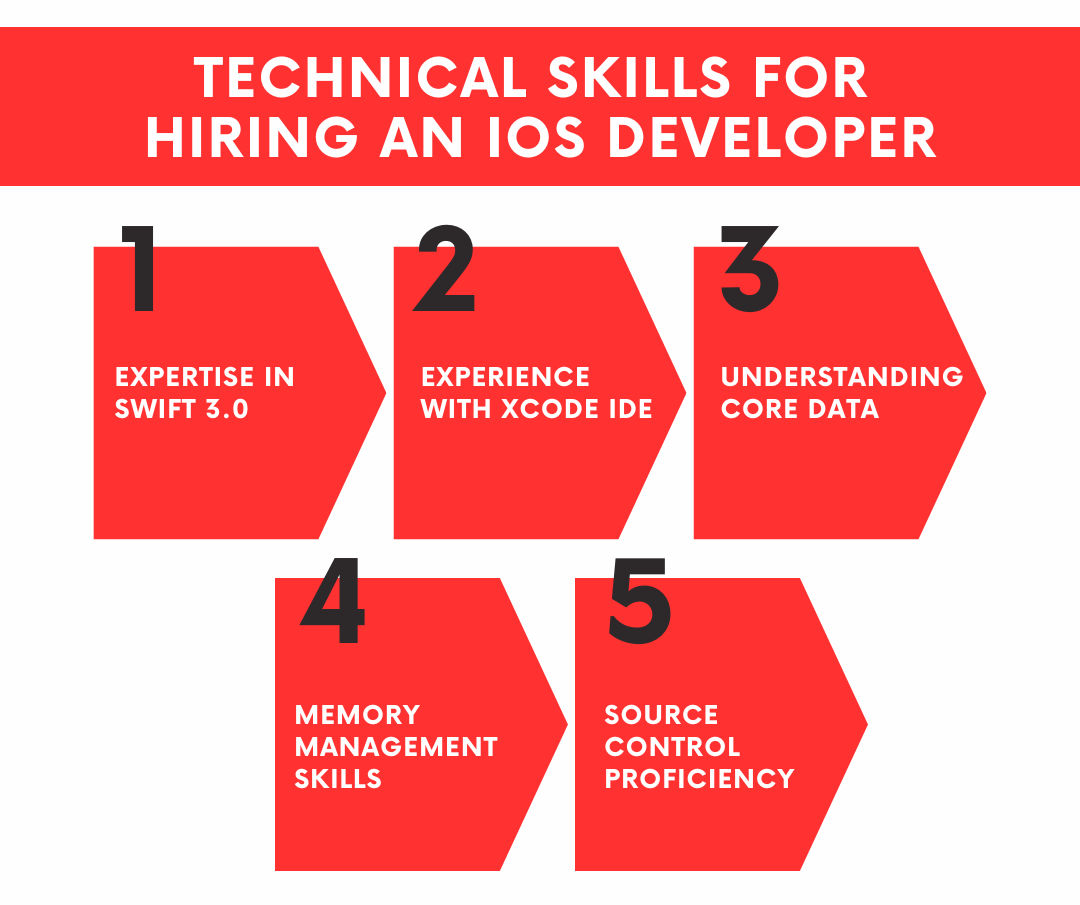
  1. Expertise in Swift 3.0
  2. Experience with Xcode IDE
  3. Understanding Core Data
  4. Memory Management Skills
  5. Source Control Proficiency
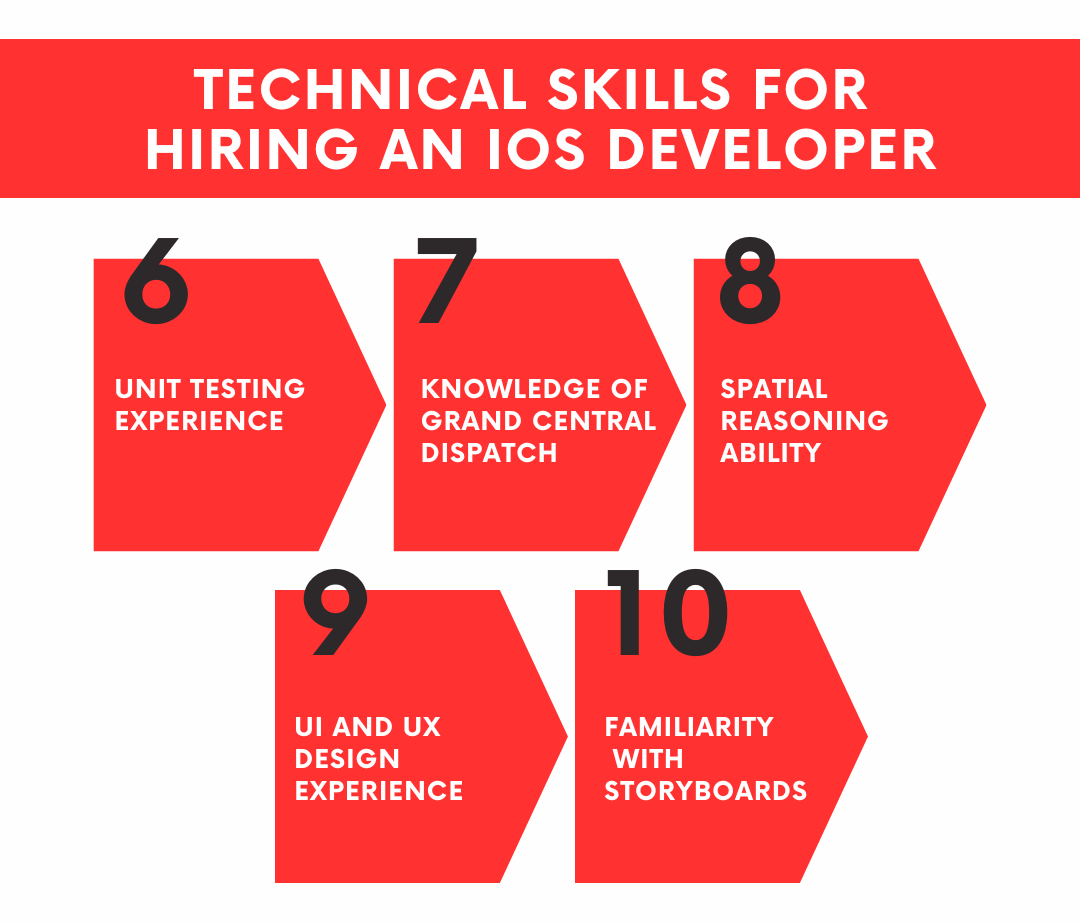
  6. Unit Testing Experience
  7. Knowledge of Grand Central Dispatch
  8. Spatial Reasoning Ability
  9. UI and UX Design Experience
  10. Familiarity with Storyboards

In iOS development, technical skills are important to guage the expertise and proficiency of an iOS Developer in using tools, programming languages, frameworks, and methodologies necessary to create iOS applications. Here’s a detailed explanation of each technical skill you need to look for when hiring iOS developers:

Technical Skills To Look In An iOS Developer Before Hiring Them

1. Expertise in Swift 3.0

Swift is one of the best languages for iOS App development as the main coding language utilized in developing iOS applications. Proficiency in Swift 3.0 involves understanding its syntax, features, and best practices for writing clean, efficient, and maintainable code. Developers should be familiar with Swift’s object-oriented programming concepts, data types, control flow structures, functions, classes, inheritance, protocols, and error-handling mechanisms.

Why Expertise in Swift 3.0 Matters?

This will help evaluate an iOS developer’s proficiency in Swift 3.0 for efficient iOS app development, given Swift’s widespread usage and effectiveness in creating high-quality applications.

2. Experience with Xcode IDE

Xcode is the official Integrated Development Environment (IDE) provided by Apple for iOS and macOS app development. Experience with Xcode involves familiarity with its various features, including code editor, interface builder, debugging tools, simulator, asset management, version control integration, and app deployment capabilities. Developers should know how to navigate and utilize Xcode effectively to develop, debug, and deploy iOS applications.

Why Look for an Experience with Xcode IDE?

Evaluating familiarity with Xcode IDE will enable you to understand the capability of an iOS developer to work with essential tools and resources for iOS app development, contributing to streamlined and effective development processes.

3. Understanding Core Data

Core Data is an Apple-provided framework used to handle model layer objects in iOS and macOS apps. It provides a high-level API for data storage, retrieval, and manipulation, along with support for object graph management, data persistence, and data modeling. Knowledge of Core Data includes understanding its concepts, such as managed object contexts, persistent stores, entities, attributes, relationships, fetch requests, and faulting behavior.

Worth of Understanding Core Data

Core Data comprehension is crucial when hiring an iOS developer to competently manage model layer objects in iOS and macOS apps, enabling efficient data handling and storage mechanisms.

4. Memory Management Skills

Memory management is crucial in iOS app development to ensure efficient utilization of device resources and prevent memory-related issues like crashes and performance degradation. Memory management skills involve understanding concepts such as Automatic Reference Counting (ARC), strong and weak references, retaining cycles, memory leaks, and optimizing memory usage to minimize the app’s memory footprint and improve performance.

Why Memory Management Skills are Important?

Proficiency in managing model layer objects in iOS and macOS applications through Core Data will help assess the skill set of iOS developers with efficient data handling and storage mechanisms.

5. Source Control Proficiency

Source control systems, such as Git, Subversion (SVN), or Mercurial, are essential for managing and tracking changes to source code files in collaborative software development projects. Source control proficiency includes knowledge of version control concepts, branching strategies, committing changes, resolving conflicts, merging code, creating pull requests, and collaborating with other developers using source control platforms like GitHub, Bitbucket, or GitLab.

The Importance of Source Control Proficiency

Evaluating proficiency in source control aids in understanding the ability of an iOS developer to manage collaborative development effectively. It also helps in tracking changes in the source code, ensuring version control and efficient collaboration within development teams.

Technical Skills To Look In An iOS Developer Before Hiring Them (continued)

6. Unit Testing Experience

Unit testing is a software testing technique used to validate the individual components or units of an application in isolation. Unit testing experience involves writing, executing, and maintaining automated test cases to verify the correctness and functionality of specific modules, classes, methods, or functions within an iOS app. Developers should be familiar with testing frameworks like XCTest or Quick/Nimble and techniques like test-driven development (TDD) to ensure code quality and reliability.

Unit testing experience evaluation

Assessing experience in unit testing assists in gauging the ioS developer’s capability to verify the functionality and stability of iOS applications, ensuring the reliability and robustness of the developed software.

7. Knowledge of Grand Central Dispatch

Grand Central Dispatch (GCD) is a technology provided by Apple for implementing concurrent and asynchronous programming in iOS and macOS applications. Knowledge of GCD includes understanding its concepts, such as dispatch queues, concurrent and serial execution, dispatch groups, barriers, semaphores, and asynchronous task scheduling. Developers should know how to use GCD effectively to improve app responsiveness, performance, and scalability by leveraging multicore processors and parallel execution.

Knowledge assessment of Grand Central Dispatch

Analyzing a developer’s knowledge of Grand Central Dispatch is crucial in determining their ability to implement concurrency and enhance app performance. This contributes to the efficient execution of tasks in iOS applications.

8. Spatial Reasoning Ability

Spatial reasoning ability refers to the capacity to understand and manipulate objects in three-dimensional space. In the context of iOS app development, spatial reasoning is essential for designing and laying out user interfaces (UIs), creating animations, and optimizing user interactions. Developers with strong spatial reasoning skills can design intuitive, visually appealing, and user-friendly interfaces that enhance the overall user experience of iOS applications.

Spatial reasoning ability assessment

Evaluating a developer’s spatial reasoning ability is essential in understanding their capacity to design user-friendly and intuitive interfaces for iOS applications. This ensures that the iOS developer for hire has enhanced usability and user experience.

9. UI and UX Design Experience

User Interface (UI) and User Experience (UX) design experience involves designing the visual appearance, layout, and interactive elements of iOS applications to optimize usability, accessibility, and user satisfaction. UI design focuses on aesthetics, typography, color schemes, icons, and graphics, while UX design focuses on user research, wireframing, prototyping, user flows, information architecture, and usability testing. Developers with UI and UX design experience can create engaging, intuitive, and immersive app interfaces that resonate with users and align with design principles and guidelines.

UI and UX design experience evaluation

UI and UX design skills helps in gauging their capability to create visually appealing and user-centric iOS app designs. This contributes to improved user engagement and satisfaction.

10. Familiarity with Storyboards

Storyboards are visual representations of an iOS app’s user interface, allowing developers to design and prototype UI screens, define navigation flows, and configure view controllers using a drag-and-drop interface. Familiarity with storyboards involves knowing how to create, customize, connect, and manage UI scenes, segues, and transitions within Xcode’s Interface Builder. When hiring iOS Developers you should understand the benefits and limitations of using storyboards for UI design and be able to integrate them seamlessly into the app development workflow.

Non-Technical Skills

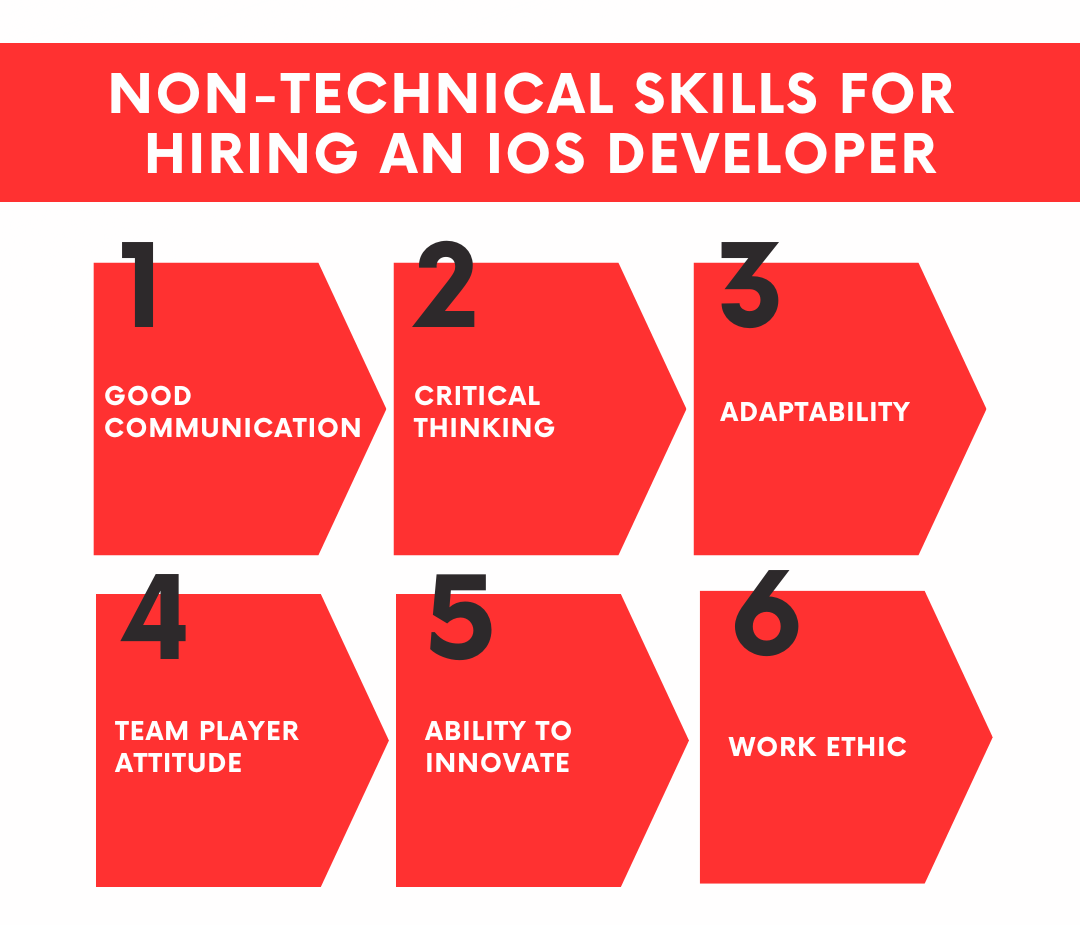
Non-technical skills are as important as technical expertise for iOS developers. These skills enhance collaboration and improve the overall quality and efficiency of iOS app development.

Non-Technical Skills fro hiring an ios developer

Good Communication

Effective communication is essential for collaborating with clients and team members and understanding project requirements.

Why look for it when hiring an iOS app developer: Clear and concise communication ensures that developers understand client expectations and project specifications accurately. It also facilitates effective collaboration within the development team, leading to smoother project execution and timely delivery.

Critical Thinking

The ability to think critically and solve problems efficiently is crucial for overcoming challenges in iOS development.

Why look for it when hiring an iOS app developer: Critical thinking enables developers to analyze complex problems, identify potential solutions, and make informed decisions during the development process. It allows them to troubleshoot issues, optimize code, and implement innovative solutions, ultimately enhancing the quality and functionality of the app.

Adaptability

iOS developers should be adaptable to changing technologies and trends, allowing them to stay relevant in a fast-paced industry.

Why look for it when hiring an iOS app developer: The technology landscape is constantly evolving, and iOS developers need to adapt to new tools, frameworks, and methodologies to remain competitive. Adaptable developers can quickly learn and master new skills, embrace emerging technologies, and pivot strategies when necessary, ensuring that their apps remain cutting-edge and market-ready.

Team Player Attitude

Collaboration and teamwork are essential for successful iOS development projects, making a team player attitude indispensable.

Why look for it when hiring an iOS app developer: iOS development projects typically involve multidisciplinary teams comprising developers, designers, testers, and project managers. A team player attitude fosters positive working relationships, promotes open communication, and encourages knowledge sharing among team members. It also enables developers to contribute effectively to group discussions, brainstorming sessions, and collective problem-solving efforts, resulting in cohesive and harmonious project outcomes.

Ability to Innovate

Innovation is key for creating unique and successful iOS apps that meet client needs and stand out in the market.

Why look for it when hiring an iOS app developer: In a crowded app market, innovation sets apps apart from the competition and drives user engagement and retention. Innovative iOS developers can conceptualize fresh ideas, explore creative solutions to user pain points, and integrate cutting-edge features and functionalities into their apps. They are proactive in exploring new technologies, experimenting with novel design approaches, and pushing the boundaries of app development, ultimately delivering compelling and differentiated user experiences.

Work Ethic

A strong work ethic, including punctuality, organization, and focus, is essential for producing high-quality work and meeting project deadlines.

Why look for it when hiring an iOS app developer: iOS development projects often have strict timelines and deliverables, requiring developers to demonstrate diligence, discipline, and commitment to their work. A strong work ethic ensures that developers manage their time effectively, prioritize tasks efficiently, and adhere to project schedules. It also reflects their professionalism, reliability, and dedication to delivering exceptional results, instilling confidence in clients and stakeholders, and fostering long-term partnerships.

Hourly rates for iOS developers for hire are based on experience.

When considering the cost of iOS app development in 2024, it’s essential to factor in various elements that contribute to the overall expense. One significant aspect is the iOS developer hourly rate, which typically ranges between $40 to $60. However, this rate can vary depending on the complexity and specific requirements of your project. Additionally, other factors such as design, features, testing, and post-launch maintenance also contribute to the total cost of developing an iOS app. Therefore, it’s crucial to conduct thorough research and collaborate closely with developers to get an accurate estimation tailored to your project’s needs.

Experience Level iOS Developers
Entry-level $40 – $60
Mid-level $50 – $100
Senior-Level $90 – $160

End Note

To create exceptional iOS apps for iPhone, it’s important to hire an iOS developer who can help you achieve your company’s or client’s goals and requirements. An iOS developer is responsible for developing, testing, and improving applications that are tailored to the specific needs of their company or customer.

They have a strong understanding of iOS and how it interacts with different Apple devices, including the iPhone, iPad, Apple Watch, and Apple TV. By hiring an experienced iOS developer, you can ensure that your applications are optimized for the iOS platform and provide a seamless experience for your users.

Best iOS Developers for Hire

At TechnBrains, we offer the best iOS developers for hire. Our team excels in Swift programming, Xcode IDE, Core Data, and memory management. We prioritize communication, critical thinking, adaptability, teamwork, innovation, and a strong work ethic in our developers. With us, you get skilled professionals dedicated to delivering top-notch results.