Build and Scale Faster
150+ products shipped for startups and enterprises by engineers focused on real outcomes.
"Their ability to quickly understand an unfamiliar use case and respond creatively to it is impressive."

Anonymous
Executive, Pured Disc Golf

"TechnBrains resolved challenges efficiently and turned my vision into a solid, functional product with a strong foundation."

Jalen Gibbs
Founder, STREAMLINE LIVE
"The talent they provided was solid, but more importantly, they were quick to align with our way of working."

Nancy Snyder
Managing Director, MimeCast
Our trusted clients


Start Your Product Journey Today
Turn your idea into a working product. Share a few details and we'll help define the roadmap, timeline, and execution approach.
Best 3PL Software in 2026: 7 Platforms Compared by Billing, Pricing and Real Operator Problems
The best 3PL software in 2026 is ShipHero for high-volume DTC fulfillment, Extensiv for per-client rate-card billing, Logiwa IO for large multi-client operations and CartonCloud for 3PLs that run warehousing and transport together. 3PLs whose billing, client ordering or reporting sit outside what these platforms support are better served by custom 3PL software.


Updated Nov 20, 2026
90% of shippers rate IT capabilities as critical when choosing a 3PL, yet only 57% are satisfied with what their providers deliver, according to the 2026 Annual Third-Party Logistics Study. For a fulfillment provider, much of that gap is decided by its warehouse software, and peak season is when billing gaps, sync failures and slow support show up first.
This guide compares seven platforms on billing, pricing, extensibility, and the problems operators report, drawing on TechnBrains’ experience in logistics software development for a US fulfillment provider.
Alongside the platform comparison, we ran a separate study. The TechnBrains 3PL Software Field Study checked each vendor’s pricing pages and developer documentation and traced 76 problems operators reported to their root causes. Billing was the most reported problem area, and 49 of the 76 problems traced to what the vendor built or how it charges.
Best 3PL Software in 2026: Key Takeaways
The best 3PL software depends on how a 3PL bills and who its clients are. These are our picks by category, based on TechnBrains’ review of seven platforms’ pricing, developer documentation and 76 operator problems.
- Best for ecommerce 3PLs: ShipHero, which never meters clients, users or warehouses, from $15,000 a year.
- Best for multi-client billing: Extensiv 3PL Warehouse Manager, with the deepest per-client rate cards, though storage billing still runs through its older Billing Wizard and Descartes now owns it.
- Best 3PL WMS for high client counts: Logiwa IO, metered on order lines rather than users. One 3PL runs about 85 clients on it.
- Best for warehousing plus transport: CartonCloud, with storage, handling and delivery on one invoice and a client portal on every tier, from $499 a month.
- Best 3PL software for small business: Packiyo, the only vendor here that publishes full pricing and overage rates, at $949 a month on month-to-month terms.
- Best for cold, hazmat and specialized storage: Camelot Excalibur WMS.
- Best for complex, scaling operations: Deposco, for 3PLs with an implementation budget.
- Best for non-standard billing, client ordering or reporting: custom 3PL software, built around how you serve clients rather than how a vendor meters them.
- What the field study found: a charge can be lost at six points between the floor and the invoice, and 49 of 76 operator problems traced to vendor features or pricing terms.

From our discovery calls: Most 3PLs we speak with already run one of the platforms above, and the platform itself is rarely what they want to fix. What costs them is the work between systems: invoices re-keyed from the WMS into accounting, client records kept separately in the CRM, and monthly reports stitched together by hand. When these teams scope a build with us, they ask for one connected system where warehouse, billing, accounting and client data stay in sync, with integrations kept only for the tools they want to keep. That also takes several overlapping subscriptions off their annual bill.
The Best 3PL Software on Your List Can Still Leave You With Spreadsheets
Your top pick might handle fulfillment well and still leave your team rebuilding invoices or client reports by hand. Bring us one workflow the shortlist doesn’t cover. We’ll help you scope a custom build that works with the platform you choose.
Scope My Custom 3PL WorkflowWhat Is 3PL Software?
3PL software is a warehouse management system built for fulfillment providers that store and ship inventory for many client businesses at once. It adds four things a standard WMS lacks:
- Multi-client inventory: each client’s stock, orders, and data kept separate in one warehouse
- Client billing: rate cards that turn storage, receiving, picking, value-added work and shipping into per-client invoices
- Client portals: self-service access for clients to check stock, place orders and pull reports
- Channel connections: links to each client’s stores, marketplaces and EDI partners
A standard WMS assumes one company owns everything on the shelves, which is the case our review of warehouse inventory software covers. 3PL software is also different from a 3PL provider such as ShipBob, which is the company a brand hires rather than the system it runs on.
What Is the Best 3PL Software in 2026?
For most multi-client warehouses, the best 3PL software is ShipHero for DTC volume, Extensiv for rate-card billing, Logiwa IO for large client counts and CartonCloud for combined warehousing and transport. When billing, client ordering or reporting sit outside what these platforms support, custom 3PL software is the better fit.
| Platform | Best for | Starting price | Sentiment | Evidence confidence |
| ShipHero WMS | High-volume DTC fulfillment | From $15,000 a year | Positive with recurring concerns | High |
| Extensiv 3PL Warehouse Manager | Per-client rate-card billing | Quote only | Mixed | High |
| Logiwa IO | Large multi-client DTC operations | Quote only | Mixed | Medium |
| CartonCloud | Warehousing plus transport | From $499 a month | Generally positive | Medium |
| Deposco | Complex, scaling operations | Quote only | Limited evidence | Limited |
| Camelot Excalibur WMS | Cold, hazmat and specialized storage | Quote only, modular | Limited evidence | Limited |
| Packiyo | Small and mid-size DTC 3PLs | $949 a month (3PL Go) | Limited evidence | Medium |
| Custom 3PL software | Non-standard billing, ordering or reporting | Scoped per build | Not rated | Not rated |
How we picked: we compared platforms built for multi-client warehouses on billing, onboarding, floor accuracy, extensibility, cost and support, using vendor documentation, pricing pages, directory ratings and operator accounts, without hands-on trials. Fulfillment services and transport management platforms were out of scope.
How Do the 7 Platforms Compare on What 3PLs Care About?
The platforms differ most on how adding a client affects the price, how billing is built and how open each one is to extensions.
| Platform | How clients affect price | Billing model | Client portal | Extension access | Implementation | Support signal |
| ShipHero | Never metered | Per-client fee profiles; documented sync gaps | White-label (vendor-stated) | Open API with billing endpoints | About 2 months (G2) | Split |
| Extensiv | Per-client fees reported | Billing Manager plus Billing Wizard | Vendor-stated | Open API, webhooks, billing details | 1 to 3 months (G2) | Mixed |
| Logiwa IO | Order lines; unlimited users | Per-client billing | Vendor-stated | Open API, webhooks | Overruns reported | Contested |
| CartonCloud | No per-client escalation | Rate cards from operational activity | Every tier | Open API, webhooks | Not reported | Strong on review sites |
| Deposco | Scope and services | Billing events in operations | Reported | Vendor-issued credentials | Services-heavy | Limited evidence |
| Camelot Excalibur | Modules | Storage, labor and material billing | WebLink View | Partner connectors only | Training-heavy | Limited evidence |
| Packiyo | Users and shipments | Rate cards set up with vendor staff | Branded dashboards | Open API | 1 to 3 weeks (vendor) | Mixed |
Every platform in this table reaches accounting and CRM through a connector or an export, so each invoice and client record crosses at least one system boundary. 3PL teams tell us in discovery calls that this hand-off is where the manual work piles up, and it is the first thing they ask a custom build to remove.
One Platform Gets Billing Right. Another Has the Portal You Want.
Show us what you’d keep from each. We’ll help you pick a platform for your core operations and scope the custom billing, ordering, or reporting workflows your clients need.
Find My Build-and-Buy FitWhich 3PL Software Platform Fits Your Operation?
Each platform works well under specific conditions and strains under others; the profiles below give our take as a team that builds 3PL software, and where you would build around each one.
-
ShipHero WMS: Best for High-Volume DTC Fulfillment
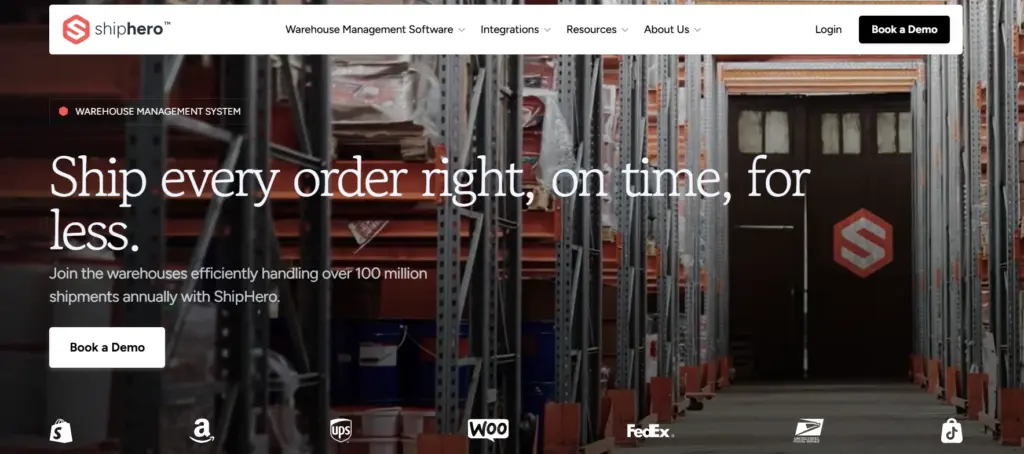
Pricing: Published. Plans start at $15,000 a year, priced on shipment volume, store connections and add-ons; users, SKUs, warehouses and 3PL clients are never metered.
Reviews: G2 4.5 from 234 reviews. Dated Trustpilot reviews praise named agents, while 2025 reviewers describe slow responses on critical tickets.
Our take: We rate ShipHero highest for growth economics. Its price ignores client count, and its API exposes billing data, which most vendors here do not.
Often misreported: it is labelled a tool for small 3PLs with 3 to 10 warehouses, a claim traced to a commercial comparison video. Integrates with Shopify, QuickBooks Online and Loop.
What we like:
- Adding clients, users or warehouses never changes the price.
- Ad hoc charges and work-order fees are available through the API since April 2026, so charge capture can be built on top.
- DTC picking is where operators report the most satisfaction.
What we don’t like:
- Ad hoc charges stop syncing once a work order closes, and flat-rate fees appear only in the CSV export.
- B2B workflows trail its DTC flows.
- Operators report carrier rate quotes that do not match carrier invoices.
Where you’d build around it: B2B pallet flows and line-level invoice backup for clients who dispute charges.
Best fit: DTC-heavy 3PLs adding many clients.
Poor fit: B2B pallet operations.
-
Extensiv 3PL Warehouse Manager: Best for Per-Client Rate-Card Billing

Pricing: Not published. Implementation, modules such as SmartScan and each extra EDI source are priced separately, and a G2 reviewer reported per-client fees after five clients.
Reviews: G2 4.0 from about 40 reviews; go-live most commonly in 1 to 3 months.
Our take: Extensiv has the rate-card depth billing-led 3PLs need. Its pricing grows with every client and connection, and its new owner adds roadmap uncertainty.
Often misreported: it runs two billing tools, with storage configuration still in the older Billing Wizard, and Descartes acquired it on September 1, 2026. Integrates with Shopify, Amazon, Walmart and EDI partners.
What we like:
- Per-client rate cards detailed enough for complex contracts.
- It is multi-client by design.
- Its documented API and webhooks carry billing details on orders and receipts.
What we don’t like:
- Implementation, SmartScan and each extra EDI source are priced separately, and one reviewer reported per-client fees after five clients.
- Storage billing still sits in the older Billing Wizard.
- Ownership change: Descartes is folding Extensiv into its Global Logistics Network. No discontinuation has been announced, but roadmap, pricing and support commitments after renewal are not public.
Where you’d build around it: Bulk B2B freight carrier options.
Best fit: billing-led 3PLs with complex contracts.
Poor fit: buyers who need a price before a sales process.
-
Logiwa IO: Best for Large Multi-Client DTC Operations

Pricing: Not published; metered on order lines, with unlimited users.
Reviews: Software Advice 4.4 from 95 reviews.
Our take: Logiwa handles high client counts without per-seat charges. Its order-line metering means your bill rises as your clients succeed.
Often misreported: support quality is contested, scored highly by directory reviewers and called poor in forum posts, so ask for a reference who escalated a critical issue recently. Invoices export to QuickBooks and NetSuite, and orders connect from Shopify.
What we like:
- Unlimited users, with no per-seat charges.
- Per-client billing inside the platform, with invoices exported to QuickBooks and NetSuite.
- One 3PL owner reported 18 months on Logiwa running about 85 clients and 1,000 orders a day.
What we don’t like:
- Order-line pricing climbs with volume.
- One operator went live in 8 weeks against a promised 4.
- It is less flexible for clients with unusual workflows.
Where you’d build around it: Client-specific ordering rules its configuration cannot express.
Best fit: DTC 3PLs with many clients and users.
Poor fit: highly customized workflows without a services budget.
-
CartonCloud: Best for Warehousing Plus Transport

Pricing: Published entry point. Plans start from $499 a month, set by package tier plus usage, with no per-user or per-client escalation.
Reviews: Software Advice 4.8 from 87 reviews.
Our take: CartonCloud has the simplest billing here and is the only platform that covers transport in the same system. That suits 3PLs with their own fleet more than integration-heavy ecommerce operations.
Often misreported: its price; directories list $396, $430 and $599, none matching the vendor’s figure. Integrates with Xero, QuickBooks, MYOB and Shopify.
What we like:
- Storage, handling and delivery charges land on one invoice.
- A client portal comes on every tier.
- It publishes an entry price with no per-client escalation.
What we don’t like:
- Integrations are described as less direct.
- We could not confirm billing data in its API.
- Forum evidence is thin, and pricing leaves a gap for mid-size 3PLs.
Where you’d build around it: Ecommerce channel connections beyond its native list.
Best fit: regional 3PLs with their own fleet.
Poor fit: integration-heavy ecommerce 3PLs on tight budgets.
-
Deposco: Best for Complex, Scaling Operations

Pricing: Not published. One WMS consultant estimated first-year cost above $180,000 for first-time WMS buyers.
Reviews: No verified review sample retrieved.
Our take: Deposco is built for multi-node operations, but routine changes run through paid statements of work, so the vendor controls the pace and cost of every adjustment. In a vendor-reported case, Nimbl Fulfillment shortened its billing cycle by four days.
Often misreported: the “150+ integrations” figure in AI summaries, which we could not source.
What we like:
- WMS and order management in one system.
- It is designed for multi-node operations.
- It has a vendor-reported billing-cycle gain at Nimbl Fulfillment.
What we don’t like:
- One WMS consultant estimates first-year cost above $180,000 for first-time buyers.
- Routine changes run through paid statements of work.
- Credentials are issued per merchant, we found no public billing endpoints, and independent reviews are few.
Where you’d build around it: Any change you expect to make more than once a year.
Best fit: scaling 3PLs with an implementation budget.
Poor fit: teams expecting self-service changes.
-
Camelot Excalibur WMS: Best for Specialized Storage

Pricing: Not published; modular.
Reviews: Software Advice 4.3 from 31 reviews, a small sample.
Our take: Excalibur is the most specialized platform here and also the most closed.
Often misreported: its platform; older listings say Dynamics NAV, while Camelot’s current Microsoft listing pairs it with Dynamics 365 Business Central. EDI runs through SPS Commerce, with UPS and FedEx shipping connections.
What we like:
- It is built only for 3PLs.
- It has configurations for dry, cold, hazmat and bulk storage.
- Modules can be bought separately.
What we don’t like:
- There is no public API reference, and integrations run through partner connectors such as Pipe17.
- Operators report a steep learning curve.
- Training is video-led.
Where you’d build around it: Client portals, reporting and integrations the partner connectors do not cover.
Best fit: regulated or specialized storage.
Poor fit: teams needing fast, self-taught onboarding.
-
Packiyo: Best for Small and Mid-Size DTC 3PLs

Pricing: Published. 3PL Go is $949 a month with 5 users and 5,000 shipments; 3PL Pro is $1,799. Extra users cost $95 a month, extra shipments 6 cents each, onboarding is free and terms are month-to-month by default.
Reviews: No reliable rating sample; several dated Trustpilot reviews from one window were treated as possibly promotional.
Our take: Packiyo is the easiest platform here to price and the easiest to leave, which matters for small 3PLs. It stops at parcel DTC work.
Often misreported: its price; directories list $849, $850 and $1,200. Connections include QuickBooks and an open API.
What we like:
- Full published pricing, including overages.
- Month-to-month terms.
- Free onboarding and unlimited store connections.
What we don’t like:
- Two operators report no pallet handling.
- Its customer success team assigns rate cards, which adds a vendor step for every new client.
- Support was email-only during one outage.
Where you’d build around it: Pallet, B2B or LTL work, and self-service rate-card changes.
Best fit: DTC 3PLs shipping 100+ orders a day.
Poor fit: pallet, B2B or LTL work.
What Causes the Problems 3PLs Blame on Their Software?
TechnBrains’ 3PL Software Field Study found that 49 of 76 problems 3PL operators blamed on their software traced to what the vendor built or how it charges, while 26 came from implementation, support, setup or client data. The study traced first-hand accounts from 2024 to 2026 forums and review sites to their root cause.
| Root cause | Problems | Where it shows up |
| Missing or limited feature | 33 | Billing edge cases, B2B and EDI, client portals, reporting |
| Pricing and contract terms | 16 | Quotes only after demos, per-client and per-connection fees |
| Implementation | 9 | Go-live overruns, thin training, paid changes |
| Support | 7 | Slow escalations, fixes pending for months |
| Process, integration, setup and client data | 10 | Unrecorded work, broken store connections, missing SKUs |
| Unclear | 1 | One account gave too little detail to trace a cause |
The counts show where problems cluster rather than how often they occur. Switching platforms moves the 49 feature and pricing problems to a new vendor, and the setup and data problems follow the 3PL to any system.
The 10 process, integration, setup and data problems match what we hear in discovery calls. The platforms do their job, but data stalls or breaks as it moves between the WMS, store connections, accounting and the CRM. A single system that owns that data end to end removes the hand-offs where these problems start.
What Breaks When a 3PL Adds Clients and Volume?
Client catalogs, rate card setup and scan rules break first when a 3PL grows, and peak season exposes all three at once.
- Client catalogs: Extensiv’s Shopify connector skips products without a SKU, so a messy catalog becomes the 3PL’s oversell problem. A clean SKU list belongs in the client contract.
- Rate cards: Packiyo’s billing documentation says rate cards are assigned by its customer success team, which adds a vendor step to each new account.
- Connections: Extensiv charges per extra EDI source, while Packiyo includes unlimited store connections.
- Scan rules: ShipHero operators reported shrinkage when pickers scanned the SKU but not the bin. Its new mobile flow offers location scanning as a setting, so the fix is configuration and labelled bins rather than a new platform.
These settings are worth fixing before any investment in warehouse automation, since robots and conveyors amplify whatever the WMS records.
Where Does 3PL Billing Break, and How Do You Test It?
According to the TechnBrains 3PL Software Field Study, a 3PL charge can be lost at six points between the warehouse floor and the client invoice, and ShipHero’s and Extensiv’s own help centers document four of them.
| Leak point | What goes wrong | Evidence |
| 1. Work is done | Done off-system, so nothing exists to price | Operators describe relabelling and repacking that never reached invoices |
| 2. Rate applies | Rate not activated for that client | Extensiv requires charge generation to be activated per customer |
| 3. Charge is recorded | Edited after the job closes | ShipHero: ad hoc charges stop syncing once a work order closes |
| 4. Charge reaches billing | Event feed changed | Extensiv: edited webhook configurations stopped charges appearing |
| 5. Invoice is reviewed | Fee hidden from the main view | ShipHero: flat-rate fees appear only in the CSV export |
| 6. Client queries it | No line-level backup | An operator called ShipHero weak on invoice backup |
Leak point 4 happens where one system hands data to another. In a connected build, the warehouse event, the charge and the invoice line live in the same system, so there is no event feed between them to break.
Leak point 1 is the expensive one, because no billing engine can price work it never saw. Script a bad month for every demo and judge the invoice:
| Scripted event | A passing system shows |
| 400-unit relabel and 50 kit builds | Each as a priced line traceable to the task |
| Storage changing mid-month, with a minimum | Prorated storage and the minimum applied once |
| One charge reversed after a dispute | A credit line and an audit trail |
| A unit-of-measure change mid-month | Correct pricing before and after |
How Open Is Each 3PL Platform to Extensions?
TechnBrains’ review of seven vendors’ developer documentation found that only ShipHero and Extensiv document client billing data in their own API references, while Deposco and Camelot Excalibur route API access through the vendor or its partners. Logiwa IO and CartonCloud offer open APIs with webhooks.
| Platform | Billing data via API | Event notifications | Access |
| ShipHero | Ad hoc charges and work-order fees (added April 2026) | Webhooks, per client account | Developer accounts |
| Extensiv | Billing details on orders and receipts | Webhooks, seven event types | Account credentials |
| Logiwa IO | Billing reports (third-party listings) | Order, receipt and tracking webhooks | Account credentials |
| CartonCloud | Not confirmed | Webhooks | OAuth2, public Postman collection |
| Deposco | Not found | Not found | Credentials issued per merchant |
| Camelot Excalibur | Not found | Not found | Partner connectors such as Pipe17 |
| Packiyo | Not confirmed | Not confirmed | Open API (vendor-stated) |
Engineer’s read, by Syed Faisal, Logistics Tech Lead:
- ShipHero: “A capture app can post a relabel charge straight onto the client’s next bill. The setup cost is webhooks, which register per client account.”
- Extensiv: “Billing Manager reads warehouse events through webhooks, so treat that setup as billing infrastructure and restrict who can change it.”
- Deposco and Camelot Excalibur: “Access runs through the vendor or its partners, so build that lead time into any integration plan.”
Charge-capture apps, client portals and reconciliation layers built on these APIs are the kind of extension TechnBrains scopes through custom software development.
What Does Custom 3PL Software Look Like in Practice?
Custom 3PL software is built around how a specific 3PL and its clients work, including the clients packaged platforms do not fit. TechnBrains built this for a US fulfillment provider that manages branded merchandise for corporate clients.
The provider’s largest client did not order like an ecommerce brand. Its departments drew stock from a shared inventory, each with its own allocation, and field teams recorded their work at each location in GoSpotCheck, a field execution app. TechnBrains built the provider two connected systems:
- Inventory management: the provider’s team tracks stock by warehouse, adjustments and transfers; client admins see every department’s allocation, department users see only their own, and authorized users publish stock and spend reports.
- Field performance reporting: GoSpotCheck mission data syncs on a schedule into mobile-ready dashboards, drill-downs and PDF reports.
| What the client needed | How the platform handles it |
| Each department sees only the stock it can use | Department allocations with role-based visibility |
| Proof of what field teams did with delivered merchandise | GoSpotCheck data in dashboards and PDF reports |
| Spend tracked by department | Reports published to selected departments |
The order rules behind department allocations, including partial shipments and order holds, shaped how stock was reserved for each department.
Engineer’s read, by Syed Faisal: “Most of the engineering went into deciding which system owns each fact. The reporting only holds up when every number comes from its owner.”
When Should a 3PL Choose Custom 3PL Software?
A 3PL should choose custom 3PL software when its billing rules, client ordering or reporting do not fit packaged platforms, or when per-client, per-connection and change-order fees grow faster than its client base. In our Field Study, 49 of 76 problems operators reported traced to what the vendor built or how it charges: 33 missing or limited features and 16 pricing and contract terms. Switching platforms moves those problems to a new vendor. Owning the software puts them under the 3PL’s control.
Three signals show a 3PL has outgrown packaged software:
- Growth is metered: Extensiv reports per-client fees after five clients and charges per extra EDI source, Logiwa IO meters order lines, and Packiyo charges $95 per extra user and 6 cents per extra shipment.
- Change goes through the vendor: Deposco runs routine changes through paid statements of work, and Packiyo’s customer success team assigns rate cards.
- Access is gated: Camelot Excalibur has no public API reference, and Deposco issues credentials per merchant, so integrations wait on the vendor or its partners.
Price a build against three years of the packaged option, including implementation and paid changes. At published prices, three years of subscription alone is at least $45,000 on ShipHero and $64,764 on Packiyo 3PL Pro before overages, and one WMS consultant puts Deposco’s first year above $180,000.
From a client engagement: One 3PL managed shipment updates, invoices, and claims across separate records. We built a custom platform that linked those workflows to a single shipment record and pulled data from the 3PL’s existing transportation management system. Customers could check shipment status and invoices directly, and the project recorded a 20–30% reduction in manual data handling.
The homegrown failure operators described came from ownership, not from building custom. One founder’s in-house team fell constantly behind on client requests and bug fixes. A build holds up when the team that designed it stays to support it. TechnBrains builds in the 3PL’s own cloud account and code repositories from day one, and the technical lead stays through delivery, with 24/7 post-launch support.
Not every 3PL needs a full system. Narrow builds also lasted, including supplier portals for inbound notices, PDF-to-order parsers, reporting systems and an Amazon inbound integration written after native support ended.
Why Do 3PLs Switch Software, and Where Do They Go?
In the TechnBrains 3PL Software Field Study, 9 of 13 3PL software switches were driven by fit and only 2 by price. Most operators left because the system stopped matching how their clients ordered or how they billed.
| Moved from | Moved to | Trigger |
| ShipHero | Cybership | Price and fit; returns still handled outside the WMS |
| Extensiv | ShipHero (attempted) | Carrier flexibility for bulk B2B freight; the move disrupted distribution |
| SkuVault | Logiwa IO | Outgrown |
| Homegrown WMS | ShipHero | Development could not keep pace |
| ShipStation | ShipHero | No inventory control or 3PL billing |
| Packiyo | Still evaluating | Scaling limits and outage support |
Switching does not fix gaps outside the WMS, such as returns or client-specific ordering. With Descartes now owning Extensiv, renewal is also the moment to get price locks and support terms in writing.
The 3PLs that come to us after a platform switch describe the same pattern. A second or third WMS did not fix the manual work around returns, accounting and client reporting, because that work sits between systems rather than inside any one of them. A custom build brings those operations into one system and keeps integrations for the tools worth keeping.
How Much Does 3PL Software Cost?
TechnBrains’ check of vendor pricing pages found that only three of seven 3PL platforms publish a price (ShipHero from $15,000 a year, CartonCloud from $499 a month and Packiyo from $949 a month), and only Packiyo publishes its overage rates.
| Platform | Published price | Metered on | Contract |
| ShipHero | From $15,000 a year | Shipments, store connections, add-ons | 12 months |
| Packiyo | $949 to $1,799 a month; overages published | Users and shipments | Month-to-month |
| CartonCloud | From $499 a month | Package tier plus usage | Usage-based |
| Extensiv | No | Clients (reported), EDI sources, modules | Quote |
| Logiwa IO | No | Order lines | Quote |
| Deposco | No | Scope and services | Quote |
| Camelot Excalibur | No | Modules | Quote |
Directory prices are not a safe shortcut: third-party listings gave three different starting prices each for CartonCloud and Packiyo, none matching the vendor. Implementation is the other surprise, with one small operator finding Extensiv implementation figures of $5,000 to $20,000 reported online. Ask for a written three-year cost covering subscription, implementation, connectors and paid changes.
Add every subscription that sits beside the WMS to that total, including accounting connectors, CRM seats, extra EDI sources and reporting tools. Clients who scope a build with us compare it against that full stack, and consolidating the stack into one system is where their annual subscription savings come from.
What Are You Paying to Work Around Your WMS?
Add up the extra seats, connectors, paid changes, and hours spent fixing invoices or rebuilding reports. We’ll help you compare three years of those costs with the cost of building and supporting the workflows you need.
Compare My 3-Year CostsAbout the TechnBrains 3PL Software Field Study
The TechnBrains 3PL Software Field Study combines a review of seven vendors’ pricing pages, a review of their developer documentation and help centers, and a root-cause analysis of 2024 to 2026 operator accounts. Promotional and vendor-affiliated posts were flagged, two possibly promotional switching accounts were excluded, and findings describe the platforms and accounts reviewed rather than the whole market.
Field Study findings:
- Charges for 3PL work can be lost at six points between the warehouse floor and the invoice, and vendor help centers document four of them.
- Only ShipHero and Extensiv document client billing data in their own API references.
- Three of seven 3PL platforms publish a price on their own website, and only Packiyo publishes overage rates.
- 49 of 76 problems 3PL operators blamed on their software traced to causes other than a missing feature.
- Of 13 3PL software switches operators described, 9 were driven by fit and 2 by price.
Best 3PL Software in 2026: Our Verdict
Choose ShipHero for DTC fulfillment across many small clients, Extensiv when detailed per-client contracts drive your billing, Logiwa IO for high client counts, CartonCloud if you also run trucks, and Packiyo for a predictable price with no long contract. Choose custom 3PL software when your billing rules, client ordering or reporting are what set you apart, because those are the parts packaged platforms meter, charge to change or keep closed. Before signing either way, script a bad billing month, get a written three-year cost, and check whether the problem sits in the software, the contract or the setup.
In our discovery calls, the 3PLs that choose to build share one goal: a single system where warehouse, billing, accounting and client data move together, with no re-keying and no records lost between tools. If that describes the friction in your operation, a free discovery meeting with our logistics software team will map what to build into one system and which integrations to keep.
Table of Contents
Frequently Asked Questions
Packiyo is the most transparent option for small 3PLs, with a published $949 monthly plan, free onboarding and month-to-month terms. None of the seven platforms offers a free multi-client plan.
ShipHero suits DTC-heavy 3PLs adding many small clients, since it does not meter clients or warehouses. Extensiv suits 3PLs with detailed per-client contracts, with a modular price stack and a new owner to weigh.
ShipHero and Extensiv document client billing data in their own API references, and ShipHero added ad hoc charge endpoints in April 2026.
Plan for one to three months; G2 reports about two months for ShipHero and one to three months for Extensiv.
Extensiv and Camelot Excalibur document EDI support, while operators describe ShipHero as weaker for B2B and Packiyo as unable to handle pallets.
Build custom 3PL software when your billing rules, client ordering or reporting sit outside what packaged platforms support, or when per-client and change fees grow faster than your client base. Keep a packaged WMS when your workflows are standard and the vendor's pricing scales with you.
Will a New WMS Fix the Work You Still Do by Hand?
Bring the workflow that’s making you consider a switch. We’ll help you decide whether to fix it in your current WMS, connect another tool, or build it around your process.