






A chicken sandwich, fries and a drink costs $9.85 at the Chick-fil-A counter. Delivered, FinanceBuzz found the same meal running $16.87 to $23.01 depending on the app. Same food. Four charges, three of which show up on your receipt.
Coverage and speed are close enough between the major food delivery apps that price and failed-order recovery decide it. This guide ranks nine food delivery apps in the USA on total cost, independent testing and what users report going wrong, plus the refund rules that changed in January 2026 and the free route into delivery most eligible households never activate.
Food delivery apps: what to know before you order
- DoorDash holds roughly 67% of US third-party delivery sales, Uber Eats about 23% and Grubhub about 8%, per Bloomberg Second Measure.
- If you have Amazon Prime, you already have Grubhub+ for free. An ongoing Prime benefit since May 2024, worth $120 a year. The cheapest realistic route into delivery.
- Fees are the story, not the apps. A FinanceBuzz study across ten chains found delivery costs 69% to 92% more than menu price once fees and tip are counted.
- A $9.99 subscription does not fix that. DashPass, Uber One and Grubhub+ cut delivery and service fees, never the inflated menu price, which is the larger cost.
- Two apps on most “top apps” lists are not separate services. Postmates runs on Uber Eats couriers. Seamless is Grubhub under a New York name.
- California changed the rules on January 1, 2026. AB 578 requires a full cash refund to your original payment method when an order fails, not app credit.
Which food delivery app is best in the USA right now?
DoorDash is the best default for most US households, with the widest coverage and the strongest independent performance scores. Uber Eats wins in dense cities and for Uber One members. Grubhub is the value pick, and free with Prime. But the cheapest way to get restaurant food to your door is usually not a marketplace app at all.
Below are 9 apps ranked, why restaurants price higher on delivery apps, and what it takes to build an on-demand delivery platform of your own.
| App | Best for | Owner | Sentiment | Coverage | Cost position |
| DoorDash | Widest selection, suburbs | DoorDash, Inc. | Positive with recurring concerns | Widest US coverage | Mid to high |
| Uber Eats | Speed, bundled membership | Uber Technologies | Mixed | Strong urban, global | Lowest markup in the FinanceBuzz test |
| Grubhub | Lowest real cost via Prime | Wonder | Mixed | Narrowing, urban-weighted | Lowest, free with Prime |
| Seamless | New York City | Wonder (via Grubhub) | Limited evidence | NYC only | Low |
| Postmates | Existing account holders | Uber Technologies | Positive with recurring concerns | Matches Uber Eats | Highest markup in the FinanceBuzz test |
| Caviar | Upscale local restaurants | DoorDash, Inc. | Limited evidence | Select metros | High |
| Slice | Independent pizzerias | Slice | Limited evidence | Pizza only, nationwide | Low |
| Favor | Texas | H-E-B | Limited evidence | Texas only, 400+ cities | Mid |
| Restaurant-direct | Paying the least | Various | Generally positive | Per restaurant | Lowest |
How we evaluated these apps
We did not place test orders, and we would rather say so than dress it up as testing. This is a public-evidence evaluation, and every source is listed at the end of this article.
Four lenses on every app:
- Real cost: the gap between menu price and what leaves your account
- Reliability: accuracy and timing from third-party mystery shops, not platform claims
- Recovery: what happens when an order fails, which is where platforms differ most
- Coverage: whether your restaurants are listed where you live
The 9 best food delivery apps in the USA
1. DoorDash (best for the widest restaurant selection)

Choose it if you live outside a dense metro or want the largest menu of options.
Skip it if your restaurants all sit on a cheaper platform.
- Cost to you: No published consumer price list. DashPass lists at $9.99 per month, waiving delivery fees on qualifying orders and reducing service fees. Bill drivers: distance, peak demand pricing, small-order minimums.
- Sentiment: Positive with recurring concerns. Strong mystery-shop performance, set against heavy refund and wrong-order complaint volume on Trustpilot and ConsumerAffairs.
- Strongest coverage: Suburban and non-metro America, where DoorDash built merchant density years before the others.
- Success signals: fastest and most accurate provider in the Intouch Insight 2024 mystery-shop study, averaging 26 minutes 24 seconds against 35:49 for Grubhub and 38:04 for Uber Eats. Restaurant staff report the same from the kitchen side: Dashers arriving before the food is ready.
- Failure signals: missing items refunded as app credit, orders marked delivered that never arrived, unnoticed DashPass renewals, and no way to adjust the tip after ordering.
2. Uber Eats (best for speed and bundled membership)
Choose it if you already pay for Uber One or you travel.
Skip it if failed-order recovery matters more to you than promo codes.
- Cost to you: No published consumer price list. Uber One lists at $9.99 per month covering rides and delivery, cheaper annually. Bill drivers: demand pricing and per-restaurant markup, which varies with the restaurant’s commission tier.
- Sentiment: Forums are dominated by refused refunds and unresolved tickets; frequent subscribers report quick resolution and heavy discounting. Read forums for failed-order recovery, subscriber accounts for the everyday case.
- Strongest coverage: Dense cities and travel. One account works across Uber’s international footprint, which no US competitor matches.
- Success signals: lowest total markup of the four platforms in the FinanceBuzz study at 69%, best food-temperature performance in the Intouch Insight 2024 study, and discounting heavy enough that subscribers cite it as the reason they stay.
- Failure signals: refund refusals and support routing between Uber and Uber Eats teams.
3. Grubhub (best for lowest real cost, free with Prime)
Choose it if you have Prime. That single fact makes it the cheapest entry point for a large share of US households.
Skip it if coverage where you live is thin, because a low fee on a restaurant you do not want is not a saving.
- Cost to you: $9.99 per month, and free for Amazon Prime members since May 2024, covering $0 delivery fees on eligible orders, lower service fees and 5% back in credit on pickup. Bill drivers: the same markup and service-fee stack as the others.
- Sentiment: Price comparisons repeatedly find it cheapest of the three; the Intouch Insight 2024 study put it last on accuracy and satisfaction. Cheapest and least reliable is coherent, not contradictory, and community threads land on exactly that: lowest fees until something goes wrong.
- Strongest coverage: Campuses, corporate and group ordering, and older dense urban markets with the longest restaurant relationships.
- Success signals: most likely of the three to beat its promoted delivery time; lowest fee totals in several independent price tests; the Prime bundle removes the subscription cost.
- Failure signals: thin coverage outside its strongholds, a dated interface, the lowest satisfaction scores of the three, and restaurant-side reports of orders waiting for pickup.
4. Seamless (best for New York City)
Choose it if you are in NYC and the fee waiver is live.
Skip it if you are anywhere else, where it is Grubhub.
- Cost to you: Relaunched with an advertised promise of no delivery, service or small-order fees. Confirm it is still running before relying on it. The restaurant’s own menu markup remains either way.
- Sentiment: Limited evidence since the April 2025 relaunch, though New Yorkers in community threads describe it as the local default.
- Strongest coverage: New York City only. Inventory matches Grubhub’s.
- Worth knowing: Seamless is not a separate service. Grubhub merged with it in 2013, Just Eat Takeaway retired the brand in 2021, and Wonder brought it back in April 2025 after a brand audit found New Yorkers still preferred the name. Any list ranking both is ranking one platform twice.
5. Postmates (best for people who already have the account)
Choose it if you hold credits tied to the account.
Skip it if choosing fresh, since Uber Eats is the same network at a lower measured markup.
- Cost to you: No published consumer price list. Highest total markup of the four platforms in the FinanceBuzz study at 92%. Bill drivers: identical to Uber Eats, because it is the same system.
- Sentiment: Positive with recurring concerns, and inseparable from Uber Eats sentiment.
- Strongest coverage: Matches Uber Eats, including convenience and retail items.
- Worth knowing: the most misreported app in the category. Uber acquired Postmates in December 2020 and shut the Postmates Fleet courier app in 2021. There is no Postmates courier fleet. Older roundups still describe one that has not existed for five years.
6. Caviar (best for upscale and independent restaurants)
Choose it if you want restaurants the mass-market apps do not carry.
Skip it if you are ordering fast food and paying a curation premium for nothing.
- Cost to you: No published consumer price list, and typically the priciest DoorDash-family option because of the restaurants it carries.
- Sentiment: Limited evidence. Review volume is small enough that we would not weigh the score.
- Strongest coverage: Select metros, curated higher-end local restaurants rather than chains.
- Worth knowing: DoorDash has owned Caviar since 2019 and still runs it as a separate brand fulfilled by Dashers. Long-term users describe a different support experience post-acquisition.
7. Slice (best for independent pizzerias)
Choose it if you order pizza from a local shop regularly.
Skip it if you need anything but pizza.
- Cost to you: A flat delivery fee regardless of distance with no surge pricing, which is a materially different model from percentage-based marketplaces.
- Sentiment: Limited evidence on the consumer side. Restaurant-side G2 scores are weak but come from a small sample and should not be read as a consumer signal.
- Strongest coverage: Pizza, nationwide, through independent pizzerias.
- Slice takes a smaller cut from the pizzeria than a general marketplace, which means less pressure on the shop to inflate its menu price, which is where your money ends up.
8. Favor (best for Texas)
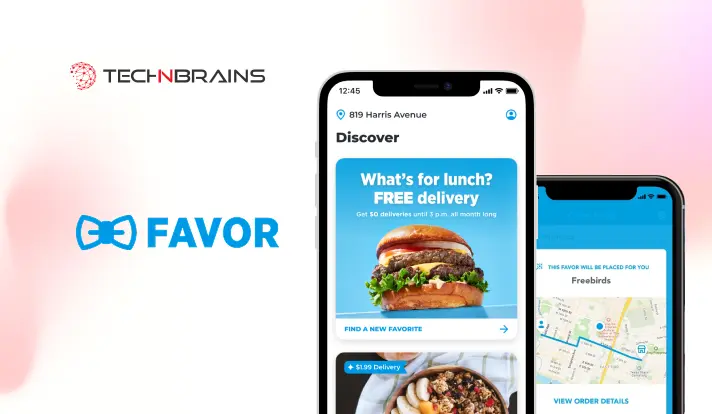
Choose it if you are in Texas and want a restaurant plus grocery in one place.
Skip it if you are outside Texas, where it does not operate.
- Cost to you: Fees vary by order, and Texas users comparing Favor against DoorDash report the delivery fee plus service fee plus tip stack being the deciding factor against it on smaller orders.
- Sentiment: Limited evidence nationally, because it does not operate nationally.
- Strongest coverage: Texas only, in more than 400 cities, with over 100,000 contract couriers, which gives it non-metro Texas reach the national apps sometimes lack.
- Worth knowing: Favor was founded in Austin in 2013 and acquired by H-E-B in 2018. It is the only major US delivery app owned by a grocery retailer, which is why groceries, alcohol and restaurant meals sit in one app, including H-E-B store delivery.
9. Restaurant-direct ordering (best for paying the least)
Choose it if you order from the same few places repeatedly.
Skip it if you are discovering somewhere new, which is the one job marketplaces do well.
- Cost to you: The restaurant’s real menu price plus its own delivery arrangement. Platforms like ChowNow charge a flat monthly fee rather than per-order commission, so there is no commission to price around. Many restaurants deliver free from their own site.
- Sentiment: Generally positive, though measured on restaurant-side reviews. In community threads it is the option people recommend to each other most consistently.
- Strongest coverage: Whatever your specific restaurant has set up, which is the catch.
- Worth knowing, because it undercuts this entire list: Intouch Insight’s 2025 study found first-party restaurant apps delivered faster, more accurately and with more customization than third-party platforms. The caveat: about one in three first-party orders was still fulfilled by a third-party courier.
What do people say about these apps?
Five complaints repeat across every platform, and four of them are not about the food.
- Missing items, refunded in credit rather than money. The most common source of one-star reviews. The anger is rarely about the missing item; it is that the refund returns as app credit, gets capped after too many reports, and often excludes the tip and fees paid on food that never came.
- Marked delivered, never received. Reviewers describe a courier circling the block, then the order closing as complete at an address that is not theirs.
- The fee stack. Commenters in one thread described saving $20 to $30 by collecting the same order themselves, and noted that service fees never reach the courier. That is correct: platform fees are platform revenue, and the tip is the courier’s variable income.
- Batching, and cold food. In a Texas delivery group, several people described the same sequence: the courier accepts more orders en route, the promised time slips, the food arrives cold. Intouch Insight’s 2024 study named order batching as a driver of worse customer experience. Customers blame the courier. Batching is a platform routing decision.
- Support that cannot see your order. Chatbot loops asking for information already attached to the order.
What each platform gets right:
- DoorDash: selection, orders arriving as ordered, and courier availability that restaurant staff notice from the kitchen side.
- Uber Eats: one account covering rides and food worldwide, and the heaviest promotional discounting of the three.
- Grubhub: beats its own quoted delivery times, and free with Prime.
What does food delivery cost, and what changed in 2026?
Expect to pay 70% to 90% more than the restaurant’s menu price once markup, fees and tip are counted. Most of that gap is invisible at checkout. California changed the refund rules on January 1, 2026.
What do food delivery apps cost in total?
FinanceBuzz priced an entree, side and drink from ten chains across four platforms, same city, same day. Markup over menu price, including tip:
- Postmates: 92%
- DoorDash: 83%
- Grubhub: 80%
- Uber Eats: 69%
The cost arrives in four layers:
| Layer | Typical size | Visible at checkout? |
| Menu markup (restaurant prices up to cover commission) | 15% to 30% | No |
| Service fee | 10% to 18% of subtotal | Yes, at the end |
| Delivery fee | $2 to $8, varies by distance and demand | Yes |
| Tip | Customer set, before service | Yes |
What follows from that:
- Menu markup is the largest layer and the only hidden one. You see it only by comparing the app listing against the restaurant’s own menu.
- Subscriptions do not touch it. DashPass, Uber One and Grubhub+ all list at $9.99 a month. All three cut delivery and service fees. None cuts the markup.
- Four orders a month on one platform is roughly where a $9.99 subscription clears its own cost against the fee layer.
- With Amazon Prime, Grubhub+ is free, so that fee saving arrives without the $120 a year.
- Direction of travel in 2026: Intouch Insight found DoorDash cut total fees $1.82 year over year and the platform average fell $1.10, while menu markup rose almost everywhere. The fee you can see went down. The one you cannot went up.
Why do restaurants charge more on delivery apps?
- The commission runs 15% to 30% of every order. A $20 entree at 30% returns $14 before packaging and labour, against net margins in the low single digits.
- Commission is not the full cost. Sponsored placement, marketing tiers and payment processing sit on top, and the higher tiers are often what make a restaurant visible at all.
- The markup is passed through, not opportunism. On this one, the customer and the restaurant are on the same side.
- Platforms keep the customer relationship. Restaurants get order counts and item performance, rarely the contact details that would let them market directly. Hence a marketplace listing for discovery and their own ordering software for regulars.
You are paying commission on customers you already had
Every reorder from a regular pays commission for an introduction the marketplace already made, and you still never get the customer's details. A direct ordering channel keeps both the margin and the customer.
Model that split against your delivery mix and scopes the build
Do coupon and cashback apps help?
- A second market has grown around clawing the fee stack back. Promo codes, deal passes and cashback apps all sell the same thing: a discount on a price inflated upstream.
- We built one. QPON is a US subscription app giving members coupons across restaurants, beauty and fitness brands, in React Native on a Node back end. The work sat in the parts users never see: promo redemption that holds up against abuse, payment handling, personalised deal surfacing, and push timed to expiring offers rather than sent on a schedule.
- A deal is a discount on the marked-up price, not a fix for it. A coupon stacked on a 25% menu markup still leaves you above the restaurant’s own price. The savings are real, just smaller than they look.
What changed for delivery customers in 2026?
California AB 578, in effect since January 1, 2026. Platforms operating in California must:
- Refund in full to your original payment method, not app credit, when an order is not delivered or the wrong order arrives, covering food, taxes, fees and tip. They can decline where the customer caused the failure or the request looks fraudulent; partial refunds remain allowed for partly correct orders.
- Refund your tip without deducting it from the courier.
- Give access to a human customer service representative, not only an automated one.
- Provide an itemized breakdown of every transaction including each fee and the tip.
In California, the credit-instead-of-refund answer that dominates negative reviews is no longer compliant.
Federal rulemaking is in motion.
- The FTC published a proposed rule on unfair or deceptive fees in online food delivery in the Federal Register on April 16, 2026.
- It follows the FTC’s January 2026 settlement with Instacart over orders advertised as free delivery that still carried mandatory service fees.
- California’s Attorney General filed a comment in May 2026 urging a federal floor rather than a ceiling.
- Why it matters: California has required all-in advertised pricing since July 2024, yet reporting in June 2026 found the major platforms still do not show it there. If the FTC rule lands with teeth, the hidden layer becomes visible, and that changes which app is cheapest more than any promo code.
What are the business ideas in food delivery apps?
Not another national marketplace. DoorDash, Uber Eats and Grubhub hold close to the entire US market. The openings are in demand; the big three cannot serve profitably at their cost base.
| Business idea | Best suited to | How it makes money | Why there is room |
| Restaurant-direct ordering | Multi-location restaurant groups | Flat monthly fee, no per-order commission | First-party apps beat third-party on speed and accuracy (Intouch Insight 2025) |
| Vertical marketplace | One food category only | Flat delivery fee, lower merchant cut | Slice for pizzerias, Caviar for upscale |
| Regional marketplace | Underserved cities and states | Commission plus local ad placement | Favor covers 400+ Texas cities |
| Cloud kitchen platform | Operators running several brands | Kitchen rent plus platform fee | One dispatch stack, many virtual brands |
| Grocery and quick commerce | Grocers and convenience chains | Basket fee plus subscription | Favor carries H-E-B groceries. See retail app development |
| Corporate meal delivery | Caterers, office-focused operators | Bulk contracts, recurring invoices | Scheduled, predictable, high average order value |
| Campus ordering | Universities and dining services | Meal-plan integration, campus payment | Captive users, repeat daily demand |
| Office pantry restocking | B2B suppliers | Recurring subscription per site | Contract revenue, no consumer acquisition cost |
| Subscription meal plans | Tiffin and home-style kitchens | Weekly or monthly prepaid plans | Predictable revenue, no per-order marketing |
| Fitness meal prep | Macro and calorie-controlled kitchens | Premium subscription | Buyers pay more for precision |
| Senior meal delivery | Care providers and dietary kitchens | Plans, sometimes insurance-funded | Aging population, dietary requirements |
| Late-night delivery | Cities with weak after-hours coverage | Standard commission at premium hours | Nationals thin out late; demand does not |
| Deals and loyalty layer | Card issuers, loyalty programmes | Merchant-funded offers, subscription | Wonder bought rewards app Claim in January 2026; our own QPON build |
| White-label fulfilment | Courier and 3PL businesses | Per-delivery fee to merchants | Restaurants want delivery without a marketplace listing |
How does TechnBrains build a food delivery app?
As four products, not one. A customer app, a courier app, a merchant app, and the admin and dispatch engine that assigns work between them. The customer app is the cheapest surface and the one founders overspend on. Dispatch is where the build succeeds or fails.
What we build, by surface
| Surface | Core features |
| Customer app | Address and geolocation, restaurant discovery and filters, menus with modifiers, cart and scheduled ordering, payments and wallets, promo codes and subscriptions, live tracking, tipping, ratings, in-app refunds and support |
| Courier app | Onboarding and document checks, availability toggle, offer accept or decline with payout shown up front, batch handling, navigation handoff, proof of delivery, earnings and payout history |
| Merchant app | Menu and stock management, prep-time control, order accept or reject, printer and kitchen display integration, opening hours and holidays, promotions, payouts and statements |
| Admin and dispatch | Assignment engine, batching rules, zone and radius configuration, pricing and surge rules, ETA engine, refund and dispute workflow, commission configuration, analytics |
Typical integrations: payment gateway, maps and routing, push and SMS, and the merchant’s POS.
The layer that decides whether a delivery app works
Assignment answers four questions, many times a minute. Get them wrong and you produce the exact complaints at the top of this article.
| The decision | What goes wrong when it is weak | What we build |
| Which courier gets this order | Orders sit unaccepted while food goes cold in the window | Live courier availability as tracked state, not stored preference, with assignment running against real constraints |
| Whether to batch it with another | The extra stop is invisible to the customer, who blames the courier for a cold delivery | Configurable batching rules with a utilization-versus-satisfaction threshold you set deliberately |
| What ETA to promise | Optimistic quotes win the order and lose the customer | ETA from live prep times and travel conditions, not a static average |
| What happens when the kitchen runs late | The courier waits unpaid, unit economics break, the customer gets no update | Reassignment logic and conflict detection at write time, plus proactive customer messaging |
Those four decisions are where the custom work sits. Most of the feature tables above can be configured; the assignment layer has to be built against your market’s order density, courier mix and merchant behaviour, and that ratio of custom to configure is what moves the cost. It is why our mobile app development team scopes each surface separately rather than quoting one app.