If you’re leading a product team, you already feel the pressure: roadmaps growing faster than your ability to hire, and delivery timelines slipping quarter after quarter. In my experience, scalable outsourced mobile teams change that dynamic by adding bandwidth and expertise when you need it most.
Organizations partnering with external development teams can achieve up to 37% faster delivery and time-to-market compared to traditional models.
That’s not theoretical. It’s the difference between winning users today or chasing them tomorrow. Outsourcing allows you to compress cycles, run parallel streams, and keep innovation moving without sacrificing product quality or architectural stability.
Let’s discuss it in detail!
TL;DR
Outsourcing mobile app development isn’t about cutting costs. It’s about increasing delivery speed, reducing time-to-revenue, and scaling innovation. When governed correctly, outsourced teams enable parallel development, faster release cycles, and better ROI than in-house hiring alone.
Why Scalable Outsourced Teams Reduce Time-to-Market
It’s simple! They allow you to add delivery capacity faster than traditional hiring ever can, and they do it without destabilizing your core product or architecture.
In practice, high-performing outsourced mobile teams function as plug-in pods of senior engineers that integrate with your backlog, tooling, and release cadence, meaning product work streams run in parallel, not serially.
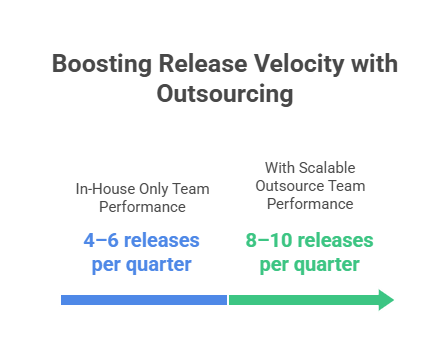
Companies leveraging external development talent consistently ship features 30% or even faster than teams limited to internal staff alone.
That acceleration isn’t magic. It’s the result of capacity scaling, reduced onboarding overhead, and mature execution practices built into the partner’s delivery model.
How Parallel Sprint Execution Works in Outsourced Teams
In traditional in-house models, sprint execution capacity is constrained by the size of your internal team. If you need to add features, fix technical debt, and improve performance all in the same cycle, someone gets deprioritized.
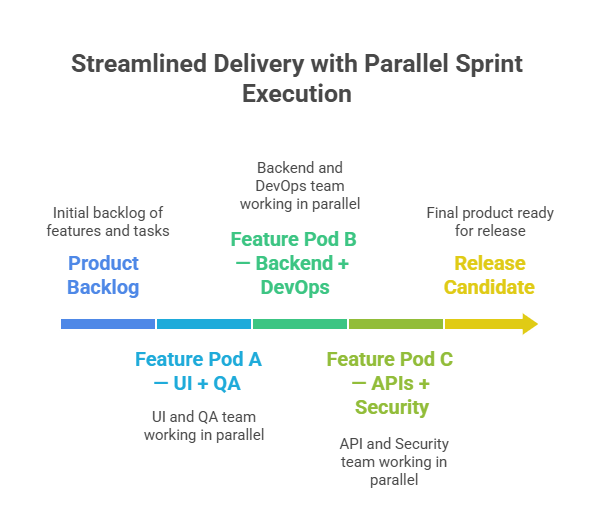
Scalable outsourced teams shift that dynamic by enabling parallel sprint execution:
Integrated sprint planning: Outsourced engineers participate in your sprint ceremonies and align with your Definition of Done.
Dedicated feature pods: Instead of bolting on “extra heads,” you form autonomous feature pods that own vertical slices (UI, backend, API, QA) for specific backlog items.
Standardized tooling and standards: They adopt your existing CI/CD, code review, and quality gates so there’s zero rework after handovers.
Release Velocity vs In-House Bottlenecks
Release velocity, the frequency at which your team ships working software, is the ultimate measure of time-to-market efficiency. Two common bottlenecks in in-house models are:
Hiring & ramp-up delays:
Even with aggressive recruiting, ramp-up time for mid-to-senior engineers can be 3–6 months before productivity matches team expectations.
Context switching & bottleneck queues:
In a fully internal team, UI work, backend services, QA validation, and DevOps deployments often back up in sequence.
Scalable outsourced teams mitigate both:
Senior expertise from day one: Partners bring engineers who already follow modern practices (e.g., clean architecture, automated testing, CI/CD).
Parallel workflows: Instead of linear task queues (design → build → test → deploy), outsourced capacity allows overlap: while one pod builds, another integrates and yet another validates.
How Outsourcing Cuts Development Cycles by 30–50%
Outsourcing reduces development cycles not by cutting corners, but by removing the two biggest drag factors in software delivery: constrained capacity and sequential workstreams.
When you augment your core team with seasoned dedicated mobile developers, backend engineers, DevOps specialists, and QA professionals, you eliminate waiting periods between handoffs and dramatically reduce idle time.
Below, we break down the delivery mechanics that make this possible.
Team Topology: Pods vs Functional Silos
In traditional development models, teams are often organized as functional silos, like UI folks in one group, backend in another, QA separately, DevOps in ops, etc. This creates serial handoffs, where each group must wait for the previous one to finish before starting their work. That’s a natural brake on cycle time.
Outsourcing flips this by organizing work into cross-functional pods:
Functional Silos
UI team
Backend team
QA team
DevOps team
Work flows serially through these groups.
Cross-Functional Outsourced Pods
Developer(s)
QA engineer
DevOps specialist
Product integrator
Work flows in parallel, within one cohesive unit aligned to a specific feature or product slice.
QA, DevOps & Frontend Running in Parallel
Outsourcing accelerates cycles by breaking the classic waterfall sequence, where frontend waits on backend, QA waits on build completion, and DevOps waits on QA, and instead enables these functions to operate concurrently.
To do this effectively, your outsourced teams should include or align to:
Dedicated QA automation engineers who write tests as code, not afterthought scripts.
DevOps specialists who embed CI/CD from day one, not just at release time.
Frontend engineers who consume APIs in parallel with backend development.
Shared sprint ownership aligned with your backlog priorities.
Here’s a practical checklist to ensure parallel execution:
Parallel Execution Checklist
Shared sprint cadence with internal team
Unified backlog with prioritized feature slices
CI/CD pipelines running at every commit
Automated test suites (unit, integration, UI)
Dedicated DevOps support for deployment automation
Real-time dashboards tracking build and test health
When these elements are in place, the result is continuous delivery and compressed cycle times, not a series of dependent checkpoints.
Modernizing or expanding an existing mobile app?
Validate your architecture, capacity, and timelines before committing to major delivery decisions.
How to Manage Outsourced App Teams Without Losing Control
You don’t “hand over work” and hope for the best. You build governance, ownership clarity, and delivery visibility into the way your outsourced teams operate. The goal isn’t micromanagement, it’s predictable delivery with aligned accountability.
High-trust governance models allow you to enforce standards, protect architecture integrity, and ensure velocity without sacrificing product quality or internal decision authority.
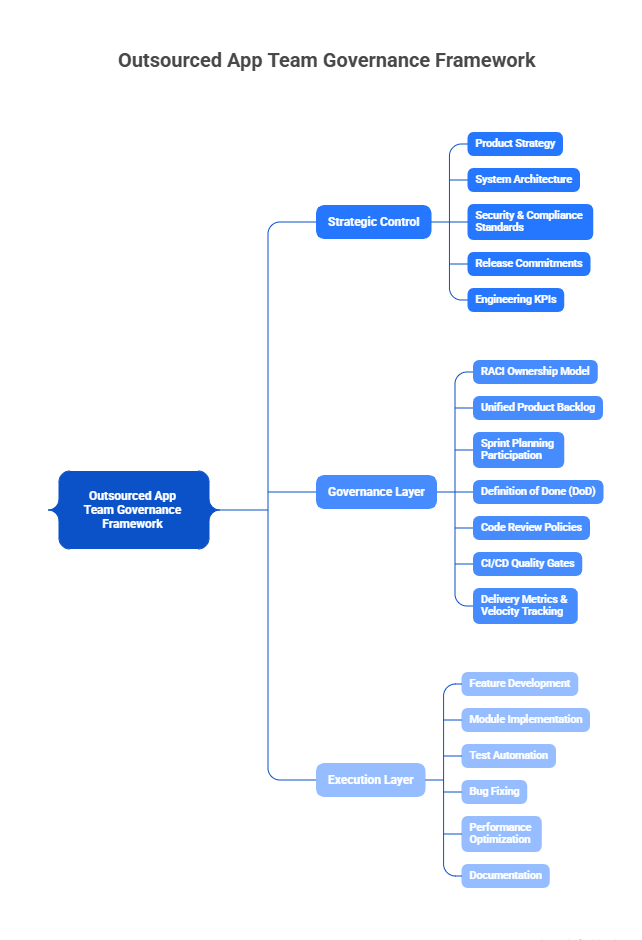
The most reliable way to do this is through a clear RACI model tied to your delivery process, combined with role-specific ownership of architecture, codebase, and roadmap cadence.
Below, we break down the governance structures that make outsourcing a controlled, scalable extension of your core team.
Who Owns Architecture, Code & Velocity
When you bring outsourced engineers into your development ecosystem, it’s vital to define who owns what, because ambiguity kills delivery speed and technical quality.
Architecture Ownership
Internal Architects / Tech Leads: Retain architectural authority, especially for core modules and interfaces.
Outsourced Senior Developers: Implement architecture under guidance and contribute to non-core modules within approved patterns.
Code Ownership
Internal Repositories & Standards: You own the codebase, branch policies, and static analysis rules.
Outsourced Contributors: Follow and enforce those standards through pre-merge checks and shared linting/test suites.
Velocity Ownership
Internal Engineering Leadership: Own release commitments, sprint goals, and quality metrics.
Outsourced Teams: Own delivery of agreed sprint items and work against your velocity targets.
Sprint, Roadmap & Backlog Governance
Once ownership is clear, the next challenge is orchestrating delivery within your product rhythm, meaning sprints, backlogs, and roadmaps must be shared and transparent.
The solution is a governance layer that treats outsourced teams as first-class participants in your delivery process:
Unified Backlog: All work, internal or outsourced, lives in the same backlog with transparent priorities.
Sprint Sync: Outsourced teams join your sprint planning, standups, demos, and retros, just like internal teams.
Definition of Done: Shared acceptance criteria for every story, including performance, security, and compliance gates.
Velocity Metrics: Measure outsourced contributions as part of team velocity, not separate KPIs.
Here’s a simple, repeatable template for sprint governance:
RACI for Delivery Governance
To operationalize the above, a RACI matrix is invaluable:
Activity
Internal Product
Internal Engineering
Outsourced Team
Delivery Lead
Define Architecture
A
R
C
C
Code Development
C
A
R
C
Code Review & Quality
C
A
R
R
Sprint Planning
A
R
R
C
Deployment & Release
R
A
R
C
Performance Monitoring
R
A
C
C
R = Responsible | A = Accountable | C = Consulted | I = Informed
This governance model locks accountability where it matters, but still leverages the execution power of outsourced teams.
What is the real ROI for startups when they outsource mobile app development versus building internally?
Outsourcing mobile app development is a return-on-velocity and time-to-revenue strategy. For startups, speed, experiment iterations, and early monetization matter more than ever.
When executed right, outsourcing can drive measurable ROI through faster delivery, lower burn rate, and earlier revenue capture, without sacrificing product quality or long-term technical viability.
Below, we break down the ROI math and what it looks like in real terms.
How does outsourcing impact your monthly burn compared to in-house scaling?
Startups often assume that outsourcing equals higher per-hour cost. In reality, the effective cost per delivered feature often goes down because velocity increases and internal friction drops.
Here’s a simplified model comparing internal hiring vs outsourcing for a typical mobile app sprint:
Cost Element
In-House Team (4 engineers + QA + DevOps)
Outsourced Model (Dedicated External Team)
Monthly Salaries + Benefits
$80,000
$50,000
Recruiting & Ramp-Up
$30,000 (one-time)
$0
Overhead (HR, tools, training)
$10,000
$5,000
Delivery Velocity (Story Points per Sprint)
20
35
Cost per Story Point
$4,000
~$1,571
In this example, even though external rates may seem higher on paper, you get nearly double the throughput per dollar spent, and you avoid long recruiting cycles that add hidden costs to your burn.
The larger the backlog and the more complex the delivery needs, the more outsourcers unlock ROI through parallel workstreams and expertise leverage.
How much earlier can a startup start generating revenue when outsourcing accelerates delivery?
Time-to-revenue is one of the most compelling ROI levers for founders and investors: shipping core features faster means capturing users and monetization earlier.
For startups on a tight runway, bringing forward revenue by even a quarter can dramatically improve financial stability, investor confidence, and product–market fit validation.
ROI Table — Startups (Example)
Metric
In-House
Outsourced
Time to MVP
24 weeks
14 weeks
Launch Revenue Acceleration
$0
$150,000+
Burn Rate Impact
High
Lower
Feature Throughput
Medium
High
Quality & Market Fit
Variable
More predictable
Outsourcing becomes not just an expense, it becomes a strategic lever that compresses runway risk and maximizes monetization potential earlier in the startup lifecycle.
When should a startup or scaling company rely on in-house teams vs outsourced teams for mobile app delivery?
The decision is about what part of your delivery engine needs scale, specialization, or flexibility right now. In-house teams are essential for deep product knowledge, strategic ownership, and long-term platform evolution.
Nearly 66% of US businesses outsource at least one department. Outsourced teams are most effective when you need burst capacity, specialized skills, or parallel execution without slowing the internal organization. The real ROI comes when you combine both in a way that leverages each model’s strengths.
Below, we compare the two models and show why hybrid approaches are often the best path for scaling mobile products.
When In-House Fails to Scale
65% of tech leaders report that talent shortages directly slow development cycles, especially for mobile and cloud-native capabilities.
In-house teams can struggle when the product roadmap outpaces hiring capacity or when specialized skills are needed faster than the market supply can deliver. Common scaling failure patterns include:
Constraint
In-House Team
Impact
Hiring Lag
3–6 months to onboard senior engineers
Delivery timelines slip
Expertise Gaps
Limited to generalists
Complex domains (DevOps, AI, security) suffer
Ramp-Up Overhead
Cultural + tooling training
Lower early throughput
Cost Pressure
High fixed labor cost
Budget squeeze
When these constraints hit, teams often resort to overtime, re-prioritization, or de-scoping; all signs that in-house capacity has maxed out.
How can you get the best of both worlds?
Hybrid delivery models combine the strategic ownership of in-house teams with the execution horsepower of outsourced expertise. Instead of outsourcing entire products, hybrid models assign:
This approach retains core decision authority while scaling capacity on demand.
Key benefits of hybrid models:
Architectural continuity: In-house architects steer the platform’s long-term evolution.
Elastic delivery: Outsourced pods accelerate specific streams without disrupting core squads.
Cost predictability: You pay for capacity you need when you need it.
Knowledge transfer: Internal teams benefit from external expertise through paired development and documentation standards.
This hybrid approach is widely adopted in scaling tech organizations because it balances control, velocity, and quality, exactly what CTOs and Heads of Product care about.
Is Outsourcing Right for Your App Roadmap?
Use this checklist the way I do when evaluating whether external delivery capacity will actually improve execution, not just add noise. If you can check most of these, outsourcing is likely to increase your roadmap velocity without increasing risk.
Strategic Fit
Our product roadmap requires more delivery capacity than our current team can realistically staff in the next 90 days.
We have revenue, growth, or competitive milestones tied to faster feature releases.
We need specialized skills (mobile, DevOps, QA automation, cloud, AI) that are hard to hire quickly.
Execution Readiness
We have a clear backlog and sprint cadence that external teams can plug into
Our architecture and APIs are documented well enough for parallel development
We can enforce code quality, CI/CD, and security standards across all contributors
Financial & ROI Logic
Faster releases would materially impact revenue, churn, or user acquisition
Hiring internally would take longer than our market window allows
We can measure velocity, cost per feature, and time-to-revenue
Governance & Control
We can assign internal owners for architecture, roadmap, and release decisions
We are prepared to run unified sprint planning and demos across teams
We can use shared tools for backlog, source control, and deployment
If you reach the end thinking, “Yes, that’s exactly where we are,” then outsourcing isn’t a risk, it’s a delivery lever.
If you want to sanity-check your situation, you can always talk to engineering and walk through your roadmap, timelines, and team structure with someone who’s done this before.
Wrapping it Up
Outsourcing, when done with proper governance, architecture ownership, and integrated delivery models, becomes a way to increase engineering throughput and reduce time-to-market while maintaining technical control.
Whether you’re a startup racing to product–market fit or an enterprise modernizing a legacy mobile platform, scalable external teams allow you to run more experiments, release faster, and turn roadmap ambition into shipped software, without the friction and delays of traditional hiring.
Working on a mobile platform that needs to move faster?
Get a clear view of what’s slowing delivery and what would actually improve release velocity.
Overview: TikTok has become a global sensation, and its popularity continues to grow. This widely used social media platform has become a primary source of entertainment for both teenagers and adults. Its success has inspired many to examine its business model, in an effort to create an app like TikTok that will attract millions of users worldwide.
TikTok, the popular short-form video-sharing app, has taken the world by storm, captivating millions with its engaging content and creative possibilities. Have you ever wondered what it takes to build an app like TikTok? This article will guide you through the journey, from understanding the basic features to diving into the realm of advanced functionalities.
What is TikTok?
TikTok, initially launched in 2016, has evolved into a global sensation. It allows users to create and share short videos set to music, offering a platform for creativity, self-expression, and entertainment. With its user-friendly interface and addictive content, TikTok has redefined how people engage with social media.
TikTok emerged as the most downloaded app in the App Store in the first quarter of 2019, with over 33 million downloads. Sensor Tower’s report also revealed that ByteDance, the developer of TikTok, has generated $75 million in revenue from in-app purchases so far.
As per Sensor Tower, TikTok has been installed by over 1.1 billion users worldwide through Google Play (Android) and App Store (iOS). The video app boasts of over 500 million monthly active users and the numbers are continuously increasing.
Basic Features of App like TikTok
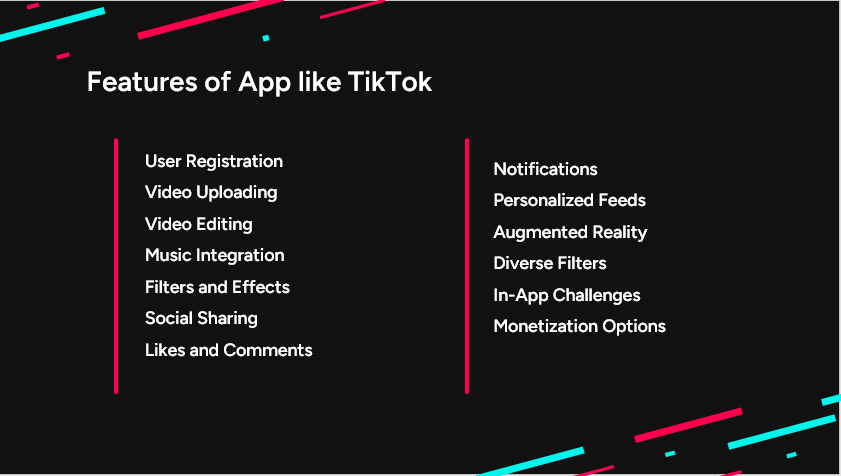
Creating an app like TikTok requires careful planning and execution. Here are the fundamental features to consider:
Features of App like TikTok
Description
User Registration
Profiles with customization to showcase personality
Video Uploading
Easy upload from device library
Video Editing
Trimming, cutting, merging, and creative tools
Music Integration
Vast library for impactful soundtracks
Filters and Effects
Diverse options to enhance videos
Social Sharing
Seamlessly share on app and social media
Likes and Comments
User engagement through liking and commenting
Notifications
Stay informed about interactions and updates
1. User Registration and Profiles
To begin, a app like TikTok should have users to register and create profiles. Incorporate options for customization, such as profile pictures and bios, enabling users to showcase their personalities.
2. Video Uploading
Central to the concept of an app like TikTok is the ability for users to upload their own videos. Users should be able to easily select videos from their device’s library and upload them to the platform.
3. Video Editing
It is essential to trim, cut, and merge video clips in app like TikTok to allow users to create polished and visually appealing videos. Incorporating basic editing tools like adding text, stickers, and transitions adds an extra layer of creativity to the user experience.
4. Music Integration
Integrating a vast library of music tracks that users can add to their videos elevates the entertainment value. App like TikTok should have the option to search for their favorite songs, explore trending tracks, and seamlessly synchronize music with their videos, enhancing the overall impact of their content.
5. Filters And Effects
A wide collection of filters, effects, and overlays allows users to enhance their videos with unique styles and aesthetics. From color filters to special effects, these features enable users to customize their content to suit their creative vision.
6. Social Sharing
This feature promotes user-generated content to a wider audience and encourages viral trends.
Users should be able to easily share their videos not only within the app but also across other popular social media platforms.
7. Likes And Comments
Users should be able to like and comment on videos, allowing them to engage with the content and express their opinions. The presence of likes and comments fosters a sense of community and encourages users to create and share more content.
8. Notifications
Having a notification system that alerts users about new likes, comments, and interactions with their videos enhances their connection to the platform. Notifications ensure that users stay up-to-date with their content’s performance and engagement.
Advanced Features for app like TikTok
Once the basic features are in place, it’s time to elevate the app’s functionality and user experience:
New Features of TikTok like App
Description
Personalized Feeds
AI-driven content recommendations
Augmented Reality
Apply AR effects to videos for creativity
Diverse Filters
Expand creative possibilities with varied filters
In-App Challenges
Encourage user-generated content through challenges
Monetization Options
Earn through ads, in-app purchases, and currency
9. Personalized Feeds
Utilize AI algorithms to curate personalized feeds for users in apps like TikTok. Recommend content based on their interests, interactions, and viewing history, enhancing user engagement.
10. Augmented Reality (AR) Effects
Apps like TikTok Integrate AR effects that users can apply to their videos. AR VR app Development Company can help you enhance the creativity by adding virtual elements to the real world, sparking innovative content.
11. Diverse Filters and Effects
Expand the range of filters and effects to provide apps like TikTok with a broad spectrum of creative tools. Regularly update the collection to keep up with trends and user preferences.
12. In-App Challenges
Introduce in-app challenges and trends that users can participate in apps like TikTok. Challenges encourage user-generated content and increase user retention.
13. Monetization Options
Consider implementing monetization features such as ads, in-app purchases, and a virtual currency system. This allows content creators to earn from their videos and incentivizes engagement.
Admin Panel Features for an App like TikTok
Managing and maintaining an app like TikTok requires a robust and user-friendly admin panel. This control center empowers administrators to oversee various aspects of the platform, ensuring smooth operations and a safe user experience. Here’s a list of essential features for the admin panel:
Feature
Description
User Management
Handle user accounts, activity, bans, and suspensions.
Content Moderation
Approve videos, filter and flag content, manage comments.
Analytics and Reporting
Track user engagement, performance metrics, and reports.
Content Management
Manage music, filters, effects, and trending content.
Monetization and Advertising
Manage ad campaigns and monetization policies.
Data and Privacy
Ensure user data protection and GDPR compliance.
Support and Communication
Provide user support and announcements.
Security
Ensure authentication, authorization, and security.
User Management
View and manage user accounts, including registration details and profile information in apps like TikTok. Monitor user interactions, posts, and content to ensure adherence to community guidelines. Suspend or ban users who violate platform rules, ensuring a safe environment.
Content Moderation
Review and approve uploaded videos to ensure compliance with content policies. Implement filters and allow users to flag inappropriate content for review in apps like TikTok. Moderate comments and interactions to prevent harassment or offensive behavior.
Analytics and Reporting
Track user engagement metrics, such as likes, shares, and comments, to understand content trends. Monitor server performance, response times, and downtime to ensure optimal user experience in apps like TikTok. Manage and respond to user-reported issues or concerns promptly.
Content Management
Manage the library of music tracks available for users to enhance their videos. Curate and update the collection of filters, effects, and AR options. Monitor and promote trending videos and challenges to encourage user participation.
Monetization and Advertising
Manage and schedule advertisements to be displayed on apps like TikTok. Set and adjust rules for content monetization, including ad revenue sharing.
Data and Privacy
Ensure compliance with data protection regulations by safeguarding user information in apps like TikTok. Provide tools to manage user data and comply with GDPR regulations.
Support and Communication
Offer a communication channel for users to report issues and seek assistance. Communicate updates, changes, and new features to users through announcements.
Security
Secure the admin panel with strong authentication and role-based access controls. Regularly conduct security audits to identify and address potential vulnerabilities.
The admin panel is the backbone of apps like TikTok, facilitating efficient moderation, analytics, content management, and user support. By incorporating these features, you can ensure the smooth functioning of your TikTok like app and provide a positive user experience.
Cost of TikTok Like App
The cost of an app like TikTok in 2023 will be estimated around $50,000 to $100,000. Here is a detailed cost breakdown:
Features
Estimated development timeAndriod and iOS
Cost of developmentUS Average Rate ($150 per hour)
User login & profile
80 hours
$12,000
Video Features
100 hours
$15,000
Music Integration
20 hours
$3,000
Filters and Effects
120 hours
$18,000
Social Sharing
25 hours
$3750
Likes and Comments
30 hours
$4500
Notifications
25 hours
$3750
Total Hours
315 hours
$60,000
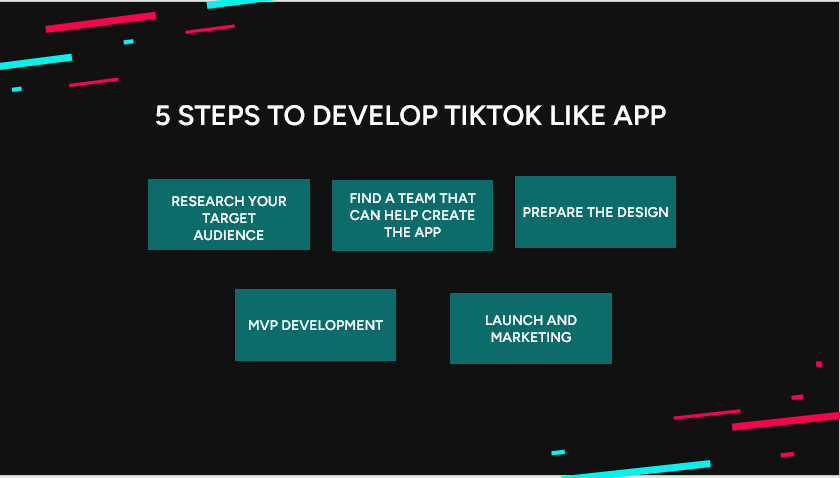
5 Steps to Develop TikTok Like App
To create an app like TikTok, you need to follow the steps below.
1. Research Your Target Audience
You need thorough research about the audience you are looking to target for app like TikTok. Learn more about your target audience so that you understand their needs and wants. This will help you create a product that will be satisfying.
Discover more about your audience, including their location, average age, device preference, operating system, and internet connectivity.
Furthermore, assess their sentiments towards important elements such as app functionality, user interface, security, slow loading times, and any other factors that may hinder their app usage.
2. Find A Team That Can Help Create The App
You want an experienced team to build your app like TikTok. You need to hire the right developers since your team will make or break your app.
You can always hire developers if you do not have the suitable people on staff. You can locate exceptional talent to build a potent social networking app through outsourcing, which is far more cost-effective.
To ensure success, it is crucial for your team to have a clear understanding of your target audience, business model, priorities, and monetization strategy. In the initial stage of your project, gather your app developers and other stakeholders to collaboratively design the concept of your app, determine its features and user roles, select the appropriate technology stack, and estimate the associated costs.
Get started on your app development journey with TechnBrains today.
3. Prepare Design
When creating your app like TikTok design, it’s important to consider usability research. This will ensure that you provide your future users with a product that is easy to use and offers an excellent experience.
Your app like TikTok should have a user-friendly and intuitive interface, free of clutter. It should be visually appealing and functional, encouraging people to download and use it regularly.
4. MVP Development
It’s crucial to develop an MVP (minimum viable product) before launching your app like TikTok in full to ensure its success. This approach enables you to test your app and gather crucial feedback from users. By doing so, you can make necessary adjustments and ensure that your app is fully functional before officially launching it.
When creating an MVP, include just enough enticing features to make the app appealing to early adopters. After gathering feedback and improving your app, add the remaining features and launch your product in its full glory.
5. Release & Marketing Activities
Before launching your app like TikTok, it’s important to optimize it for the specific app marketplace where you plan to publish it. Begin by crafting a clear and engaging description that outlines what your app does and how it can be used, while also highlighting its unique features. To make your app more appealing, include captivating screenshots, incorporate relevant keywords into the title, and create a memorable logo. By taking these steps, your app will stand out from the competition and draw in more users.
Have you thought about how to promote your newly released app like TikTok? You can advertise it on your website and social media and keep it promoted regularly. Remember to attach screenshots and links to the app marketplace/s so people can download it. If you want to reach a wider audience, consider running paid ads like Google Ads and social media ads. This will help you attract more interested leads who might enjoy your musical app. You can also manage your app store reviews to have a positive impact for more downloads.
Creating a TikTok like app can be relatively easy if you follow these tips. First, find the right mobile app developers to handle all technical aspects. However, it’s crucial to understand your target audience’s desires before proceeding. Delving into their needs and preferences is important to develop a musical app that they will love.
Best TikTok alternatives on Android in 2023
One of the finest Android apps today, TikTok is a social media network that attracts millions of viewers with captivating, brief films that last between 15 and 60 seconds. The platform encourages self-expression and discovery, and it serves as a channel for showcasing your abilities and general interests to a younger audience. Despite its growing popularity, TikTok is still banned in some countries and cannot even be downloaded onto government-owned smartphones. For this reason, we look to TikTok alternatives that imitate the platform’s success on your preferred Android phone.
1. Likeme Pte. Ltd.
Category: Social App
Price: Free
Rating: 4.4
The Likee app is an amazing alternative to TikTok for sharing and editing short videos because of its customizable features and simplicity of use. It offers live streaming, viral videos, clips that have been captured, and social tools like friend group chats and community pages for your favorite topics. The system utilizes an AI-based recommendation mechanism to assist you in discovering additional options. Additionally, Likee makes adding a personal touch to your edited movies easy with stickers, filters, and special effects, making it a fun way to style all of your footage. Likee may not be suitable for children due to its explicit and graphic content.
2. Zoomerang
Category: Social App
Price: Free
Rating: 4.3
We often choose applications that allow us to connect with our creative and unique style. This includes making trendy videos, which require more direction and structure. The app Zoomerang offers a variety of themes, tutorials, aesthetic effects and filters, text fonts, and gifs/stickers to spruce up your films, making it a great alternative to TikTok for creating short videos. In order to continue stylizing your media, you will not run out of tools. The videos you create on Zoomerang can be shared on TikTok, YouTube, and Snapchat even if you are not seeking for an app to take the position of TikTok. Zoomerang might be the media production company that makes your content stand out and become popular.
3. Triller
Category: Social App
Price: Free
Rating: 3.8
A built-in video editor and an AI for selecting the best clips are features of an app that focuses on creating and showcasing authentic music videos. Triller is still a good tool for showcasing your brand, whether it be through a collection of shorts or by making a personal vlog, even if you’re not looking to change and advance as a music content maker. Furthermore, Triller Gold, a crowdfunding option, empowers influencers to earn money through fan contributions that can be transformed into tangible funds. Therefore, Triller might be the appropriate choice if you’re trying to start somewhere as a content creator or influencer.
4. Funimate
Category: Social App
Price: Free
Rating: 4.4
Funimate should be on your radar if you’re not simply a socialite wanting to stand out on a big network but rather someone who wants to improve the production value of their video. Using handy tools like the ability to add unique animations using keyframes, overlays, or transitions to elevate your work to a professional level, the software is focused on providing a wonderful video editor app at your fingertips. Of course, if you’d rather stay away from socially conscious communities like TikTok or Instagram, you can share your work with the encouraging Funimate community. Still, the Funimate app allows you to share across several platforms whenever you’re ready to showcase your idea to the world. With Funimate, there are no boundaries to media invention.
5. YouTube (Shorts)
Category: Social App
Price: Free / Premium Available
Rating: 4.2
Millions of people are already familiar with YouTube, and some may even have an active channel. However, if you want to create a separate channel for YouTube Shorts, a new category of films with a runtime of only 60 seconds or less, you can do so. A separate channel for these bite-sized films may help your brand’s growth because YouTube Shorts typically draw a different audience. And suppose you’re choosing between TikTok and YouTube as your main platform. In that case, YouTube wins if you want to develop as a content producer in the long run because of its age, reputation, and ethical monetization policies.
Snapchat
Category: Communication
Price: Free
Rating: 4.2
TikTok helps separate material with filters and hashtags to focus on the correct audience for more niche products/brands, whereas TikTok is more than simply a video creation and sharing app; the platform offers brand sharing and marketing for medium-to-large businesses. Snapchat is the finest place for launching a new brand or product because it has more users than other social media platforms, which may help you draw in more customers.
Snapchat is now also on the web, which makes it even more accessible to snap, share and connect with your friends. In addition, Snapchat is still a great platform for personal use outside of social media marketing strategies for content and brand creation, such as creating your own library of quick videos with the Snapchat story function. Therefore, whether you’re looking to promote yourself professionally or just want to try something new personally, there is something in it for everyone.
Instagram (Reels)
Category: Social Media
Price: Free
Rating: 4
Since Instagram is one of the most widely used social media sites right now, it should come as no surprise that the platform has discovered a way to enhance brand delivery and content development. It turns out that the algorithm favors Instagram Reels, the platform’s equivalent of short videos, because they get more views and generate more engagement. In order to promote your content using Instagram Reels each month, if you’re interested in social discovery, you need to work on it. Thankfully, Instagram’s app has features to help you get started.
Over to you
The TikTok alternatives that allow you a creative outlet and opportunities to share your original works with the world—whether you’re generating the funniest memes, releasing brand teasers, or bringing in top-notch infotainment—are the best. There are apps like TikTok available to support all (short) media types. And occasionally, showcasing your skills and brand on a variety of social media sites may be more advantageous to observe where you’re attracting a following. But after showcasing your company, the next step is mastering the top social apps, which are ideal for creating social spaces for your recent viewers.
YouTube Shorts vs. TikTok
In the era of short-form video content, YouTube Shorts and TikTok have emerged as prominent players, each captivating a significant share of the online audience. While both platforms allow users to create and share short videos, there exist noteworthy differences that set them apart. Let’s delve into the divergent facets that define YouTube Shorts and TikTok.
Ownership & Content
The foundation of any platform lies in its ownership. YouTube Shorts is under the umbrella of Google, whereas TikTok is the creation of the Chinese conglomerate ByteDance. This distinction brings about linguistic diversity – YouTube Shorts predominantly caters to an English-speaking audience, while TikTok’s global presence showcases content in various languages.
User Base & Demographics
User demographics play a pivotal role in platform outreach. YouTube Shorts seamlessly integrates into the expansive YouTube ecosystem, boasting a significantly larger user base encompassing a wide array of age groups and interests. In contrast, TikTok, while immensely popular, tends to attract a younger demographic. This unique positioning empowers YouTube Shorts to potentially engage a broader audience.
Monetization
Monetization avenues diversify the appeal of short-form video platforms for content creators. YouTube Shorts offers creators the opportunity to earn through ads and sponsorships, presenting a straightforward revenue stream. TikTok, however, lacks a built-in monetization mechanism, leading content creators to explore alternative channels for financial gain.
Features & Tools
The tools and features embedded within each platform enable users to craft captivating content. YouTube Shorts introduces a distinctive green screen feature, allowing creators to superimpose themselves against various backgrounds. In contrast, TikTok offers the engaging “duet” feature, facilitating split-screen collaborations between users, fostering interaction and creativity.
Copyright & Intellectual Property
Safeguarding the rights of content creators is a critical concern. YouTube’s comprehensive copyright protection system mitigates infringement risks, demonstrating a commitment to content ownership. TikTok, on the other hand, has encountered criticism due to perceived inadequacies in addressing copyright issues, highlighting a disparity in intellectual property management.
TikTok VS Instagram
TikTok and Instagram stand out as two prominent platforms, each offering a unique experience for users to connect, share, and engage. TikTok is better for raw content whereas Instagram is better for polished content.
Content Format
TikTok: Known for its short-form video content, TikTok thrives on brief, engaging videos typically lasting 15 to 60 seconds. Users can leverage music, effects, and filters to craft creative and entertaining videos.
Instagram: While initially a photo-sharing platform, Instagram has evolved to include various content formats, such as photos, videos, and Stories. The introduction of Reels brought Instagram into the short-form video arena, akin to TikTok.
User Base and Demographics
TikTok: TikTok attracts a predominantly younger audience, with a significant presence among teenagers and young adults. Its vibrant and dynamic content resonates with Gen Z and millennials.
Instagram: Instagram boasts a diverse user base spanning various age groups, including a substantial number of users in the 18 to 34 age bracket. It offers a platform for individuals, brands, and businesses to showcase visual content.
Engagement and Interaction
TikTok: TikTok thrives on user engagement through features like “duets,” where users can collaborate on split-screen videos, and the “For You Page” (FYP), which employs an algorithm to curate personalized content feeds.
Instagram: Instagram encourages interaction through features like likes, comments, and direct messages. Stories and Reels provide avenues for creative expression and interactive engagement.
Discoverability and Reach
TikTok: TikTok’s algorithmic feed and emphasis on trends enable rapid content discovery and potential virality. Users have the chance to gain widespread visibility even with a smaller following.
Instagram: Instagram’s algorithm presents content based on user interactions and interests. While it may require a larger following for broader reach, the platform’s Explore page enhances content discoverability.
Monetization Opportunities
TikTok: TikTok’s monetization options include the Creator Fund, where creators can earn based on video performance and engagement. Brands can collaborate with influencers for promotional campaigns.
Instagram: Instagram provides diverse monetization avenues, including sponsored posts, affiliate marketing, and the Instagram Partner Program. Instagram Shopping enables e-commerce integration.
Visual Identity
TikTok: TikTok thrives on authenticity, allowing users to create unfiltered, candid content that resonates with its younger audience.
Instagram: Instagram’s focus on visual aesthetics encourages curated and polished content, appealing to a wide spectrum of users including influencers, artists, and photographers.
How Technbrains Can Help You Build an App Like TikTok
If you’re aspiring to create an app like TikTok, or an app like Instagram, Technbrains is your ideal partner for a seamless and successful journey. Here’s how we can assist you:
Expertise and Experience
TechnBrains boasts a team of skilled developers and designers with extensive experience in app development. Our experts understand the intricate nuances of creating an engaging platform like TikTok.
Custom Solutions
We are a top-notch on-demand app development company that delivers solutions that meet your specific requirements. Our team collaborates closely with you to comprehend your vision and integrate unique features that set your app apart.
UI/UX Excellence
The creative designers we have, excel in crafting intuitive and user-friendly interfaces, ensuring that your app resonates with users and keeps them engaged.
Scalability and Performance
As your app gains traction, TechnBrains ensures it scales seamlessly. We optimize performance to handle growing user interactions without compromising speed or reliability.
Cutting-Edge Technology
We stay ahead of technological trends, incorporating the latest tools and frameworks to create a robust and innovative app that aligns with industry standards.
Data Security and Privacy
User data is precious. We prioritize stringent data security measures and compliance with privacy regulations, fostering user trust.
Timely Delivery
Our expert developers are committed to delivering your app within agreed-upon timelines, ensuring your vision becomes a reality promptly.
Ongoing Support
Our relationship doesn’t end at launch. We provide continuous support, updates, and maintenance to keep your app running smoothly and efficiently.
Collaborative Partnership
You are not just a client; you’re a partner. We value collaboration and work closely with you throughout the development process.
In essence, Technbrains is your go-to partner for building an app like TikTok. From concept to execution, we provide the expertise, innovation, and commitment needed to bring your vision to life.
FAQs
How to Make an App like TikTok?
Creating an app like TikTok in just 5 steps:
Research Your Target Audience
Find A Team That Can Help Create The App
Prepare Design
MVP Development
Release & Marketing Activities
How Much Does It Cost to Build an App like TikTok?
The cost of an app like TikTok in 2023 will be estimated around $50,000 to $100,000. Costs include development, design, testing, backend infrastructure, and ongoing maintenance.
How Does TikTok Work?
TikTok is a short-form video platform where users create and share videos up to 60 seconds long. The app offers tools for video recording, editing, adding music, filters, and effects. TikTok’s algorithm analyzes user interactions to curate a personalized “For You Page” (FYP) feed, showcasing content based on individual preferences.
What Are the Key Features of TikTok?
TikTok’s key features include:
Short-Form Videos: Users can create videos ranging from 15 to 60 seconds in length.
Music Integration: A vast library of music tracks for adding to videos.
Filters and Effects: Diverse visual effects and editing tools to enhance videos.
For You Page (FYP): An algorithmic feed that presents personalized content to users.
User Interaction: Like, comment, share, and duet options for engaging with content.
Challenges and Trends: Users participate in viral challenges and trends.
Discoverability: Easy content discovery through hashtags and trending categories.
In-App Editing: Users can edit videos within the app before sharing.
Privacy Settings: Options to control account privacy and interactions.
User Profiles: Customizable profiles to showcase videos and engage with others.
These features contribute to TikTok’s unique and engaging user experience.
Overview: An exciting app like Airbnb may become the next billionaire idea because the travel industry is flourishing faster than ever, with more than 150 million people globally who have made more than 1 billion bookings in 2023. With this boom in the industry, people are advertising their homes as holiday rentals. Our experts explain how to build an app like Airbnb, scale it, and introduce features using the right technologies in this comprehensive guide.
Are you looking to make it big in the travel industry with an app like Airbnb? But you don’t know where to start? Look no more; after how to build an app like Snapchat TechnBrains has this comprehensive guide of all you need to know about how to build an app like Airbnb.
There has been a lot of buzz about the travel industry flourishing at a 10x pace, just as when we have a giant named Airbnb to revolutionize the way people find accommodation while traveling. As of 2023, the number of Airbnb hosts has surpassed 4 million, with over 6 million active listings available for booking. Impressively, an average of six guests check into an Airbnb every second, showcasing the immense popularity and convenience of this service. Now that we have all the stats about it let us dive into how to build an app like Airbnb.
What is Airbnb?
Airbnb is an established platform for vacation rentals that offers travelers the ability to book a local hotel and improve the experience for both hosts and guests. Using smartphone and web applications, Airbnb offers online hospitality services to customers all over the world from its San Francisco headquarters.
The business began by developing a straightforward website where people could provide lodging to travelers passing through their area. After nine years of consistently growing sales over the long run, the company released a mobile application for its product.
Funding for Airbnb
More than 45,000,000 listings are currently available on Airbnb, which has a global presence in 65,000 cities and 191 countries. With a $4.4 billion fundraising, Airbnb has already attracted money from 15 businesses.
In recent years, Airbnb has expanded its offerings to include a list of experiences and reviews for various eateries and lodging rates for travelers. The business also intends to enhance its user experience by including sightseeing excursions and travel advice provided by nearby Airbnb hosts.
How Does an App Like Airbnb Work?
If you’ve ever used Airbnb or wondered about the inner workings of vacation rental apps, you’re not alone. Let’s delve into the functioning of an app like Airbnb, providing insights into its key features and the user experience it offers.
User Registration and Profile Creation
To begin using an app like Airbnb, users are required to register an account. They can sign up using their email address or social media accounts. During the registration process, users provide necessary details such as their name, contact information, and payment preferences. Once registered, users have the option to create a detailed profile that includes personal information, profile pictures, and a short bio.
Browsing and Searching for Accommodations
After completing the registration process, users can start searching for accommodations based on their desired location, travel dates, and other specific requirements. The app’s search functionality allows users to filter results based on price range, property type, amenities, and more. Users can also view property descriptions, photos, and availability calendars and read reviews from previous guests to make an informed decision.
Booking Process
When users find an accommodation that meets their criteria, they can proceed with the booking process. The app provides information about the total cost, including any applicable fees or taxes. Users can review the cancellation policy and payment terms before confirming the booking. To secure the reservation, users are prompted to provide payment details. The app facilitates secure transactions, often using trusted third-party payment gateways.
Communication between Hosts and Guests
Clear and direct communication is crucial between hosts and guests. The app provides a messaging feature that allows users to communicate with each other before, during, and after the stay. Hosts can address specific inquiries or provide additional details, while guests can ask questions or request additional services. This open line of communication helps ensure a smooth and pleasant experience for both parties.
Reviews and Ratings
After completing a stay, guests have the opportunity to leave a review and rating for the host and the property. This feedback system is an integral part of the app’s community-driven approach and helps maintain quality standards. Reviews and ratings provide valuable insights for future guests and allow hosts to build their reputation within the app.
Host Management and Listing Creation
For individuals interested in hosting their properties on the platform, the app offers host management tools. Hosts can create and manage their property listings, including uploading photos, writing descriptions, setting availability calendars, and specifying pricing. The app provides guidance on optimizing listings to attract more guests and offers tips for enhancing the overall guest experience.
Secure Payment System
To ensure secure and reliable transactions, vacation rental apps like Airbnb implement robust payment systems. These systems handle payment processing, including the collection of guest payments and disbursement to hosts. The app often acts as an intermediary, holding the payment until the guest successfully checks into the accommodation. This approach protects both hosts and guests by ensuring fair and secure transactions.
Customer Support
Vacation rental apps understand the importance of providing excellent customer support. They offer various channels for users to seek assistance, including online chat support, email, and phone. Customer support teams are available to address any queries, resolve issues, and provide guidance throughout the booking and stay experience.
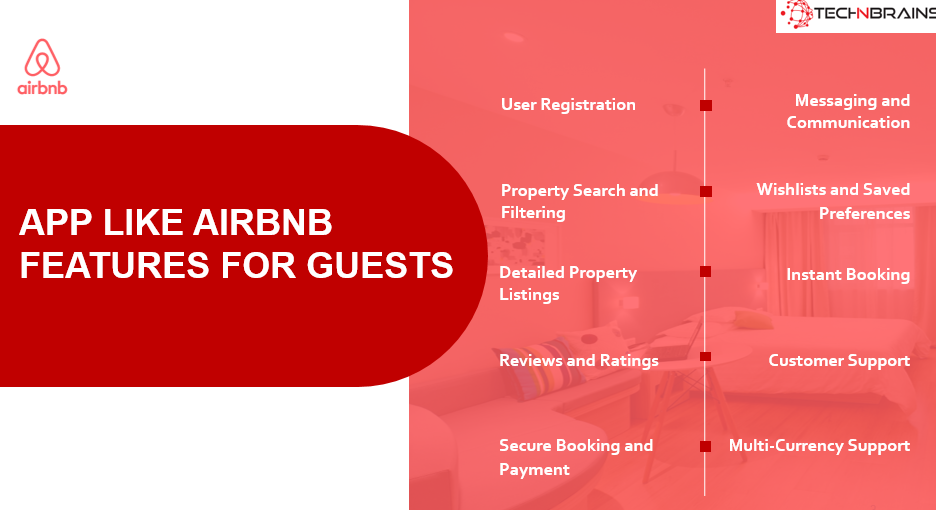
An app like Airbnb: Features for Guests
When building an app like Airbnb, it’s important to understand the key features that will attract and engage guests. By offering a user-friendly experience and valuable functionalities, you can create a successful vacation rental app. Let’s explore the essential features to include when building an app like Airbnb, specifically focusing on features for guests.
Features for Guests
Description
User Registration
Register and create profiles
Property Search and Filtering
Robust search function with advanced filters
Detailed Property Listings
Comprehensive property details
Reviews and Ratings
Feedback and rating system
Secure Booking and Payment
Secure booking and payment system
Messaging and Communication
Direct messaging between guests and hosts
Wishlists and Saved Preferences
Create wishlists and save preferences.
Real-Time Availability and Instant Booking
Up-to-date availability and instant booking
Customer Support
Reliable support channels
Localization and Multi-Currency Support
Language options and multi-currency support
1. User Registration and Profile Creation
Allow guests to register and create their profiles within an app like Airbnb. This enables them to personalize their experience, manage bookings, and access saved preferences and wishlists. Registration can be done using email or social media accounts, ensuring a seamless onboarding process.
2. Property Search and Filtering
Implement a robust property search functionality that allows guests to search for accommodations based on location, travel dates, and specific criteria. Enable advanced filters to refine search results based on price range, property type, amenities, and more. This feature helps guests find suitable accommodations on apps like Airbnb that match their preferences.
3. Detailed Property Listings
Ensure each property listing provides comprehensive details. Include property descriptions, high-quality images, amenities, pricing, availability calendars, and host profiles. This information helps guests on apps like Airbnb assess the suitability of the accommodation and make informed decisions.
4. Reviews and Ratings
Integrate a review and rating system that allows guests to provide feedback on their stay on apps like Airbnb. Display reviews and ratings prominently on property listings to help guests gauge the quality and reliability of accommodations. This feature builds trust and assists guests in making informed choices.
5. Secure Booking and Payment
Implement a secure booking and payment system to facilitate seamless transactions. Provide multiple payment options and ensure that personal and financial information is encrypted and protected. Guests should feel confident that their bookings and payments on apps like Airbnb are secure within the app.
6. Messaging and Communication
Enable direct messaging between guests and hosts within the app like Airbnb. This feature allows guests to ask questions, communicate specific requirements, and seek clarification before making a booking. It promotes effective communication and helps guests feel more comfortable during their stay.
7. Wish lists and Saved Preferences
Allow guests to create wish lists of their favorite accommodations on apps like Airbnb. Enable the saving of search preferences, such as location, dates, and amenities, for future reference. This feature enhances the user experience by providing a personalized and convenient way to track and organize desired properties.
8. Real-Time Availability and Instant Booking
Provide real-time availability updates to guests. Ensure that the availability calendars on property listings are always up to date. Consider implementing an instant booking option for selected accommodations on apps like Airbnb to allow guests to book immediately without host approval, increasing convenience and efficiency.
9. Customer Support
Offer reliable customer support channels to assist guests throughout their journey on apps like Airbnb. Provide options such as live chat, email support, and a helpline for prompt resolution of inquiries, issues, or emergencies. Excellent customer support enhances the overall guest experience.
10. Localization and Multi-Currency Support
Consider localizing the app like Airbnb to cater to a global audience. Provide language options and support multiple currencies to accommodate guests from different regions. This feature makes the app more accessible and user-friendly for international travelers.
Remember, building an app like Airbnb requires careful planning, user-centric design, and robust development. Conduct thorough market research, engage experienced developers, and continually iterate and improve your app based on user feedback and industry trends. By incorporating these essential features, you can create an engaging and successful vacation rental app for guests.
App like Airbnb: Features for Hosts
If you’re looking to create a vacation rental platform that empowers hosts, let us guide you through the key features that can enhance their experience and maximize their success.
Features
Description
Property Listing
Create and manage property listings.
Booking Management
Efficiently manage bookings and communicate with guests.
Communication
Messaging system for host-guest communication.
Reviews and Ratings
View and respond to guest reviews.
Pricing and Revenue
Manage pricing and maximize revenue.
Analytics and Metrics
Access data on booking trends and revenue.
Host Community and Support
Connect with hosts and receive customer support.
– Property Listing and Management
One of the core features for hosts in an app like Airbnb is the ability to create and manage property listings. Hosts should be able to easily create a listing that includes property details such as location, size, amenities, and photos. They should also have the flexibility to update availability, set pricing, and manage reservations conveniently through the app.
– Booking Management
Efficient booking management is crucial for hosts to keep track of reservations and ensure a smooth guest experience. The app like Airbnb should provide hosts with a centralized dashboard where they can view and manage upcoming bookings, review guest details, and communicate with guests. Integration with a calendar system can help hosts avoid double bookings and effectively plan their availability.
– Communication and Messaging
A robust messaging system within the app is essential for hosts to communicate with potential guests, address inquiries, and provide relevant information. The app like Airbnb should facilitate real-time messaging, allowing hosts to respond promptly and efficiently. Hosts should also receive notifications for new messages and booking inquiries to ensure timely communication.
– Reviews and Ratings
Reviews and ratings play a vital role in building trust and attracting potential guests. The app like Airbnb should enable hosts to view and respond to guest reviews, helping them maintain a positive reputation. Hosts should have the ability to address any concerns or issues raised by guests, demonstrating their commitment to providing an exceptional experience.
– Pricing and Revenue Management
An app like Airbnb should provide hosts with tools to manage pricing and optimize revenue. Hosts should be able to set dynamic pricing based on factors such as seasonality, demand, and local events. The app can provide insights and recommendations on competitive pricing to help hosts maximize their earnings. Additionally, integration with payment gateways should allow hosts to receive secure and timely payments for their bookings.
– Analytics and Performance Metrics
To help hosts make informed decisions and enhance their performance, the app like Airbnb should offer analytics and performance metrics. Hosts should have access to data such as booking trends, occupancy rates, and revenue analytics. These insights can guide hosts in refining their listing strategy, improving guest satisfaction, and maximizing their earning potential.
– Host Community and Support
An app like Airbnb should foster a sense of community among hosts. It can provide a platform for hosts to connect with each other, share experiences, and exchange tips. Additionally, the app should offer reliable customer support channels where hosts can seek assistance, report issues, and receive prompt resolutions.
By incorporating property listing and management tools, efficient booking management, seamless communication, reviews and ratings, pricing and revenue management capabilities, analytics and performance metrics, and a supportive host community, your app like Airbnb can empower hosts to provide exceptional experiences for guests while maximizing their own success.
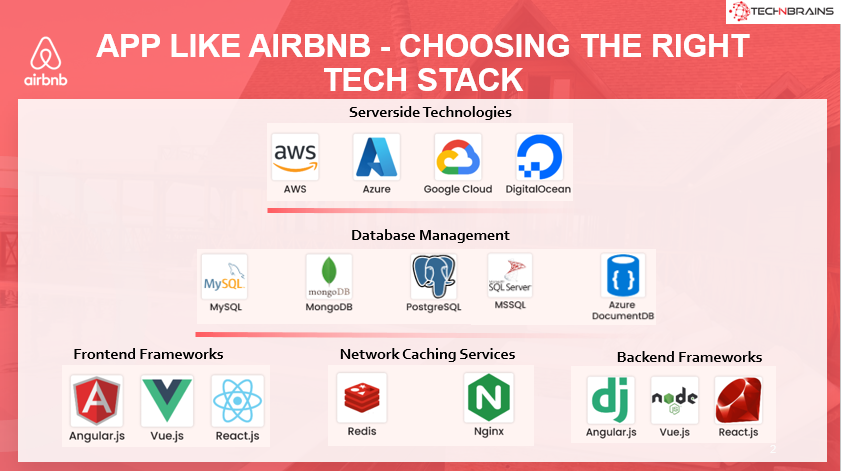
App like Airbnb: Choosing the Right Tech Stack
To develop an app like Airbnb, you would need to be familiar with various programming languages and frameworks. Here’s a breakdown of the tech stack commonly used for building such an application:
Frontend Frameworks
Angular.js: A popular JavaScript framework for building dynamic and responsive user interfaces.
Vue.js: A progressive JavaScript framework known for its simplicity and ease of integration.
React.js: A widely-used JavaScript library for building reusable UI components. If you want to build a hybrid app using React, then TechnBrains has you covered.
Server-side Technologies
AWS (Amazon Web Services): A cloud computing platform that provides a range of services for hosting, storage, and scalable infrastructure.
Azure: Microsoft’s cloud computing platform offers a variety of services for building, deploying, and managing applications.
Google Cloud: Google’s cloud computing platform provides infrastructure and various services for application development and deployment.
DigitalOcean: A cloud infrastructure provider known for its simplicity and developer-friendly environment.
Backend Frameworks
Django: A high-level Python web framework is known for its robustness and rapid development capabilities.
Node.js: A JavaScript runtime that allows you to build scalable server-side applications using JavaScript.
Ruby: A dynamic, object-oriented programming language often used with the Ruby on Rails framework for rapid web application development.
Database Management Technologies
MySQL: An open-source relational database management system that is widely used for data storage and retrieval.
MongoDB: A popular NoSQL database that stores data in a flexible, JSON-like format.
PostgreSQL: An open-source relational database management system known for its reliability and advanced features.
Now that we know what should go in another app like Airbnb let’s get down to make your own.
1. Understanding the Demand for Vacation Rental Apps
The first step in creating a vacation rental app like Airbnb is to recognize the demand for such platforms. The travel industry has witnessed a significant shift towards alternative accommodations, and travelers are increasingly looking for unique and personalized experiences. By catering to this demand, your app can tap into a growing market and attract a wide range of users.
2. Market Research and Analysis
Thorough market research is crucial to understanding the competition and identifying opportunities for differentiation. Analyze existing vacation rental apps, including their strengths and weaknesses. Identify the unique selling points that will set your app apart from the competition.
3. Defining Your Target Audience
To develop a successful vacation rental app, it’s essential to define your target audience. Consider factors such as demographics, travel preferences, and user behavior. This information will help you tailor your app’s features and marketing strategies to attract and retain your desired user base.
4. Identifying Key Features and Functionality
The success of your app hinges on offering the right features and functionality. Some essential features include property listings, booking management, secure payment systems, user profiles, reviews, and ratings, search and filter options, and messaging capabilities. Identify additional features that will enhance the user experience and make your app stand out.
5. Choosing the Right Technology Stack
Selecting the appropriate technology stack is vital for the development of a robust and scalable vacation rental app. Consider factors such as the platform (iOS, Android, or both), programming languages, frameworks, and third-party APIs. Engaging with an experienced mobile app development company can greatly assist in making the right technology choices.
6. Designing a User-Friendly Interface
A user-friendly interface is crucial for attracting and retaining users. Invest in intuitive design principles, ensuring that users can navigate your app effortlessly. Create a visually appealing interface that showcases property listings effectively and allows users to view images, amenities, and pricing details seamlessly.
7. Implementing Secure Payment Systems
Incorporating secure payment systems is vital to establishing trust among users. Integrate reliable payment gateways that offer secure transactions and multiple payment options. Ensure compliance with data security standards to protect user information.
8. Ensuring Effective Property Management
Efficient property management features are essential for both hosts and guests. Develop a robust backend system that allows hosts to manage their listings, availability, and pricing. Enable guests to view property details, check availability, and make bookings with ease.
9. Integrating User Reviews and Ratings
User reviews and ratings are critical for building trust and credibility within your app. Implement a review and rating system that allows guests to provide feedback and rate their experiences. Encourage hosts to maintain high standards to enhance their reputation.
10. Implementing Search and Filter Options
To enhance the user experience, incorporate advanced search and filter options. Enable users to refine their search based on location, price range, amenities, and other relevant criteria. This functionality will help users find the most suitable accommodations quickly.
11. Enabling Instant Messaging and Notifications
Facilitate communication between hosts and guests by enabling instant messaging within your app. This feature allows users to clarify any doubts or discuss specific requirements directly. Additionally, implement push notifications to keep users informed about booking updates, special offers, and other relevant information.
12. Incorporating Geolocation Services
Geolocation services are instrumental in providing accurate search results and personalized experiences. Incorporate geolocation features to display nearby accommodations, attractions, and amenities. This will help users make informed decisions based on their preferences and location.
13. Monetization Strategies
To make your app financially viable, consider various monetization strategies. Popular options include charging hosts a commission on bookings, offering premium listing features, and displaying targeted advertisements. Choose a strategy that aligns with your app’s value proposition and user base.
14. Marketing and Promoting Your App
Developing a high-quality app is only the first step. Effective marketing and promotion are essential to attract users and gain traction in the market. Utilize online marketing channels, social media platforms, influencer collaborations, and app store optimization techniques to reach your target audience.
15. Testing and Launching Your App
Thoroughly test your app across different devices and operating systems to ensure optimal performance and usability. Address any bugs or issues before the official launch. Create a buzz around your Airbnb like app launch and provide incentives for early adopters to encourage downloads and user engagement.
Cost to Build an App like Airbnb
When building one platform with limited functionality, the cost to develop an Airbnb-like app should be between $25,000 and $30,000. However, choosing platforms for both iOS and Android that have extensive functionalities directly increases the cost and could run up to $5000–6000 in total.
The Top 7 Vacation Rental Booking Apps like Airbnb
These top 7 alternative app like Airbnb, provide a diverse range of options for booking vacation rentals, catering to various preferences, budgets, and travel experiences. Whether you’re wondering what another app like Airbnb? for a cozy cabin in the mountains, a luxurious villa by the beach, or a city apartment with exceptional amenities, this other app like Airbnb offers a wealth of choices for memorable stays.
1. Vrbo
Vrbo, which stands for Vacation Rentals By Owners, has been in operation since 1995 and has become one of the leading alternatives to Airbnb.
With over 2 million vacation rentals available, including condos, cabins, lake houses, and beachfront properties, Vrbo offers a wide range of options for travelers.
Whether you’re planning a weekend getaway or a family trip, Vrbo provides homes suitable for all types of vacations.
2. Booking.com
Founded in 1996, Booking.com is a well-established digital travel company that offers more than just vacation rentals.
With over 28 million listings across 120,000 destinations worldwide, it provides a comprehensive platform for travelers.
In addition to vacation rentals, Booking.com enables users to book hotels, flights, car rentals, city attractions, and even airport taxis.
3. Plum Guide
While relatively new to the vacation rental market, Plum Guide has gained popularity by focusing on offering only the top 1% of holiday homes.
Founded in 2015, Plum Guide follows a rigorous vetting process for every listed home in cities across the United States, the United Kingdom, and Europe.
Only the homes that pass their 150-point Plum Test are accepted, ensuring guests are provided with exciting spaces that offer hotel-like amenities, such as fast Wi-Fi, quality linens, fluffy towels, and well-stocked kitchens. Plum Guide also focuses on curating characterful neighborhoods that are well-connected for exploring the city.
4. TripAdvisor Rentals
Established in 2000, TripAdvisor is a well-known online travel company that offers hotel reservations, transportation bookings, and travel experiences.
To cater to the growing demand for vacation rentals, TripAdvisor introduced a separate service called TripAdvisor Vacation Rentals.
TripAdvisor Rentals offers exceptional spaces with privacy and convenience, ensuring a memorable stay for travelers.
5. HomeExchange
Unlike other apps similar to Airbnb, HomeExchange operates on the concept of home and apartment exchanges.
This unique approach allows members to swap homes with one another for their vacations. HomeExchange offers two types of exchanges: the Classic Exchange, which is reciprocal, and the Exchange with GuestPoints, which is non-reciprocal.
In the Classic Exchange, two families exchange their homes either simultaneously or on different dates. GuestPoints are used as a currency to facilitate non-reciprocal exchanges. This flexible exchange system allows travelers to experience new destinations while saving on accommodation costs.
6. HouseTrip
As a part of TripAdvisor, HouseTrip is one of the largest vacation rental websites globally, offering over 350,000 rentals across the United Kingdom and other international destinations.
HouseTrip’s rentals are an ideal alternative to hotels, providing more space, extra bedrooms, kitchens, Wi-Fi, and laundry facilities at no extra charge.
The platform is attractive for property owners as well, offering a free listing service and charging just a 3% commission (excluding VAT) on confirmed bookings.
7. Onefinestay
True to its name, Onefinestay offers some of the finest homes and villas in dreamy destinations. With a focus on luxury and exceptional service, Onefinestay provides unique and upscale accommodations.
Their collection is categorized into City Collection and Villa Collection, catering to different preferences and travel experiences.
The City Collection offers luxurious homes in urban settings, while the Villa Collection provides exquisite villas in stunning locations. Additionally, they offer a 2-day cancellation period for select homes, giving travelers flexibility in their bookings.
Choose TechnBrains for Building Your App like Airbnb
When it comes to building an app like Airbnb, choosing the right development partner is crucial. TechnBrains is the best mobile app development company with a proven track record of delivering exceptional mobile app solutions. With our expertise and experience, we can bring your vision of a successful vacation rental app to life.
At TechnBrains, we specialize in developing robust and scalable apps that match the functionality and user experience of Airbnb. Our talented team of developers, designers, and project managers possess deep knowledge of the latest technologies and frameworks required for building successful vacation rental platforms.
From ideation to deployment and ongoing maintenance, TechnBrains provides end-to-end development services. Our streamlined development process ensures efficient project management, timely delivery, and continuous communication. We collaborate closely with you throughout the development journey, ensuring that your requirements are met at every stage. Our goal is to create an Airbnb-like app that not only meets your expectations but also exceeds them.
Partnering with TechnBrains for your Airbnb-like app development ensures a high-quality, scalable, and customized solution that will set you apart in the vacation rental market. Contact us today to discuss your project and turn your vision into reality.
FAQs
Can I create a vacation rental app like Airbnb without prior coding experience?
Yes, you can hire a professional mobile app development company to handle the technical aspects of app development if you don’t have coding experience.
Are there any legal considerations for developing a vacation rental app?
Yes, ensure compliance with local regulations, including property rental laws, data privacy, and taxation.
Can I integrate additional features not found in Airbnb?
Absolutely! Identifying unique features that differentiate your app from Airbnb can attract more users and provide added value.
How long does it take to develop a vacation rental app like Airbnb?
The development time depends on various factors such as complexity, features, and the size of your development team. It can range from a few months to a year or more.
What are the ongoing maintenance costs for a vacation rental app?
Ongoing maintenance costs include hosting, server maintenance, updates, bug fixes, and customer support. Budget for these costs to ensure a smooth user experience.
If you want to build an App like Uber, TechnBrains is here with all the information you need to build one. Let’s look at some Uber Stats in 2023 to get started.
Uber, established in 2009, has expanded its operations to encompass over 900 metropolitan areas worldwide. Undoubtedly, Uber has achieved immense success by offering customers a cost-effective and efficient means of transportation.
The integration of technology introduced by Uber was not only innovative but also disruptive. Uber now has 93 million active users as of 2023, with five cities alone contributing the 22% of Uber’s gross bookings. As the mobile app industry has been shaping the world for quite a while now, the boom of taxi apps like Uber has been a game-changer for custom mobile app development company.
(Source: Backlinko)
App Like Uber – Use Cases
Despite facing intense competition from various similar apps, Uber continues to stand its ground and dominate the ridesharing market. Below are some examples of apps like Uber:
Lyft
Lyft offering similar services is the biggest competitor of Uber. There are some notable differences in it, like the Lyft drivers are required to pass the background check and have a clean driving record. It also offers an economical carpool service that allows you to share rides with other passengers called Lyft Line.
Via
Via matches riders and drivers through the ridesharing service using a dynamic pricing approach. This implies that the cost of your journey will change based on variables like supply and demand. Via also has a shared transport option.
Curb
You may order a taxi, request a trip, or plan a ride in advance with the taxi app Curb. You may also reserve a black automobile or an SUV through Curb’s car service option.
Wingz
Wingz offers a reliable and efficient service for airport travel through its specialized ridesharing platform. You can effortlessly pre-book a ride and enjoy the benefits of saving both your time and money.
Flywheel
If you’re a business traveler in need of dependable transportation, Flywheel is the way to go. You can count on our experienced drivers and user-friendly features like ride tracking and expense reporting to make your travel experience effortless and worry-free.
How does the Uber App Work?
A driving app like Uber operates through a user-friendly interface, connecting riders and drivers seamlessly to facilitate convenient and reliable transportation services. Here is a detailed breakdown of how the Uber app works:
1. Registration and Account Setup
Users download the Uber app from their respective app stores and register for an account. They provide personal information, including their name, phone number, email address, and preferred payment method.
2. Requesting a Ride
Riders open the app and specify their desired pickup location and destination. They can also choose the type of vehicle they prefer, such as UberX, UberXL, Uber Black, or UberPool. The app displays an estimated fare and the estimated time of arrival for the nearest available drivers.
3. Driver Matching
Once a ride request is made, the app uses GPS technology to locate nearby Uber drivers. The app sends the ride request to multiple drivers in the vicinity, and the first driver to accept the request is assigned to the ride. Riders can track the driver’s location and estimated time of arrival in real time on the app’s map.
4. Ride Confirmation
Once a driver accepts the ride request, the rider receives a confirmation notification with the driver’s details. This includes the driver’s name, profile picture, license plate number, and the make and model of the vehicle.
5. Ride Experience
Riders wait at the specified pickup location for the driver to arrive. The app provides notifications and updates about the driver’s arrival time. Riders can contact the driver through the app’s messaging or calling feature if needed. Once inside the vehicle, the driver begins the trip by starting the ride in the app.
6. Navigation and Route Optimization
The driver uses the built-in navigation system in the app to reach the destination. The app provides turn-by-turn directions and real-time traffic updates to optimize the route and minimize travel time.
7. Fare Calculation and Payment
At the end of the ride, the app automatically calculates the fare based on factors like distance traveled and duration. Riders can view the fare breakdown on their app, including any additional charges or discounts.
The fare is charged to the user’s preferred payment method, such as a credit card or digital wallet, which is securely stored in the app. Riders have the option to add a tip for the driver directly through the app or provide a cash tip.
8. Rating and Feedback
After the ride, both the rider and driver have the opportunity to rate each other and provide feedback. This two-way rating system helps maintain a high level of service quality and accountability.
9. Receipt and Trip History
Riders receive an electronic receipt via email or within the app detailing the trip’s fare and other relevant information. The app stores a history of past rides, allowing users to access receipts, review previous routes, and track expenses.
Overall, the Uber app provides a streamlined and user-friendly experience, connecting riders with drivers efficiently and offering a range of transportation options to suit different needs.
How to Make an App like Uber – Features
Developing an Uber-like app involves a combination of essential features and functionalities that contribute to a seamless and reliable ride-hailing experience. Here is a detailed breakdown of the key features you should consider when developing an app like Uber:
User Registration and Profile Management
Allow users to sign up and create their profiles using their email, phone number, or social media accounts. Enable users to manage their personal information, payment methods, and preferences within the app.
Geolocation and Map Integration
Integrate GPS technology to determine the user’s current location and provide accurate real-time positioning. Incorporate maps and route optimization to display nearby drivers, track the vehicle’s progress, and suggest the best routes.
Ride Booking and Fare Calculation
Enable users to request a ride by selecting their pickup and drop-off locations. Implement algorithms to calculate fares based on factors such as distance, time, surge pricing, and additional services. Display an estimated fare before confirming the ride, allowing users to make informed decisions.
Driver Availability and Matching
Develop a system to manage driver availability and display nearby drivers to users. Implement a matching algorithm that considers factors like proximity, rating, and driver preferences to assign the most suitable driver for the ride request.
Real-time Tracking and Notifications
Provide users with real-time updates on the driver’s location, estimated arrival time, and other relevant information. Send push notifications or in-app messages to inform users about ride confirmations, driver arrivals, and other important updates.
In-app Payments and Receipts
Integrate secure payment gateways to enable cashless transactions within the app. Support multiple payment options such as credit/debit cards, digital wallets, and mobile payment systems. Generate and send digital receipts to users after completing the ride.
Ratings and Reviews
Allow users to rate drivers and leave reviews based on their ride experience. Implement a feedback system to maintain quality standards and improve the overall user experience.
Driver Management
Provide a separate app or dashboard for drivers to manage their profiles, accept or reject ride requests, and track earnings. Include features for driver verification, background checks, and document submission to ensure safety and trustworthiness.
Admin Panel
Develop an admin panel to manage and monitor the entire platform, including user accounts, driver registrations, payments, and reported issues. Implement analytics and reporting tools to gain insights into user behavior, driver performance, and overall system efficiency.
How to Make an App like Uber – Features for Riders
When it comes to developing an Uber-like app for riders, several key features can enhance the user experience and make the app more convenient and efficient. Here is a detailed list of features commonly found in such applications:
Registration and Profile Creation
Users should be able to create an account and set up their profiles with essential details like name, contact information, and payment preferences. This allows for a personalized experience and easy identification.
Real-Time Booking
The app should allow riders to request a ride instantly by selecting their pickup and drop-off locations. The integration of GPS technology enables the app to provide accurate location tracking and estimated arrival times for drivers.
Multiple Vehicle Options
Riders should have the flexibility to choose from various vehicle options based on their needs and preferences. This can include options like economy cars, luxury vehicles, SUVs, or even specialized services such as wheelchair-accessible vehicles.
Fare Estimation
The app should provide riders with an estimated fare for their trip before confirming the booking. This helps users plan their budget and make informed decisions.
Driver Ratings and Reviews
After completing a ride, riders should have the option to rate and provide feedback on their experience with the driver. This helps maintain service quality and allows future riders to make informed choices.
Payment Integration
Seamless and secure payment options are crucial for an Uber-like app. Integration with popular payment gateways allows riders to pay for their trips directly within the app using credit/debit cards, digital wallets, or other supported payment methods.
Ride Tracking
Real-time tracking of the assigned driver’s location allows riders to monitor their driver’s progress and the estimated time of arrival. This feature enhances transparency and provides peace of mind to riders.
Trip History and Receipts
Riders should have access to a trip history section where they can review details of their past trips, including route taken, distance traveled, and fare breakdown. They should also be able to download or receive digital receipts for their records.
In-app Support
A dedicated support system within the app enables riders to reach out to customer service if they encounter any issues or have inquiries. This can be in the form of a live chat, email support, or a helpline number.
Multi-language and Multi-Currency Support
To cater to a diverse user base, the app should provide language options and support multiple currencies for payment.
Integration with External Services
Integration with external services like Google Maps or Waze can provide accurate navigation and real-time traffic updates for drivers, ensuring efficient and timely rides for riders.
These are some of the key features that can be incorporated into an Uber-like app for riders. However, it’s important to note that the specific features and their implementation may vary based on the requirements and customization preferences of the app development process.
How to Make an App like Uber – Features for Drivers
To create an app like Uber for drivers, there are several key features that should be considered. These features are designed to provide drivers with a user-friendly platform that enables them to offer transportation services efficiently and effectively. Here are some detailed features for a driver-focused app like Uber:
Registration and Profile Creation
Drivers should be able to easily sign up and create their profiles within the app. This process typically involves providing personal information, vehicle details, driver’s license verification, and other required documents.
Geolocation and Mapping
Integration of geolocation services allows drivers to track their own location in real time and receive accurate navigation instructions. This feature also enables drivers to locate passengers and plan their routes efficiently.
Trip Acceptance and Management
Drivers should be able to accept or decline ride requests based on their availability. Once a ride is accepted, the app should provide them with detailed trip information, including passenger details, pickup and drop-off locations, and estimated fare.
Real-time Tracking
This feature allows drivers to track the progress of their trip, ensuring that they stay on the right track and reach their destination efficiently. Real-time tracking also provides passengers with visibility of their driver’s location.
In-app Communication
An in-app messaging or calling feature enables drivers and passengers to communicate directly within the app. This allows drivers to contact passengers for any necessary clarifications or updates regarding the trip.
Earnings and Payment Management
Drivers should have access to a comprehensive earnings dashboard that provides details on their trip history, earnings, and incentives. The app should also facilitate seamless and secure payment processing, allowing drivers to receive their earnings directly into their bank accounts or digital wallets.
Ratings and Feedback
This feature enables passengers to rate and provide feedback on their experience with the driver. Driver ratings can help improve service quality and build trust within the community.
Driver Support and Assistance
A dedicated support system should be available to drivers, allowing them to report issues, ask questions, or seek assistance whenever needed. This could be through in-app chat support, email, or phone.
Driver Safety Features
Safety is a critical aspect of any transportation service. The app should include features like an SOS button, emergency contact information, and an option to share trip details with trusted contacts for enhanced driver safety.
Creating an app like Uber for drivers requires careful consideration of these features to ensure a seamless experience for both drivers and passengers. Additionally, it is crucial to comply with local regulations and ensure data security and privacy throughout the app development process.
Admin Panel for an App like Uber
The Admin Panel for an app like Uber plays a crucial role in managing and overseeing the operations of the entire platform. It provides administrative control and facilitates efficient management of various aspects of the app. Here is a detailed description of the key features and functionalities commonly found in an Admin Panel for an app like Uber:
User Management
The Admin Panel allows the administrators to manage user accounts and profiles. They can view user details, verify identities, manage permissions, and handle user-related issues such as blocking or suspending accounts if necessary.
Driver Management
The panel provides tools to manage the driver network. Admins can onboard new drivers, review and verify their documents, set driver availability, track driver ratings, and handle any driver-related concerns.
Trip Management
This feature allows administrators to monitor and track ongoing trips. They can view trip details, including pickup and drop-off locations, trip fares, distance traveled, and the driver assigned to the trip. Admins can intervene or provide assistance during trips if needed.
Pricing and Fare Management
The Admin Panel enables administrators to set and manage pricing rules and fare structures. They can configure base fares, surge pricing during peak hours, minimum fare thresholds, and any additional charges. This helps maintain consistency and flexibility in fare calculations.
Analytics and Reporting
The panel provides comprehensive analytics and reporting features. Admins can access various metrics such as the number of trips, active users, driver performance, revenue generated, popular routes, and customer feedback. These insights help in making data-driven decisions and identifying areas for improvement.
Support and Communication
The Admin Panel includes a communication system to handle customer support queries and driver communications. Admins can interact with users and drivers through in-app messaging, push notifications, or email. They can resolve issues, provide assistance, and ensure effective communication across the platform.
Vehicle Management
In an app like Uber, the Admin Panel allows administrators to manage the fleet of vehicles associated with the platform. They can view vehicle details, track maintenance schedules, ensure regulatory compliance, and manage vehicle documentation.
Geolocation and Mapping
The Admin Panel integrates with mapping services to provide real-time monitoring of vehicles, track driver locations, and display the status of active trips. This ensures efficient dispatching, effective route optimization, and overall operational visibility.
Payments and Financial Management
Admins can monitor and manage financial transactions within the platform. They can view payment details, handle refunds or cancellations, manage payment gateways, and ensure secure and reliable financial operations.
Content Management
The panel enables administrators to manage content displayed within the app. They can update information such as FAQs, help sections, promotions, and notifications to ensure accurate and up-to-date information for users and drivers.
System Configuration and Settings
Admins have access to system settings and configurations, allowing them to customize various aspects of the app. This includes setting up language preferences, currency options, notification preferences, and other platform-specific settings.
Overall, the Admin Panel for an app like Uber acts as a centralized hub for managing and monitoring the entire platform. It empowers administrators with the tools and data necessary to ensure smooth operations, enhance user experience, and drive business growth.
How to Make an App like Uber – Business Strategy Uber’s business strategy can be characterized by several key elements:
Disruptive Innovation
Uber’s strategy centered on leveraging technology to disrupt the traditional taxi industry. By introducing a user-friendly mobile app that connected riders with drivers, Uber revolutionized the way people accessed transportation services.
Platform Business Model
Uber adopted a platform-based business model, acting as an intermediary between riders and drivers. This approach enabled them to scale rapidly without the need to own a fleet of vehicles or employ drivers directly. By providing a seamless platform for both riders and drivers, Uber created a network effect, attracting more users and drivers to its platform.
Pricing and Convenience
Uber differentiated itself by offering competitive pricing and convenient services. Its dynamic pricing model, based on supply and demand, allowed for flexible pricing during peak hours, ensuring the availability of drivers when needed. The ease of booking a ride and tracking its progress in real time also contributed to Uber’s success.
Focus on Customer Experience
Uber prioritized the customer experience by providing convenient payment options, reliable service, and safety features such as driver ratings and GPS tracking. By continuously improving and refining its services based on customer feedback, Uber built a loyal customer base.
Expansion and Market Penetration
Uber pursued an aggressive expansion strategy, rapidly entering new markets around the world. This approach allowed Uber to establish a strong global presence and capitalize on the growing demand for ride-hailing services. By localizing its operations and adapting to local regulations, Uber overcame many barriers to entry in different markets.
Diversification
In addition to its core ride-hailing service, Uber expanded into other areas such as food delivery (Uber Eats), freight transportation (Uber Freight), and electric bikes and scooters (Jump). This diversification strategy helped Uber tap into new revenue streams and broaden its customer base.
Uber’s success can be attributed to several factors
Technological Disruption
Uber leveraged technology to disrupt an industry that had remained largely unchanged for decades. The convenience and ease of use offered by its app-based platform revolutionized the way people accessed transportation services.
Customer-Centric Approach
Uber focused on providing a superior customer experience by addressing pain points in traditional taxi services. Features like upfront pricing, cashless transactions, and real-time tracking resonated with customers, leading to widespread adoption.
Scalability and Network Effects
Uber’s platform model allowed for rapid scalability and expansion into new markets. As more riders joined the platform, the availability of drivers increased, leading to shorter wait times and improved service quality. This virtuous cycle of supply and demand fueled Uber’s growth.
Continuous Innovation
Uber demonstrated a commitment to continuous innovation by introducing new features, services, and partnerships. By staying ahead of competitors and adapting to changing market dynamics, Uber maintained its competitive edge.
Brand Recognition
Uber’s brand became synonymous with ride hailing, achieving a level of recognition and trust that gave it a significant advantage over newer entrants. This brand strength helped Uber attract both riders and drivers, further solidifying its market position.
Overall, Uber’s success can be attributed to its disruptive business model, customer-centric approach, aggressive expansion, and continuous innovation in an industry ripe for transformation.
Uber Vs Lyft
Uber and Lyft are two prominent ridesharing companies that have revolutionized the transportation industry. Have a look at the table below for the comparison of App like Uber vs Lyft.
Features
Uber
Lyft
Availability
Operates in over 900 metropolitan areas worldwide.
Operates in over 600 cities across the United States.
Ride Options
Offers various ride options such as UberX, Uber Black, etc.
Provides ride options like Lyft Standard, Lyft XL, etc.
Carpooling
Provides carpooling options like UberPool.
Offers carpooling services like Lyft Line.
Driver Requirements
Requires drivers to meet specific vehicle and document criteria.
Sets driver requirements based on vehicle and documents.
Pricing Model
Primarily uses dynamic pricing based on demand (surge pricing).
Implements surge pricing during high-demand periods.
App Interface
Features a user-friendly and intuitive interface.
Offers an easy-to-use app interface.
Loyalty Program
Offers Uber Rewards to earn points and benefits.
Provides the Lyft Rewards program for customer benefits.
International Presence
Operates in many countries globally.
Focuses primarily on the United States and Canada.
Brand Perception
Often perceived as a more established and larger company.
Seen as a more friendly and community-oriented brand.
Comparison of Uber vs. Lyft
How to Make an App Like Uber – Technology Stack
The Uber app is built using a combination of various technologies and frameworks to provide a seamless and reliable ridesharing experience. Here are some key technologies that power the Uber app in 2020:
Mobile App Development: The Uber app is developed natively for both iOS and Android platforms using their respective development frameworks.
Geolocation: Uber heavily relies on GPS (Global Positioning System) technology to track the real-time location of drivers and passengers. This allows for accurate pickup and drop-off coordination.
Mapping and Routing: Uber integrates with mapping services like Google Maps or Mapbox to provide accurate directions and efficient routes for drivers and passengers.
Real-Time Data Streaming: The app utilizes real-time data streaming technology to ensure that drivers and passengers receive up-to-date information regarding trip requests, driver availability, and estimated arrival times.
Payment Gateway Integration: Uber integrates with popular payment gateways to facilitate seamless and secure transactions. This involves integrating APIs (Application Programming Interfaces) of payment service providers.
Push Notifications: The app employs push notification services to send timely updates and alerts to both drivers and passengers regarding trip confirmations, driver arrival, and other important information.
Communication: Uber includes in-app communication capabilities to enable drivers and passengers to communicate with each other, usually through chat or call features.
Comparison of iOS vs. Android Tech Stack
Development Aspect
iOS Technology Stack
Android Technology Stack
Programming Languages
Swift, Objective-C
Java, Kotlin
Frameworks
UIKit, Core Location, MapKit
Android SDK, Google Maps API
Backend Development
Node.js, Ruby on Rails
Node.js, Ruby on Rails
Database
PostgreSQL, MySQL
PostgreSQL, MySQL
Cloud Storage
Amazon S3, Google Cloud Storage
Amazon S3, Google Cloud Storage
Real-time Messaging
Firebase Cloud Messaging
Firebase Cloud Messaging
Payment Integration
Apple Pay, Stripe
Google Pay, Stripe
Geolocation Services
Core Location, MapKit
Google Location Services, Google Maps
Analytics
Google Analytics, Firebase Analytics
Google Analytics, Firebase Analytics
Technological Integrations to Create an App like Uber
To create an app similar to Uber, you would need to integrate various technologies and features. Here are some essential technological integrations:
User Registration and Authentication: Implement a secure registration and authentication system to onboard drivers and passengers onto the platform.
Geolocation and Mapping: Integrate geolocation services and mapping APIs to enable real-time tracking of drivers and passengers, as well as provide accurate directions.
Ride Request and Matching: Develop algorithms to handle ride requests, match drivers with passengers based on proximity and availability, and calculate estimated fares.
Payment Gateway Integration: Integrate a secure payment gateway to process transactions between drivers and passengers.
Ratings and Reviews: Implement a system for users to rate and review drivers, enhancing trust and accountability within the platform.
Notifications: Set up push notification services to keep users informed about trip updates, driver arrival, and other important notifications.
Admin Dashboard: Create an administrative dashboard to manage drivers, passengers, payments, and other aspects of the platform.
Technological integration and their descriptions
Technological Integration
Description
Geolocation Services
Integration of GPS and mapping services for real-time location tracking and route optimization.
Payment Gateway Integration
Secure integration with popular payment gateways to enable seamless and cashless transactions between users and drivers.
Messaging Services
In-app messaging functionality to facilitate communication between users and drivers for ride coordination and updates.
Push Notifications
Real-time notifications to inform users about ride status, driver arrival, and other important updates.
Social Media Integration
Optional integration with social media platforms for user registration, sharing, and referrals.
Analytics and Reporting
Integration of analytics tools to track app performance and user behavior and generate reports for data-driven insights.
Reviews and Ratings
User review and rating system to ensure accountability and maintain service quality.
API Integration
Integration with external APIs for services like weather data, traffic updates, and third-party app integrations.
Cloud Hosting
Reliable cloud hosting services to support the app’s backend infrastructure and handle high user traffic.
Security and Authentication
Implementation of secure authentication mechanisms to protect user data and prevent unauthorized access.
Voice Assistance Integration
Optional integration with voice assistants to enable voice commands and enhance user experience.
How Much Does It Cost to Develop an App Like Uber?
The cost of developing an app similar to Uber involves various factors that contribute to the overall pricing model. To gain a better understanding, let us delve into the breakdown of pricing for an Uber-like app.
Pre-development Costs
Before diving into the development process, pre-development costs are incurred. These costs include market research, feasibility studies, identifying business objectives, and assembling the right development team. Depending on the project’s complexity, pre-development costs typically range from $10,000 to $50,000.
Infrastructure Costs
Building an Uber-like app requires a robust technical infrastructure to handle a large user base and real-time data processing. Some essential technical infrastructure costs to consider are as follows:
Backend Development: Creating a scalable backend infrastructure is crucial for an Uber-like app, and its cost can vary based on the app’s features. Typically, backend development costs range from $25,000 to $50,000.
API Integration: Integrating various APIs is essential for an Uber-like app to provide services like location-based services, payment gateways, and messaging. The cost of API integration falls within the range of $10,000 to $25,000.
Cloud Hosting: Reliable cloud hosting is necessary to support the backend infrastructure of an Uber-like app. The cost of cloud hosting varies depending on the hosting provider and app traffic, typically ranging from $5,000 to $10,000 per year.
Design and Development Costs
Moving on to design and development costs, these factors may vary based on platform selection, desired features, and the size of the development team. The breakdown is as follows:
iOS and Android App Development: Developing an Uber-like app for both iOS and Android platforms can cost between $50,000 – $100,000. This estimate includes essential features such as login/signup, ride request, driver tracking, payment gateway integration, and messaging.
Web Development: Creating a web interface for an Uber-like app may cost from $25,000 to $50,000.
UI/UX Design: A user-friendly and visually appealing design is crucial for an Uber-like app’s success. The cost of UI/UX design can range from $10,000 to $30,000, depending on the team size.
Additional Costs of making an app like Uber
Additionally, there are some additional costs associated with building an Uber-like app:
Testing and Quality Assurance: Testing and ensuring the app’s quality is vital and can cost between $5,000 to $15,000.
App Deployment: Deploying the app on the App Store or Google Play Store requires an annual fee of $99 and $25, respectively.
Maintenance and Updates: Regular maintenance and updates are necessary to keep the app running smoothly. The cost of maintenance and updates can range from $5,000 to $10,000 per year.
Considering the various components involved, the total cost of developing an Uber-like app typically ranges from $150,000 to $300,000 or more, depending on the project’s complexity and desired features. It’s crucial to note that these figures are estimates and can vary based on specific requirements and market conditions.
Our step-by-step process of building an app like Uber
TechnBrains offers a systematic process to creating an app similar to Uber. Here is a summary of the steps involved in building your own Uber-like app:
Conceptualization and Planning
Define your app’s purpose, target audience, and unique selling points. Conduct market research to understand user demands and preferences. Create a detailed plan outlining features, functionalities, and monetization strategies.
Design and User Interface
Develop wireframes and prototypes to visualize the app’s structure and flow. Design an intuitive user interface (UI) and ensure a seamless user experience (UX). Focus on simplicity, clarity, and ease of use to enhance user engagement.
Backend and Frontend Development
Choose a suitable technology stack for your app’s backend development. Implement a scalable and robust server infrastructure to handle user requests. Develop APIs to facilitate communication between the app’s frontend and backend. Select appropriate frameworks and programming languages for app development. Create interactive screens, navigation, and features based on the wireframes. Implement real-time tracking, payment gateways, and push notifications.
Geolocation and Mapping
Integrate geolocation services to enable real-time tracking and accurate location identification. Utilize mapping APIs to display routes, estimated arrival times, and driver locations.
User Authentication and Profiles
Implement secure user authentication and authorization mechanisms. Allow users to create profiles, manage personal information, and save payment methods.
Driver Management
Develop a separate interface for drivers to receive and accept ride requests. Implement features for driver registration, background checks, and rating systems.
Ride Booking and Management
Enable users to request rides, select vehicle types, and specify pickup/drop-off locations. Implement algorithms for efficient ride matching and fare calculation. Provide real-time updates on ride status, driver arrival, and estimated arrival times.
Payment Integration
Integrate secure payment gateways to facilitate cashless transactions. Implement features for automatic fare calculation, receipts, and invoice generation.
Testing and Quality Assurance
Conduct comprehensive testing to identify and resolve bugs, errors, and performance issues. Perform usability testing to ensure a seamless user experience. Gather feedback and make necessary improvements based on user testing results.
Launch and Deployment
Prepare the app for deployment on app stores (e.g., Apple App Store, Google Play Store). Adhere to the respective app store guidelines and submission processes. Plan a marketing strategy to promote your app and attract users.
Maintenance and Updates
Regularly update and maintain your app to ensure compatibility with new OS versions and devices. Address user feedback, add new features, and improve overall performance.
TechnBrains’ experience in Uber like App Development
TechnBrains is the best mobile app development company in USA, with extensive experience in Uber-like app development. Over the years, we have successfully designed, developed, and deployed several high-quality on-demand transportation applications similar to apps like Uber and Lyft.
Our team of skilled developers, designers, and project managers work collaboratively to create customized solutions tailored to the specific needs of their clients. TechnBrains follows a comprehensive development process that includes requirement analysis, design prototyping, development, testing, and deployment.
The in-depth knowledge of the latest technologies and frameworks necessary for building robust and scalable Uber-like applications is just one of the reasons why you should choose TechnBrains. Their expertise extends to key features such as real-time tracking, secure payment gateways, driver and passenger profiles, ratings and reviews, surge pricing, and navigation integration.
TechnBrains focuses on delivering user-friendly interfaces and seamless user experiences to ensure customer satisfaction. We also prioritize data security, ensuring that sensitive user information remains protected throughout the app’s functionality.
With our extensive experience and expertise in Uber-like app development, TechnBrains is well equipped to handle complex projects and provide reliable solutions. So why wait? Get an App like Uber developed now.
FAQs
How to create an app like Uber?
Key features required for an Uber-like app include ride booking, real-time tracking, driver management, payment integration, user authentication, reviews and ratings, and geolocation services. For a detailed overview, TechnBrains can help you build an app like Uber.
What features are required to build an app like Uber?
To create an app like Uber, follow these steps: conceptualize and plan, design the user interface, develop the backend and frontend, integrate geolocation and mapping, implement user authentication and profiles, manage drivers, handle ride booking and management, integrate payment systems, conduct testing, and launch the app.
How much does it cost to build an app like Uber?
The cost to build an app like Uber can range from $150,000 to $300,000 or more, depending on factors such as development complexity, platform selection, location, and features. This cost includes pre-development expenses, technical infrastructure, design and development, testing, deployment, and ongoing maintenance and updates.
As an iOS mobile app developer, you play an important role in the ever-growing food delivery industry. With the increasing demand for convenient and efficient food delivery services, it’s essential to stay updated on the top food delivery apps in the USA.
The United States is widely recognized as a global leader for several reasons, including their advancements in technology. Often, they establish the standard, and the rest of the world follows suit. This is true for the rise of smartphones and the predicted success of on-demand food delivery apps as a profitable industry in the USA by 2023.
This blog will provide insights for iOS mobile app developers about the best food delivery apps.
List of Top 5 Food Delivery Apps in USA
1. Seamless
Seamless was founded as a food ordering website in 1999. As time progressed Seamless as a popular food delivery app. Seamless offers users an ordering experience with a wide selection of restaurants and cuisines to choose from. Whether you’re craving pizza, sushi, or burgers, Seamless has you covered. Seamless currently boasts over one million users on the Google Play Store and over 700,000 users on the Apple Store.
Features:
Customer App
Restaurant App
Driver App
With Seamless, placing an order is a breeze. The app’s intuitive interface allows users to browse through restaurant menus. Users can customize their orders and securely process payments with just a few taps. Additionally, the app provides real-time order tracking. This feature allows you to keep an eye on your food as it makes its way to your doorstep.
2. Doordash
DoorDash started its operations in 2013 and has since become one of the top food delivery app companies. In the first quarter of 2019, DoorDash surpassed Uber Eats in terms of market share and valuation, and it is now valued at USD 16 billion.
Features of the app:
Customer App
Restaurant App
Driver App
When it comes to food delivery apps, Doordash stands tall as a leading player in the USA. DoorDash was the first food delivery app that introduced “contactless delivery” during Covid-19 for safety. With its extensive reach and diverse restaurant partners, Doordash connects users to their favorite meals.
3. Grubhub
As an iOS mobile app developer, it’s essential to familiarize yourself with Grubhub, another prominent food delivery app in the USA. Grubhub’s user-friendly interface, unique features, and robust restaurant network make it a go-to choice for many users.
Features of the Grubhub app:
Customer App
Restaurant App
Driver App
Meanwhile, Google Play reports over 10 million active installs. In 2013, the merger between GrubHub and Seamless was revealed. The app is accessible in roughly 3,000 cities throughout the United States and London. According to recent data, Grubhub’s user base is quite impressive. On the iOS store alone, there are approximately 7 million users. Not to mention, on the PlayStore, the number surpasses 10 million users. These figures highlight the widespread popularity and reach of the Grubhub platform.
4. Uber Eats
Uber Eats needs no introduction as a global leader in the food delivery industry. With its seamless ordering process and vast selection of restaurants, Uber Eats has captured a significant market share in the USA. This app offers a wide range of menus from local restaurants and delivers straight to your door. It’s a popular food delivery app in the USA.
Just like on demand grocery app like Ez Grocery is famous in Digital Grocery Industry, Uber Eats is one of the Best Food Ordering App in the USA. As of 2023, Uber Eats operates in over 6,000 cities and is available in more than 24 countries worldwide.
Features of UberEats Food Delivery Software App
Customer App
Driver App
Provider/Restaurant App
You can hire a iOS mobile app developer, understanding Uber Eats’ key functionalities, optimizing the user experience through iOS-specific features, and integrating cutting-edge technologies will elevate your own food delivery app’s success.
5. Postmates
With its extensive reach and reliable service, Postmates has revolutionized the way people order and receive their favorite meals. Whether you’re in the mood for breakfast, lunch, dinner, or even a late-night snack, Postmates has got you covered. Postmates has over 10 million users on the Google Play store and more than 5 million users on the Apple iOS store.
Features of the app:
Customer App
Restaurant App
Driver App
Postmates prides itself on its fleet of delivery drivers known as “Postmates.” These dedicated individuals work tirelessly to ensure that your food arrives quickly and in pristine condition. With real-time order tracking, you can stay updated on the status of your delivery, allowing you to plan your day accordingly.
Food Delivery Near Me
The “food delivery near me” feature is essential in food delivery apps as users prioritize convenience and efficiency. Locating nearby restaurants and delivery options is crucial in meeting these needs.
As a developer of iOS mobile apps, it is crucial to prioritize the accuracy and efficiency of the geolocation and mapping features. This can be achieved by utilizing sophisticated algorithms to deliver precise results. Seamlessly integrate with either Apple Maps or Google Maps for easy navigation. Utilize push notifications to provide timely updates. By doing so, enhance the user experience and establish your app as a top choice for those seeking nearby food delivery options.
Key Characteristics of Top-Notch Food Delivery Apps
Food delivery apps with the following features are typically considered the best:
User-friendly interface: They have a simple, intuitive interface that makes it easy for users to navigate and place orders without any confusion.
Extensive restaurant selection: These apps offer a wide range of restaurants and cuisines to choose from, giving users plenty of options and ensuring they can find something they like.
Advanced search and filter options: They provide powerful search and filter functionalities, allowing users to refine their search based on various criteria such as cuisine type, price range, dietary restrictions, and more.
Real-time order tracking: Users can track their orders in real-time, which includes updates on the status of the order, estimated delivery time, and the ability to contact the delivery person if needed.
Secure payment options: The apps prioritize user security by offering multiple secure payment options such as credit/debit cards, digital wallets, and cash on delivery, ensuring a convenient and safe transaction process.
Customization and special requests: They allow users to customize their orders, including special requests or dietary preferences, ensuring that users can get their food prepared exactly the way they want it.
Ratings and reviews: Users can view ratings and reviews for restaurants and delivery personnel, helping them make informed decisions about where to order from and ensuring quality service.
Loyalty programs and discounts: The best food delivery apps often have loyalty programs or offer discounts and promotions to encourage repeat orders and reward loyal customers.
In-app customer support: They provide a reliable and responsive customer support system within the app, allowing users to easily resolve any issues or get assistance whenever needed.
Seamless user experience: These apps prioritize a seamless user experience from start to finish, including smooth order placement, timely delivery, and clear communication throughout the process.
All things considered
If you are interested in creating any of the popular food delivery apps mentioned above, we would be happy to provide you with a quote. Additionally, if you are looking to hire developers specifically for food delivery apps, TechnBrains is here to help you out.
The list above features some of the most popular food delivery apps in the USA, but there are many others that are also highly sought after by customers.
Keeping up with the latest trends, user preferences, and technological advancements is crucial in the ever-evolving world of food delivery. As an iOS mobile app developer, it’s important to take advantage of the opportunities presented by industry leaders such as Uber Eats and Postmates.
You can create a fantastic food delivery app by combining your next big food delivery app idea with our app development expertise with the insights gained from studying industry giants. This will capture the attention of users, delight their taste buds, and satisfy their cravings. It’s a challenge worth embracing, and with the potential of these apps, you can make your mark in the thriving food delivery industry.
Nowadays, home delivery or doorstep delivery has become a popular trend not only in the food industry but also in other industries. In the United States market, Uber Eats and GrubHub are considered to be strong players. As an entrepreneur, TechnBrains can help you with our custom food delivery app development services if you want to enter the USA Online Food Delivery Industry.
FAQ’s
How much does DoorDash make you pay?
DoorDash charges a delivery fee like every other app in the USA. The range typically is between $2 to $8 depending on factors like distance and demand. Other than that, customers may be subjected to taxes, service fees and tips for the delivery driver.
What pays more Uber Eats or DoorDash?
Determining the earning potential of Uber Eats and DoorDash depends on several factors. Such as location, time of day, and individual order details. According to stats, Uber Eats earnings per trip being 18% higher than that of DoorDash. To determine which platform is more profitable in a specific area, it is recommended to sign up for both and compare earnings.
How to make $1,000 a week with Uber Eats?
To earn $1,000 weekly with Uber Eats, focus on accepting orders during peak hours and providing great customer service for higher tips and ratings.
Are Seamless and Grubhub the same company?
Seamless and Grubhub are part of the same company. They work together to provide a smooth food ordering and delivery experience.
Developing an app for your business can be a game-changer, but finding the right app development company can be an overwhelming task. With so many app development companies in the USA, it’s important to know what qualities to look out for to ensure you get the best results.
In the digital age, a mobile application is a critical component of any business that wants to stay ahead of the competition. However, developing a successful mobile app requires expertise, creativity, and technical know-how. Therefore, it’s essential to partner with a top-notch app development company to ensure your app’s success.
In this blog, we’ll cover the top qualities to look out for in top app development companies in the USA in 2023.
1/ TECHNICAL EXPERTISE
One of the most important qualities to look out for in a top app development company is technical expertise.
You want a company that has a team of skilled developers who are experienced in developing apps for various platforms, including iOS and Android.
2/ EXPERIENCE AND REPUTATION
Look for a company that has
a proven track record of developing successful apps for clients.
See their portfolio and previous clients’ testimonials.
Learn about their history and reputation.
Thorough knowledge of advanced technologies.
You want a company that has experience in developing apps for various industries and can provide solutions to different challenges.
3/ COMMUNICATION AND COLLABORATION
A good app development company should be able to communicate effectively with clients and collaborate with them throughout the development process.
They should be able to understand your requirements and provide regular updates on the progress of your app development project. They should also be able to provide suggestions and recommendations to help you make the best decisions.
“TechnBrains is remarkable in terms of technical knowledge, experience, reputation, and collaborative abilities for developing apps.”
4/ PROBLEM SOLVING
When it comes to developing a successful app, problem-solving skills are crucial. The ability of an app development company to quickly identify and solve problems can make or break the success of your app. App development can be full of unexpected problems.
Look for a team that can quickly identify issues and comes up with effective solutions. When problems do arise, a skilled app development team will be able to quickly identify the root cause and come up with effective solutions. This means your app will be up and running again in no time.
5/ USER-CENTERED DESIGN
The best app development companies prioritize user-centered design. They understand the importance of creating a user-friendly app that meets the needs of your target audience.
They should conduct thorough user research and testing to ensure the app is intuitive, easy to navigate, and visually appealing.
6/ APP MAINTENANCE AND SUPPORT
A top app development company should offer ongoing maintenance and support services to ensure your app remains up-to-date and functional. They should provide regular updates and bug fixes, and be available to answer any questions or concerns you may have after the launch of your app.
7/ CREATIVE THINKING
A successful mobile app requires not only technical expertise but also creativity. The app development company you choose should have a team of designers and developers who can think outside the box and come up with unique and innovative ideas to ensure that your app stands out from the crowd.
A good app development company should put the customer’s needs first. They should be willing to listen to your requirements, provide solutions to your challenges, and work with you to create an app that meets your business needs. They should also be willing to provide ongoing support after the app is launched to ensure its success.
8/ STRONG PORTFOLIO
Before you choose an app development company, it’s essential to review its portfolio. A good app development company should have a strong portfolio of successful mobile apps they have developed for other businesses. Reviewing their portfolio will give you an idea of their expertise, creativity, and the types of apps they have developed.
9/ POST-LAUNCH SUPPORT
Launching an app is just the beginning. Look for a company that provides post-launch support to ensure that your app continues to function correctly and stays up-to-date with the latest technologies. They should provide regular updates and bug fixes to ensure that your app remains competitive in the market.
10/ QUALITY ASSURANCE
Finally, the app development company you choose should have a robust quality assurance process in place. They should test the app thoroughly to ensure it is free of bugs and glitches and meets your business requirements. Quality assurance should be an ongoing process, even after the app is launched, to ensure its continued success.
CONCLUSION:
When it comes to finding the best app development company in the USA, it’s important to consider a range of factors. Choosing the right app development company can boost your growth and attract customers. TechnBrains is exceptional when it comes to technical expertise, experience, reputation, effective communication, and collaboration skills for App development. With these qualities in mind, TechnBrains will provide services that can help bring your app idea to life and help you achieve your business goals.
Companies and big shot businesses are always in a search for latest technologies to stay one step ahead of their competitors, same is the industry of mobile app development. When several industries faced a set-back, some industries like mobile app development bloomed. Covid-19 pandemic had rather a good impact on this industry and here’s why.
Once everything was down and shut, people had nowhere else to go, but to stay online and utilize that virtual space to fill-in their boredom. As the number of people download various applications increased, so did the demand of app development. Android and iOS mobile app development in New York are on its full-swing since then.
Flocks of people are ready to invest their money on building applications that are unique, provide value and offer people to stay connected with the latest technologies. It is high time that we discuss and anticipate the future of this blooming industry, and where it is likely to go in the upcoming years. In this article, we will share the top trending technologies that are going to heavily influence the mobile app development in the future.
TOP TRENDING MOBILE APP DEVELOPMENT TRENDS
Internet of Things (IoT)
As the name suggests, internet of things is a technology which was first surfaced by Kevin Ashton, back in 1999. It was his idea to connect the physical things to the world of internet. By the time of 2008 or 2009, it actually began to happen where objects were more interconnected with internet than humans.
The integration of this technologies in the mobile application simply means that you can give verbal or written instructions to your smartphone about the physical objects in your room to operate. For instance, you can ask your app to turn on or off your air conditioning, fan, television and such.
Many companies and apps have already started using this technology in their mobile apps, and many are on their way to adopt this futuristic technology. A study done by Statista shows the result that by the year 2025, Internet of Things will be installed in about more than 1 Billion devices.
Artificial Intelligence
You’d be surprised to know that Artificial intelligence isn’t something as new or modern as we think it is. It was first coined in 1956 by computer science pioneer, John McCarthy. Then later, the actual theoretical and substantial work in this field to make it what it is today was continued by computer pioneer Alan Mathison Turing.
So what we use now a day so easily and enjoy the best of the benefits in tech world, the credit goes to the pioneers of the past of course. AI has proven itself as a revolutionary invention for not just technological world, but other sectors of life too. Be it marketing, advertisement, of mobile app development, AI is always there to help you, via your smartphone.
AI in the mobile app development help people do tasks with minimum human or physical interaction. It must have occurred with you by now that you talked about a product in front of your phone and then you start seeing its advertisement on your social media or other platforms. Other than that, mobile apps with predictive texts, route suggestions on maps, voice search, email filters, voice assistances all of these features are the examples of AI and how much it controls our daily life now. Artificial intelligence uses it algorithm to help you before you even ask for it.
Wearable devices
Another great technological marvel which was given to us via customizable software development is the use of wearable gadgets. Long gone are the times when wrist watches were online worn to look at the time. Now, smart watches by Brands like Apple, Samsung, Fitbit etc. are making sure you get all the most important information that you need, anytime, anywhere (without having to look at your phone).
Wearable devices can range from being for fashion, fitness, hobbies, healthcare or sports. All wearables gadgets are connected with a mobile app from where it can get started. Once settled, these wearables are responsible to keep a track on your health like blood pressure, pulse rate, calorie burn, daily step count and more.
ENDNOTE
The above mentioned top three app technologies are all set to continue their rule in the mobile application development industry and we hope to see new innovations coming up as well.
We as humans have a few primary requirements, and one of them is education. The conventional education model has been mostly the same for the past couple of centuries and has not been through considerable changes apart from few practices.
However, the past decade has been revolutionary in this regard. A number of platforms have emerged in the last ten years, committed to providing quality education to all through digital means. Many educational platforms have become famous in the last couple of years, including Coursera, edX, Udemy, Byju’s, Khan Academy, Lynda, and Udacity.
Conventional education continued through platforms like Zoom, but efficiency was a challenge.
Apart from Zoom, free courses are available on platforms like YouTube and Dailymotion, covering a wide range of subjects and topics.
According to a statistic, more than 81% of U.S. students find digital learning helpful to better their grades, and 84% thought they could better their education through digital education. Moreover, 82% of the students in the U.S. believed that e-learning is much better because they can learn while being anywhere.
E-LEARNING & EDUCATIONAL MOBILE APPS
E-Learning has been around even before mobile applications came into widespread use. However, after 2014, educational smartphone applications have dramatically changed the industry’s dynamics.
There are a number of mobile applications, both public and private, available that offer quality education. These apps cater to either everyone or a specific audience.
With reference to a report published on Statista.com, educational smartphone app downloads amounted to more than 466 billion for Google Play Store and 470 billion for the Apple App Store in the first quarter of 2020. Combined, the figures go around 936 billion mobile educational apps in the first quarter of the year.
1) LEARN FROM ANYWHERE & ANYTIME
Probably the most significant advantage of e-learning and educational smartphone apps is that you can study from anywhere and anytime. Enroll in a course and continue at your own pace. These platforms offer most online courses in a self-paced format, allowing you to avoid rushing.
Also, you can learn the most through self-paced learning because you have the convenience to learn and grasp at the pace that suits you.
2) PAY LESS, LEARN MORE
Online education, apart from being convenient, is also light on your pocket and for obvious reasons. There is no need to attend and spend on physical education when you are getting superior quality through digital platforms.
The rent for considerable physical space and other large expenditures add to the cost reductions, resulting in lower prices and better affordability.
3) MORE ACCESSIBLE, MORE APPROACHABLE
Earlier, studying was a luxury to some because of their inability to access or approach institutions for various reasons. With educational smartphone apps, this is not a problem and accessibility has increased, and everyone can now study whatever they want, and the development is made possible because any top-rated mobile application development company can develop such an app.
4) STUDY FROM THE BEST
Studying from smartphone applications offers several benefits. One such advantage is the ability to learn from the best teachers worldwide. No matter your area of interest, whether it’s marketing, coding, or engineering, you can access lectures from industry gurus. Learn from top programmers and experienced engineers in their respective fields. With smartphone apps, the world of education is at your fingertips.
Though it is possible that the course you want is not available and for that, many platforms offer special on-demand service, which can pretty much solve your problem.
5) PERSONALIZED CONTENT
One more advantage we get from online platforms is a personalized environment. It is tailored according to our academic background and experience. This makes navigation and usage of the platform effortless for users. We can easily select courses and paths that suit us best.
The use of the latest technologies such as artificial intelligence (AI) and machine learning (ML) have made it easier to design and develop intelligent platforms.
6) PARALLEL EVALUATION
In online education, there is an additional advantage: the evaluation is not done at the end. You don’t have to wait for days or weeks to get the result. Instead, all the test, quiz, or exam results can be created programmatically instantly. These results are generally shown to the user or student right away.
Parallel evaluation proves useful in many cases. It allows you to instantly decide whether you should continue with the course or path, or if it’s not suitable for you.
7) TEACHER & CONTENT ASSESSMENT
When displaying content digitally, one can thoroughly inspect and adjust it for improvements. In many ways, digital content consumption surpasses conventional methods as it allows for evaluation and review, which is typically not possible in physical, in-person teaching classes.
ENDNOTE
The world is progressing at a fast past, and the need for convenient and quality teaching methods is higher than ever. Educational mobile apps have been revolutionary and proved to be extremely helpful in various ways. Thousands and millions of students around the globe have benefitted from the technology and are continuing to do so.
Although technology is still maturing with time, it has already added value to the lives of many. Mobile apps are the most used devices in the world, and educational mobile applications have become nothing less than a blessing, providing quality education to everyone.
The accessibility, cost-effectiveness, variety of subjects of this educational model, and many other advantages have genuinely transformed the education industry, and mobile apps have an important role in it.
Businesses worldwide are moving to mobile apps, creating an atmosphere where the competition is ludicrously high, and the chance of failure is more than that of success, for obvious reasons.
According to a survey conducted in the first quarter of 2018, the data revealed that more than 42% of businesses already had a mobile application while 28% had second thoughts offering it to their customers, which shows a lack of trust in mobile apps.
The Cons of Having an App for Enterprise
Having a mobile application for your business is an added advantage and a blessing, but it comes at a cost. Have a look at some of the cons of having a mobile application.
1) EXTRA INVESTMENT FOR IOS & ANDROID APPS
The first disadvantage of choosing an application is that one has to invest in both iOS and Android mobile applications. This means that you would need a separate budget for both platforms and resources to develop the applications.
Moreover, Google Play Store and Apple App Store have separate guidelines for creating applications, and there are certain design constraints as well that one has to consider while designing or building an application.
2) NOT ALWAYS A REPLACEMENT OF WEBSITE
Another disadvantage is that an application can never be a proper replacement for a website. This is because many users still opt to use the website and not mobile apps, and it is easier for them to get their stuff done this way.
In any case, a website is an ultimate requirement for a business, a primary need, and would always be preferred over an application, at least in the few decades to come. Furthermore, developing an application is an added expense, and not everyone can afford a full-fledged application.
3) MAINTENANCE & SUPPORT BILL
If you have an app or plan to develop one for either of the two most used platforms or even one, you would be paying an additional sum for its support and maintenance to keep it up and running without any problems and difficulties for the user.
These two apps would require an extra workforce for any relevant tasks, and you would also be paying for any third-party services used in your smartphone application, such as an API, plugin, or something else.
4) ADDITIONAL RESOURCES
App development is an additional task and requires additional resources to build the complete system. For example, when you decide to develop an app, you have to have developers for Android and iOS or someone proficient enough to develop the applications, a mobile solutions architect who knows how to design an app.
5) ASO REQUIRED
ASO or App Store Optimization is a process of optimizing your smartphone application for uploading it on either of the app stores. This is something like SEO (Search Engine Optimization) but still very different. SEO deals with optimizing a website, while ASO deals with an app’s optimization on the app store, and their parameters are pretty different.
There is some serious competition for smartphone apps for both iOS and Android and optimizing an application to its optimum level where it is displayed among the top is not child’s play. Doing ASO is a separate task from SEO and has to be done at an extra cost.
THE PROS OF HAVING AN APP
There are numerous advantages of having a mobile app for enterprise. Despite some disadvantages that want you to opt-out of an app’s development, the merits of an app are undoubtedly fascinating. Have a look at some of the pros of having an app below.
1) BETTER DESIGN
This is out of the question that which platform offers better design features. Smartphone apps take the lead here too, like in many other instances. Websites can constantly be optimized for mobile responsiveness, but the design is never as good as in an application.
Also, the design of a smartphone application is highly adjustable as per the users’ needs or the organization’s needs, which naturally provide a feel and ease, and comfort.
2) EASIER BRANDING
This is one of the most important factors and advantages that developers and app owners get with an app’s development. Smartphone apps offer a more personalized environment to do the branding of the application in a rather aggressive manner.
The design features and elements in a smartphone app can be more consistent and appealing that pack a punch, and it involves and indulges the users in using the app more often.
3) CUSTOMIZED ATMOSPHERE
Mobile applications are designed in a way that they can be customized in a number of ways, just as you want. There are more than 5 million smartphone applications available for download on Apple App Store and Google Play Store, and no application is completely similar to another app.
This helps enterprises provide a distinct and unique look of the application while providing all the services and retaining the users and businesses alike while increasing the revenue figures.
4) FEATURES ACCESSIBILITY
Smartphones, these days, contain the latest hardware with advanced features and services. These features can be used with the functions of smartphone applications, and mobile-optimized or mobile responsive websites are generally not good at using these device features.
Whether you have to use the camera or need guidance going somewhere through GPS or setting up the reminder, all this can be done through the application with ultimate convenience.
5) OFFLINE USE OF MOBILE APP FOR BUSINESSES
Smartphone applications have the advantage that certain features can also be used when offline, which means you can still watch the downloaded video in your YouTube app, listen to a track on SoundCloud without having access to the internet and make the most of your time doing offline activities.
Mobile websites do not offer online functionality and cannot work without an active, working internet connection.
WHAT SHOULD BE YOUR DECISION?
Developing a mobile app for the business or not is a highly subjective matter. There are some cons of developing an app, but the advantages of mobile app development overshadow the disadvantages.
However, there are some challenges to be faced first up while starting the application’s development but nothing that cannot be sorted.
Considering all the factors, merit, and demerits of enterprise app development, it is upon the business to decide if developing a mobile app would benefit them or not and if they are ready to take the leap.
The mobile app development industry is highly impacted by the events happening in the world, and the technology trends in the mobile app development domain shift where the demand is. Companies and brands that are reluctant to change are often left behind.
Many industries, including the tourism industry, airline industry, physical sales outlets, took massive hits, but those having a technological solution not only survived the tough period but did well compared to normal days.
Last year was the year of lockdowns, staying home, and technology. We saw an increase in the number of mobile application downloads, especially ZOOM, MS Teams, and Google Meet. Many other apps also came into the limelight and saw millions of downloads.
According to a research report, the global mobile application economy will go through a CAGR (Compound Annual Growth Rate) of 37% in 2021 from 13% compared to 2016. This will be an increase from 1.3 trillion USD to a massive 6.3 trillion USD.
ARE WE GOING TO SEE A MASSIVE TRENDS SHIFT?
Technology trends in 2020 were impacted by the COVID-19 pandemic, and it hasn’t gone anywhere. Although we have the vaccine for it now, vaccinating the entire population of the world is a mammoth manufacturing and logistical challenge. Hence, the technology trends and mobile app development trends in the former year will not be very distinct from the prior year.
MOBILE APP DEVELOPMENT TRENDS
Smartphone application development trends for this year will be a lot like the previous year, with minor expected changes. This year, developers, technology experts, and investors will be putting their sincere efforts into building apps that not only generate revenue but add to the lives of the users.
Let’s have a look at the mobile app development trends and what type of apps will make it to the top ranks of this year.
1) IOT APPLICATION DEVELOPMENT
Internet of Things or IoT is not a new term when talking about technology, but for the year 2021, we think it will resurface with better real-world, practical applications, offering more value and better control. The variety of tasks that one can do through IoT is virtually unlimited. The experts are still trying to explore new ways to make full use of it.
From controlling home appliances, lights, bulbs to taking hold of doors, cars, and other IoT-enabled or internet-connected devices, we have come a long way. This year will be a decisive year, and we will see lots of IoT application development solving real-life problems.
2) MOBILE ECOMMERCE
COVID-19 came and brought along the trend of shopping online while being safely distant from others. Another trend for the mobile app development industry will be mobile ecommerce applications, bringing everything within reach of the consumers.
These apps will provide better services and introduce new features to make the lives of the users more comfortable and convenient. Companies such as TechnBrains are proficient in developing mobile ecommerce apps according to the latest industry standards that can provide your business the push it needs.
3) SMARTWATCH & WEARABLE DEVICES
Smartwatch and wearable device industry will see a boom, especially in the domain of health-related devices. Focused mobile apps with exciting features will be seen offering leading services to the customers. The Smartwatch app industry has been around for a while, and there are multiple amazing applications available for download.
4) ENHANCED USER EXPERIENCE
One thing we foresee happening this year is enhanced user experience. Companies like Google, Apple, Microsoft, and the likes pay special attention when developing their systems. It’s high time other players in the market adopt these practices as well.
This year we will be witnessing creative and novel approaches towards making user experiences more immersive, smooth, and easy flowing. Newer technologies such as AR, VR, AI & ML will be used to enhance the UX and take it to a whole new level.
5) 5G TECHNOLOGY
5G technology has been announced, and now there are multiple locations around the world with 5G towers emplace. Several leading smartphone manufacturers around the world, including Samsung, Apple, Mi, LG, and others, have included the 5G module in their flagship offerings in multiple variants.
Subsequently, there will be a need for applications that can make the most of the 5G technology and keep up with such high speeds. These advancements will increase the overall efficiency of the mobile apps but will pose new challenges too.
6) HEALTHCARE SOLUTIONS
The Coronavirus outbreak brought a number of challenges with it, with most relating to the healthcare industry. Technology gurus and experts will be working hard to develop sustainable mobile solutions to support the health system.
Mobile applications will play a critical role in comprehensive management and operations solutions.
7) MOBILE APP SECURITY
With progress comes responsibility and challenges. The increasing number of security threats will make the mobile app experts devise new ways to improve the existing security standards and ensure a completely safe and secure environment.
Foolproof data and app security will be crucial, and developers and security experts will have to work round the clock to roll out updates to counter any bugs and vulnerabilities.
8) FINTECH MOBILE APPLICATIONS
All the progress and the advancements that we talk about are useless with state-of-the-art FinTech services. Nowadays, debit or credit cards are considered old and dated, pose several issues, and are more prone to fraudulent activities.
Mobile wallets will offer the convenience of safe and quick transactions from one account to anywhere in the world, offers, and services that lure the users into keep using the system.
9) FOLDABLE DEVICES APPLICATIONS
Last year, many foldable mobile devices were released, with the most famous being the Galaxy Fold from Samsung. More companies will be developing such technology, wanting developers to build applications that offer the same excellent user experience and compatibility as they provide on regular smartphone devices.
10) ON-DEMAND PICKUP & DELIVERY APPS
On-demand pickup and delivery apps will experience a surge in demand. Many locations of the world are still under the lockdown state, and many organizations have entirely opted for the Work From Home strategy; this is where on-demand pickup and delivery apps will be useful, leveraging you to have anything at your doorstep without stepping a foot out of it
CONCLUSION
Whatever the trends we see pertaining to the mobile app development industry, all these will be related to consumer demands and focused on facilitating the customers at the maximum that will have improved and lasting effects on the industry. We think this year will be an incredible year for mobile app development technology with lots of surprises and updates.
Still deciding on your next step?
Tell us what you're planning, and we'll help you understand scope, cost, and timeline.
Get Your Free Quote
Our experts can help you turn early ideas into a practical execution plan.