Build and Scale Faster
150+ products shipped for startups and enterprises by engineers focused on real outcomes.
"Their ability to quickly understand an unfamiliar use case and respond creatively to it is impressive."

Anonymous
Executive, Pured Disc Golf

"TechnBrains resolved challenges efficiently and turned my vision into a solid, functional product with a strong foundation."

Jalen Gibbs
Founder, STREAMLINE LIVE
"The talent they provided was solid, but more importantly, they were quick to align with our way of working."

Nancy Snyder
Managing Director, MimeCast
Our trusted clients


Start Your Product Journey Today
Turn your idea into a working product. Share a few details and we'll help define the roadmap, timeline, and execution approach.
How Much Does AI App Development Cost in 2026?
The cost of AI app development ranges from about $15,000 for a working prototype to $400,000 or more for an enterprise platform, with most production apps landing between $40,000 and $180,000. MIT's Project NANDA found that 95% of enterprise generative AI pilots returned no measurable value, even after companies spent an estimated $30 to $40 billion on them. The tricky...

Updated Sep 14, 2026
The cost of AI app development ranges from about $15,000 for a working prototype to $400,000 or more for an enterprise platform, with most production apps landing between $40,000 and $180,000.
MIT’s Project NANDA found that 95% of enterprise generative AI pilots returned no measurable value, even after companies spent an estimated $30 to $40 billion on them.
The tricky part is that the sticker price of AI app development is rarely where the budget goes. The model or the API is often the cheap part now. The expensive parts are the data work, integration, testing, and running costs after launch. That is the gap that surprises most teams, and this guide is built to close it.
AI app development cost at a glance
- Typical range: $15,000 (prototype) to $400,000+ (enterprise platform). Most production AI apps cost $40,000 to $180,000.
- Biggest cost drivers: feature complexity, data quality and volume, model choice (API vs custom), integrations, and compliance.
- Cheapest AI feature to add: an API-based chatbot or image generator. Most expensive: a custom voice assistant or a multi-agent system.
- The hidden cost most teams miss: ongoing inference and infrastructure. NVIDIA and industry analyses put roughly 80% of an AI product’s compute budget on inference (running the model), not training.
- Good news on running costs: inference for GPT-3.5-level quality fell from $20 to $0.07 per million tokens between late 2022 and late 2024, a 280-fold drop (Stanford HAI, AI Index 2025). Using AI is far cheaper than it was.
- Build vs buy: an AI app builder is fine for a demo. A production app with payments, user roles, or sensitive data usually needs an agency or in-house engineering.
- Fastest way to blow the budget: underscoping the data and the post-launch work, then treating the prototype as if it were finished.
Planning an AI App? Get a Realistic Cost Estimate
Walk away with a clear scope, recommended architecture, delivery timeline, and realistic first-year cost.
How much does it cost to build an AI app?
Most AI apps cost $40,000 to $180,000 to production standard, whether you call it the cost to build an AI app or the cost to create an AI app. The two describe the same project. A prototype can start near $15,000; an enterprise platform can pass $400,000. The clearest view is by stage.
| Stage | What it is | Typical cost | Timeline |
| Prototype / proof of concept | Test one AI idea with an off-the-shelf model | $15,000 to $40,000 | 4 to 8 weeks |
| MVP | Launchable first version, core features, real users | $40,000 to $90,000 | 2 to 4 months |
| Production app | Hardened, integrated, monitored, ready to scale | $90,000 to $180,000 | 4 to 8 months |
| Enterprise platform | Multi-role, compliant, custom models | $200,000 to $400,000+ | 8 to 12+ months |
What we’ve seen during AI or mobile app development projects is that the jump that catches founders off guard is MVP to production, where auth, access control, error handling, and monitoring get built. That is often 40% to 60% of the real cost.
A no-code AI app builder runs $15 to $50 a month. A freelancer typically charges $15,000 to $50,000 for a simple build. An agency runs $25,000 to $150,000 or more for a production-ready app. An in-house team costs $100,000 to $500,000 or more once salaries, benefits, and full-time upkeep are counted.
| Builder | Typical cost | Best for |
| No-code AI app builder | $15 to $50/month | Solopreneurs, quick prototypes, internal tools |
| Freelancer | $15,000 to $50,000 | Simple standalone apps built on existing APIs |
| Agency | $25,000 to $150,000+ | Production-ready, scalable apps with custom AI features |
| In-house team | $100,000 to $500,000+ | Enterprise builds needing custom models, compliance, and full-time engineering |

Caution:
Match quotes by what they include, not the number alone. Before comparing an agency quote to a freelancer or in-house estimate, confirm whether testing, security review, and the first three months of monitoring are actually in the price.
What factors affect AI app development cost?
Six ai app development cost factors move the numbers: feature complexity, data quality and volume, model choice, platform, integrations, and compliance requirements. Get clear on these six and you can estimate a project within a reasonable range before writing a line of code.

- Feature complexity: A single AI feature bolted onto a standard app is cheap. Multiple AI capabilities that depend on each other (search, then reasoning, then action) multiply the work.
- Data: If clean, labeled data exists, you save a lot. If it has to be collected, cleaned, and labeled, this becomes one of the largest line items.
- Model choice: Calling an existing API (OpenAI, Anthropic, Google) is far cheaper than training or heavily fine-tuning a custom model.
- Platform: Web only is cheapest. iOS plus Android plus web raises both build and testing cost. Native mobile adds more than cross-platform.
- Integrations: Every external system (CRM, payments, EHR, ERP) adds build and testing time. This is often underestimated.
- Compliance: HIPAA, SOC 2, GDPR, and financial regulations add security, audit, and documentation work that is real and non-optional in regulated industries.
Where do these factors sink budgets?
The most public AI failures are cost-factor failures, not model failures, and the pattern holds from small apps to nine-figure builds.
- McDonald’s spent three years testing an IBM voice-ordering app across 100-plus drive-thrus, then ended the program in 2024 after accuracy remained around 80% to 85% in noisy real-world conditions.
- Air Canada launched a chatbot without strong guardrails. It gave a passenger incorrect fare information, and a tribunal held the airline liable in 2024.
- MD Anderson Cancer Center and IBM spent $62 million on a Watson cancer advisor that never treated a patient. Messy medical-record data, failed Epic integration, and scope creep turned a six-month, $2.4 million contract into twelve extensions.
We saw the same pattern when a PropTech company received a quote for a custom model spanning separate scheduling, pricing, and dispatch tools.
We replaced it with one shared data model, existing model APIs, retrieval instead of fine-tuning, and compliance built into the first sprint. The first production version shipped without the custom-model bill and reduced double-bookings, dispatch back-and-forth, and scheduling failures, the kind of scheduling and pricing groundwork that shows up across AI in real estate development more broadly
Scope the Product Before You Fund the Build
TechnBrains helps you separate essential AI capabilities from expensive extras, so your budget goes toward features users will actually need.
The AI app development cost breakdown by component
The AI app development cost splits across five components: AI model work, data, application build, testing, and maintenance. On most projects, the application build and the data work are the two heaviest.
| Component | What it covers | Typical cost |
| AI model / integration | API integration, prompt engineering, fine-tuning, RAG | $10,000 to $150,000+ |
| Data acquisition and prep | Collecting, cleaning, labeling, structuring | $10,000 to $100,000 |
| Application build | Front end, back end, APIs, databases, user roles | $30,000 to $150,000 |
| Testing and QA | Model accuracy, edge cases, cross-device, security | $10,000 to $50,000 |
| Maintenance (annual) | Bug fixes, model updates, monitoring, retraining | $10,000 to $50,000/yr |
TechnBrains production note: before we call an AI app production-ready, we review authentication, role-based access, database permissions, API failure handling, logging, and monitoring. A prototype that skips these looks finished but is not.
What are the hidden and ongoing costs of AI apps?
The hidden parts of the AI app development cost are infrastructure, inference, and maintenance, continuing every month after launch.
| Hidden cost | Why it appears |
| Inference / API usage | Every request to the model costs money; scales with usage |
| Cloud compute and hosting | Serving the app and any self-hosted models (AWS, Azure, GCP) |
| Vector database | Storing embeddings for RAG and search (Pinecone, Weaviate) |
| DevOps and monitoring | Keeping it running, catching failures |
| Model retraining / updates | Stopping accuracy from drifting over time |
| Compliance and security upkeep | Audits, patches, policy changes |
The biggest hidden cost is inference: NVIDIA and industry analyses put ~80% of an AI product’s compute spend on inference (running the model), only 20% on training.
How much do AI models and APIs cost?
Calling a commercial model through an API now costs a fraction of two years ago, which is why most apps use APIs over custom models. Inference for GPT-3.5-level quality fell from $20 to $0.07 per million tokens.
Pricing is per token (about 0.75 words each). Your bill depends on model tier, request volume, and text per request.
| Approach | Rough cost profile | Best for |
| Economy API models | Cents per million tokens | High-volume, simple tasks |
| Frontier API models | Dollars to tens per million tokens | Complex reasoning, lower volume |
| Fine-tuned model | API cost plus one-time tuning | Consistent, domain-specific output |
| Self-hosted open-source (Llama, Mistral) | No per-token fee, but GPU and DevOps cost | High volume, data control, at scale |
How much does each AI feature cost?
Individual AI features in apps range from about $10,000 for an API image generator to $250,000+ for a multi-agent system, tracking how much custom logic, data, and real-time performance is needed.
| AI feature | Typical cost | What drives it |
| AI chatbot (LLM + RAG) | $15,000 to $60,000 | Data connection, guardrails, integrations |
| AI voice assistant | $40,000 to $120,000 | Speech recognition, latency, NLP tuning |
| AI image generator | $10,000 to $40,000 | Mostly API integration and UI |
| AI video generator | $30,000 to $120,000 | Heavier compute, longer processing |
| Recommendation engine | $25,000 to $80,000 | Data pipeline, model training, tuning |
| AI agent (single task) | $20,000 to $70,000 | Tool use, planning, error handling |
| Multi-agent system | $80,000 to $250,000+ | Coordination, reliability, oversight |
An AI personal assistant app like Siri, Alexa, or Google Assistant is among the pricier features, usually $40,000 to $120,000, for speech recognition, understanding, low latency, and context handling.
CTO risk: an agent that works in a demo can take a wrong action confidently in production. The cost is mostly guardrails, permissions, and failure handling, not the happy path.
How much does an AI app cost by industry?
AI app development cost varies widely by industry, from around $50,000 in marketing to $500,000+ in a healthcare app, driven by data sensitivity, regulation, and integration depth.
| Industry | Typical cost | Common use cases |
| Healthcare | $100,000 to $500,000+ | Diagnostics, telemedicine, imaging, monitoring |
| Finance and banking | $70,000 to $300,000+ | Fraud detection, risk scoring, robo-advisors |
| Retail and ecommerce | $70,000 to $150,000 | Recommendations, search, shopping assistants |
| Marketing | $50,000 to $150,000 | Personalization, segmentation, analytics |
| Education | $60,000 to $200,000 | Adaptive learning, tutoring, grading |
| Manufacturing | $100,000 to $300,000 | Predictive maintenance, quality control |
| Construction | $80,000 to $250,000 | Project management, safety monitoring |
| Real estate / PropTech | $100,000 to $250,000 | Predictive pricing, valuations, virtual tours |
| Logistics | $80,000 to $250,000 | Route optimization, forecasting, fleet tracking |
| Sports | $80,000 to $200,000 | Performance analysis, injury prediction |
The industry usually sets the price more than the feature does. The same chatbot or recommendation engine costs far more for a healthcare or finance client than for a retail one, and the difference is rarely the model. It is the audit trails, access controls, encryption, and documentation that HIPAA, SOC 2, and financial rules require.
How much does an AI agent or generative AI app cost?
For agents, the AI app development cost runs $20,000 to $70,000 for a single-task agent and $80,000 to $250,000+ for a multi-agent system. Generative AI apps on an existing model start lower, but cost rises fast once you add your own data via fine-tuning or RAG.
This is the fastest-moving cost category. McKinsey’s State of AI 2025 found 23% of organizations already scaling an AI agent system, 39% more experimenting. Two decisions drive the number: whether you fine-tune, and whether you use retrieval (RAG).
| Approach | When it fits | Cost profile |
| Prompting only | Simple, general tasks | Cheapest, no training |
| RAG (retrieval) | Model needs your data or docs | Moderate: vector DB plus retrieval |
| Fine-tuning | Consistent, domain-specific behavior | Higher: one-time tuning plus data prep |
| Fine-tuning + RAG | Specialized behavior on live data | Highest: both cost layers |
Our read: RAG is cheaper than fine-tuning more often than teams expect. If the goal is “use our knowledge base to answer accurately,” retrieval usually gets there without a custom model. Reach for RAG first; fine-tune only when you have proven you need it.
Build vs buy: agency, freelancer, in-house, or AI app builder?
An AI app builder is the cheapest, fastest route to a demo; a production app with real users and data needs an agency or in-house team.
| Option | Cost | Speed | Production readiness | Best for |
| AI app builder | Lowest | Fastest | Weak (backend, auth, data) | Demos, internal tools, validation |
| Freelancer | Low to mid | Variable | Depends on the person | Small, well-defined features |
| In-house team | Highest fixed cost | Slow to start | Strong once staffed | Long-term core products |
| Agency | Mid to high | Fast | Strong | Production apps on a timeline |
CTO risk: A working preview mainly proves the UI, and the UI is often the cheapest part. Generated applications can still introduce security gaps, unreliable business logic, and AI coding hallucination risks when models produce confident but incorrect outputs.
How do you estimate your own AI app development cost?
Some vendors and buyers say ‘intelligent app’ instead of ‘AI app.’ An intelligent app development cost estimation follows the identical four-block method (app build, AI layer, data work, first-year run cost) plus 15% to 20% contingency, for a defensible AI app development cost estimate.
Total first-year cost = App build + AI/model layer + Data work + (Testing + Deployment) + Annual run cost + 15 to 20% contingency
Use this checklist to size each block:
- Scope: how many AI features, and do they depend on each other?
- Data: does clean data exist, or does it need collecting and labeling?
- Model: API, fine-tuned, or self-hosted?
- Platform: web, one mobile OS, or all of them?
- Integrations: how many external systems (CRM, payments, EHR, ERP)?
- Compliance: any regulated data (health, financial, personal)?
- Usage: expected requests per month, which sets your inference run cost.
- Team: builder, freelancer, agency, or in-house?
How can you reduce AI development cost without weakening the product?
The biggest AI app development cost savings come from four moves, none of which cut quality when done well.
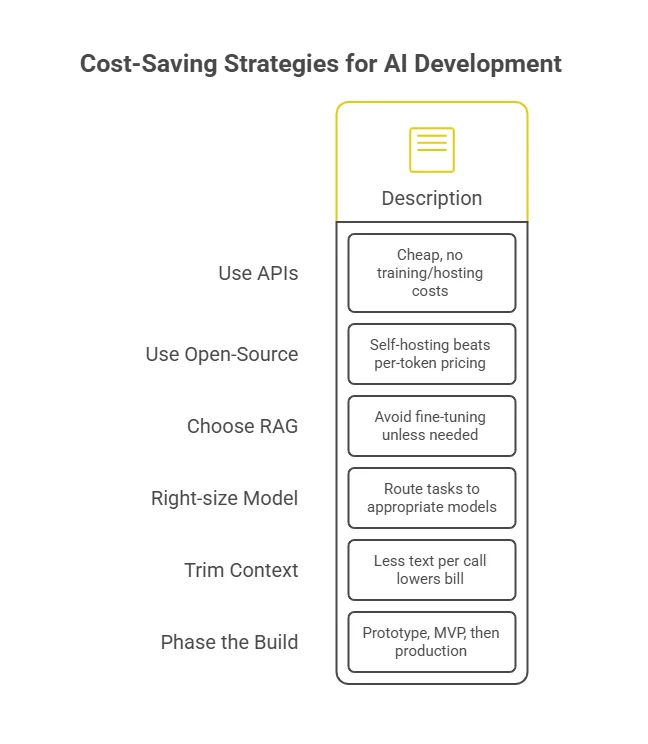
- Use APIs before custom models. The price collapse makes them cheap and removes training and hosting cost.
- Use open-source at scale. At high volume, self-hosting Llama or Mistral can beat per-token pricing.
- Choose RAG over fine-tuning unless you have proven you need custom behavior.
- Right-size the model. Route simple tasks to cheap models; reserve frontier models for the hardest reasoning.
- Trim context. Less text per call lowers the bill.
- Phase the build. Prototype, then MVP, then production, so you never build unvalidated features.
Where AI budgets go wrong?
AI budgets overrun for a small set of repeatable reasons: underscoped data work, underestimated integrations, treating the prototype as production, and ignoring run costs. None of these are about the AI itself.
- Data is underscoped. The model is ready in days; clean, labeled data takes weeks.
- Integrations are underestimated. Connecting to a real CRM, EHR, or payment system takes longer than it looks.
- Prototype mistaken for product. A demo hides missing auth, permissions, monitoring, and error handling.
- Run costs are ignored. Teams budget the build and forget the monthly inference and infra bill.
- Budget-eating features: voice, multi-agent coordination, and real-time work consume the largest share.
Is AI app development worth the cost?
For most businesses, yes, provided the use case is validated and the run cost is understood. The return comes from real integration, not from adding a model for its own sake.
The market case is established: PwC’s Sizing the Prize projected AI could add up to $15.7 trillion to the global economy by 2030, and the cost of using AI has fallen sharply. The question is not whether AI is worth using, but whether your specific app is scoped to deliver a return.
Founder risk: AI is worth it when it solves a validated problem and you have budgeted the full lifecycle, including run cost. Validate first, then build for production.
Planning an AI app build?
If you have a prototype or an idea and are unsure what it takes to reach production, we can scope it clearly: what to keep, what to rebuild, and what it costs to build and run. A clear AI app development cost estimate up front is the cheapest part of any project.
TechnBrains builds AI applications across healthcare, fintech, PropTech, logistics, and construction technology. For a grounded estimate on your use case, reach out and we will walk through the numbers.
Turn Your Requirements Into Real Numbers
Share your product idea with TechnBrains and get a practical estimate covering development, AI integration, data work, deployment, and ongoing costs.
Table of Contents
Frequently Asked Questions
Most AI apps cost $40,000 to $180,000 to build to production standard. A prototype can start around $15,000, and an enterprise platform can exceed $400,000, depending on features, data, and integrations.
Building from scratch (custom model, custom data pipeline) sits at the higher end, often $150,000 and up. Most teams keep costs down by using existing models through APIs rather than training their own.
An LLM-based chatbot with retrieval and integrations typically costs $15,000 to $60,000. A simple API wrapper is cheaper; the cost rises with data connections, guardrails, and the systems it plugs into.
A single-task agent usually costs $20,000 to $70,000, and a multi-agent system runs $80,000 to $250,000 or more. Most of the cost is in guardrails, tool permissions, and failure handling, not the core logic.
Building a genuine large language model from scratch runs into the millions and is out of reach for most teams. Building a ChatGPT-style app on top of an existing model (chat UI, retrieval, your own data) is far more realistic, typically $40,000 to $150,000+.
A voice-based personal assistant usually costs $40,000 to $120,000 because it combines speech recognition, natural language understanding, low latency, and context handling. Text-only assistants cost less.
The API usage itself is cheap, often cents per million tokens for smaller models. The integration work (connecting the model to your data, adding guardrails, and testing) is where the cost sits, usually $10,000 and up.
Annual maintenance typically runs $10,000 to $50,000, covering bug fixes, model updates, monitoring, and retraining, plus your inference and infrastructure run costs on top.
Blocked by backlog or missing expertise?
Senior developers who build, fix, and ship — without slowing your team down.