


How Outsourcing Mobile App Projects Accelerates Innovation

If you’re leading a product team, you already feel the pressure: roadmaps growing faster than your ability to hire, and delivery timelines slipping quarter after quarter. In my experience, scalable outsourced mobile teams change that dynamic by adding bandwidth and expertise when you need it most.

Organizations partnering with external development teams can achieve up to 37% faster delivery and time-to-market compared to traditional models. 

That’s not theoretical. It’s the difference between winning users today or chasing them tomorrow. Outsourcing allows you to compress cycles, run parallel streams, and keep innovation moving without sacrificing product quality or architectural stability.

Let’s discuss it in detail! 

TL;DR

Outsourcing mobile app development isn’t about cutting costs. It’s about increasing delivery speed, reducing time-to-revenue, and scaling innovation. When governed correctly, outsourced teams enable parallel development, faster release cycles, and better ROI than in-house hiring alone.

Why Scalable Outsourced Teams Reduce Time-to-Market

It’s simple! They allow you to add delivery capacity faster than traditional hiring ever can, and they do it without destabilizing your core product or architecture. 

In practice, high-performing outsourced mobile teams function as plug-in pods of senior engineers that integrate with your backlog, tooling, and release cadence, meaning product work streams run in parallel, not serially.

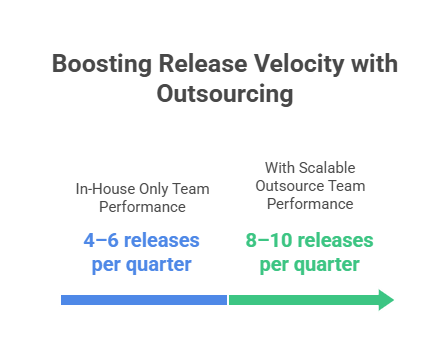
Companies leveraging external development talent consistently ship features 30% or even faster than teams limited to internal staff alone. 

That acceleration isn’t magic. It’s the result of capacity scaling, reduced onboarding overhead, and mature execution practices built into the partner’s delivery model.

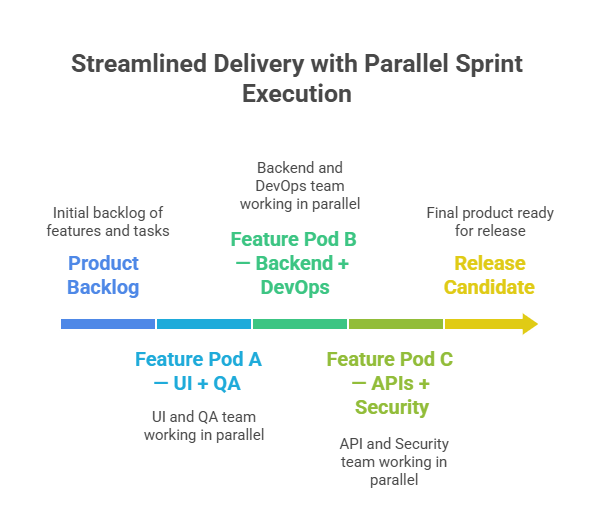
How Parallel Sprint Execution Works in Outsourced Teams

In traditional in-house models, sprint execution capacity is constrained by the size of your internal team. If you need to add features, fix technical debt, and improve performance all in the same cycle, someone gets deprioritized.

Scalable outsourced teams shift that dynamic by enabling parallel sprint execution:

  • Integrated sprint planning: Outsourced engineers participate in your sprint ceremonies and align with your Definition of Done.
  • Dedicated feature pods: Instead of bolting on “extra heads,” you form autonomous feature pods that own vertical slices (UI, backend, API, QA) for specific backlog items.
  • Standardized tooling and standards: They adopt your existing CI/CD, code review, and quality gates so there’s zero rework after handovers.
Outsourcing Mobile App Projects

Release Velocity vs In-House Bottlenecks

Release velocity, the frequency at which your team ships working software, is the ultimate measure of time-to-market efficiency. Two common bottlenecks in in-house models are:

  1. Hiring & ramp-up delays:

Even with aggressive recruiting, ramp-up time for mid-to-senior engineers can be 3–6 months before productivity matches team expectations.

  1. Context switching & bottleneck queues:

In a fully internal team, UI work, backend services, QA validation, and DevOps deployments often back up in sequence.

Scalable outsourced teams mitigate both:

  • Senior expertise from day one: Partners bring engineers who already follow modern practices (e.g., clean architecture, automated testing, CI/CD).
  • Parallel workflows: Instead of linear task queues (design → build → test → deploy), outsourced capacity allows overlap: while one pod builds, another integrates and yet another validates.
Outsourcing Mobile App Projects

How Outsourcing Cuts Development Cycles by 30–50%

Outsourcing reduces development cycles not by cutting corners, but by removing the two biggest drag factors in software delivery: constrained capacity and sequential workstreams

When you augment your core team with seasoned dedicated mobile developers, backend engineers, DevOps specialists, and QA professionals, you eliminate waiting periods between handoffs and dramatically reduce idle time. 

Below, we break down the delivery mechanics that make this possible.

Team Topology: Pods vs Functional Silos

In traditional development models, teams are often organized as functional silos, like UI folks in one group, backend in another, QA separately, DevOps in ops, etc. This creates serial handoffs, where each group must wait for the previous one to finish before starting their work. That’s a natural brake on cycle time.

Outsourcing flips this by organizing work into cross-functional pods:

Functional Silos

  • UI team
  • Backend team
  • QA team
  • DevOps team

Work flows serially through these groups.

Cross-Functional Outsourced Pods

  • Developer(s)
  • QA engineer
  • DevOps specialist
  • Product integrator

Work flows in parallel, within one cohesive unit aligned to a specific feature or product slice.

QA, DevOps & Frontend Running in Parallel

Outsourcing accelerates cycles by breaking the classic waterfall sequence, where frontend waits on backend, QA waits on build completion, and DevOps waits on QA, and instead enables these functions to operate concurrently.

To do this effectively, your outsourced teams should include or align to:

  • Dedicated QA automation engineers who write tests as code, not afterthought scripts.
  • DevOps specialists who embed CI/CD from day one, not just at release time.
  • Frontend engineers who consume APIs in parallel with backend development.
  • Shared sprint ownership aligned with your backlog priorities.

Here’s a practical checklist to ensure parallel execution:

Parallel Execution Checklist

  • Shared sprint cadence with internal team
  • Unified backlog with prioritized feature slices
  • CI/CD pipelines running at every commit
  • Automated test suites (unit, integration, UI)
  • Dedicated DevOps support for deployment automation
  • Real-time dashboards tracking build and test health

When these elements are in place, the result is continuous delivery and compressed cycle times, not a series of dependent checkpoints.

Modernizing or expanding an existing mobile app?

Validate your architecture, capacity, and timelines before committing to major delivery decisions.


How to Manage Outsourced App Teams Without Losing Control

You don’t “hand over work” and hope for the best. You build governance, ownership clarity, and delivery visibility into the way your outsourced teams operate. The goal isn’t micromanagement, it’s predictable delivery with aligned accountability. 

High-trust governance models allow you to enforce standards, protect architecture integrity, and ensure velocity without sacrificing product quality or internal decision authority. 

The most reliable way to do this is through a clear RACI model tied to your delivery process, combined with role-specific ownership of architecture, codebase, and roadmap cadence.

Below, we break down the governance structures that make outsourcing a controlled, scalable extension of your core team.

Who Owns Architecture, Code & Velocity

When you bring outsourced engineers into your development ecosystem, it’s vital to define who owns what, because ambiguity kills delivery speed and technical quality.

Architecture Ownership

  • Internal Architects / Tech Leads: Retain architectural authority, especially for core modules and interfaces.
  • Outsourced Senior Developers: Implement architecture under guidance and contribute to non-core modules within approved patterns.

Code Ownership

  • Internal Repositories & Standards: You own the codebase, branch policies, and static analysis rules.
  • Outsourced Contributors: Follow and enforce those standards through pre-merge checks and shared linting/test suites.

Velocity Ownership

  • Internal Engineering Leadership: Own release commitments, sprint goals, and quality metrics.
  • Outsourced Teams: Own delivery of agreed sprint items and work against your velocity targets.

Sprint, Roadmap & Backlog Governance

Once ownership is clear, the next challenge is orchestrating delivery within your product rhythm, meaning sprints, backlogs, and roadmaps must be shared and transparent.

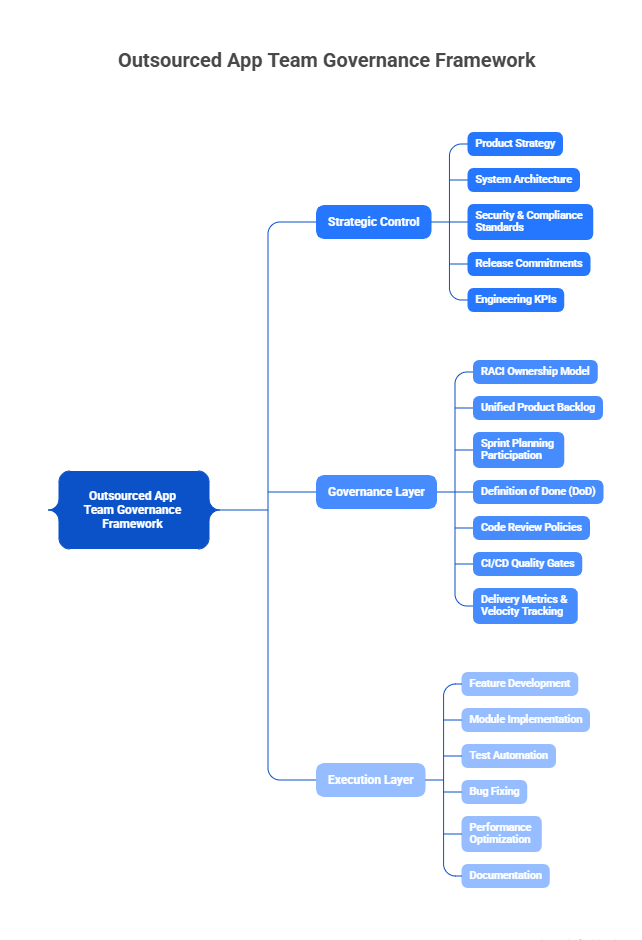
The solution is a governance layer that treats outsourced teams as first-class participants in your delivery process:

  • Unified Backlog: All work, internal or outsourced, lives in the same backlog with transparent priorities.
  • Sprint Sync: Outsourced teams join your sprint planning, standups, demos, and retros, just like internal teams.
  • Definition of Done: Shared acceptance criteria for every story, including performance, security, and compliance gates.
  • Velocity Metrics: Measure outsourced contributions as part of team velocity, not separate KPIs.

Here’s a simple, repeatable template for sprint governance:
Outsourcing Mobile App Projects - 3

RACI for Delivery Governance

To operationalize the above, a RACI matrix is invaluable:

Activity Internal Product Internal Engineering Outsourced Team Delivery Lead
Define Architecture A R C C
Code Development C A R C
Code Review & Quality C A R R
Sprint Planning A R R C
Deployment & Release R A R C
Performance Monitoring R A C C

R = Responsible | A = Accountable | C = Consulted | I = Informed

This governance model locks accountability where it matters, but still leverages the execution power of outsourced teams.

What is the real ROI for startups when they outsource mobile app development versus building internally?

Outsourcing mobile app development is a return-on-velocity and time-to-revenue strategy. For startups, speed, experiment iterations, and early monetization matter more than ever. 

When executed right, outsourcing can drive measurable ROI through faster delivery, lower burn rate, and earlier revenue capture, without sacrificing product quality or long-term technical viability. 

Below, we break down the ROI math and what it looks like in real terms.

How does outsourcing impact your monthly burn compared to in-house scaling?

Startups often assume that outsourcing equals higher per-hour cost. In reality, the effective cost per delivered feature often goes down because velocity increases and internal friction drops.

Here’s a simplified model comparing internal hiring vs outsourcing for a typical mobile app sprint:

Cost Element In-House Team (4 engineers + QA + DevOps) Outsourced Model (Dedicated External Team)
Monthly Salaries + Benefits $80,000 $50,000
Recruiting & Ramp-Up $30,000 (one-time) $0
Overhead (HR, tools, training) $10,000 $5,000
Delivery Velocity (Story Points per Sprint) 20 35
Cost per Story Point $4,000 ~$1,571

In this example, even though external rates may seem higher on paper, you get nearly double the throughput per dollar spent, and you avoid long recruiting cycles that add hidden costs to your burn. 

The larger the backlog and the more complex the delivery needs, the more outsourcers unlock ROI through parallel workstreams and expertise leverage.

How much earlier can a startup start generating revenue when outsourcing accelerates delivery?

Time-to-revenue is one of the most compelling ROI levers for founders and investors: shipping core features faster means capturing users and monetization earlier.

Let’s break down a simple calculation:

  • In-house delivery estimate for MVP: 24 weeks
  • Outsourced delivery estimate: 14 weeks
  • Projected weekly revenue post-launch: $15,000

Revenue difference from faster launch:

(24 weeks − 14 weeks) × $15,000 = $150,000 additional revenue

For startups on a tight runway, bringing forward revenue by even a quarter can dramatically improve financial stability, investor confidence, and product–market fit validation.

ROI Table — Startups (Example)

Metric In-House Outsourced
Time to MVP 24 weeks 14 weeks
Launch Revenue Acceleration $0 $150,000+
Burn Rate Impact High Lower
Feature Throughput Medium High
Quality & Market Fit Variable More predictable

Outsourcing becomes not just an expense, it becomes a strategic lever that compresses runway risk and maximizes monetization potential earlier in the startup lifecycle.

When should a startup or scaling company rely on in-house teams vs outsourced teams for mobile app delivery?

The decision is about what part of your delivery engine needs scale, specialization, or flexibility right now. In-house teams are essential for deep product knowledge, strategic ownership, and long-term platform evolution. 

Nearly 66% of US businesses outsource at least one department. Outsourced teams are most effective when you need burst capacity, specialized skills, or parallel execution without slowing the internal organization. The real ROI comes when you combine both in a way that leverages each model’s strengths.

Below, we compare the two models and show why hybrid approaches are often the best path for scaling mobile products.

When In-House Fails to Scale

65% of tech leaders report that talent shortages directly slow development cycles, especially for mobile and cloud-native capabilities.

In-house teams can struggle when the product roadmap outpaces hiring capacity or when specialized skills are needed faster than the market supply can deliver. Common scaling failure patterns include:

Constraint In-House Team Impact
Hiring Lag 3–6 months to onboard senior engineers Delivery timelines slip
Expertise Gaps Limited to generalists Complex domains (DevOps, AI, security) suffer
Ramp-Up Overhead Cultural + tooling training Lower early throughput
Cost Pressure High fixed labor cost Budget squeeze

When these constraints hit, teams often resort to overtime, re-prioritization, or de-scoping; all signs that in-house capacity has maxed out.


How can you get the best of both worlds?

Hybrid delivery models combine the strategic ownership of in-house teams with the execution horsepower of outsourced expertise. Instead of outsourcing entire products, hybrid models assign:

  • In-house teams: Product strategy, architecture vision, core platform ownership
  • Outsourced teams: Feature pods, parallel workstreams, specialized tasks (e.g., QA automation, DevOps pipeline setup, performance engineering)

This approach retains core decision authority while scaling capacity on demand.

Key benefits of hybrid models:

  • Architectural continuity: In-house architects steer the platform’s long-term evolution.
  • Elastic delivery: Outsourced pods accelerate specific streams without disrupting core squads.
  • Cost predictability: You pay for capacity you need when you need it.
  • Knowledge transfer: Internal teams benefit from external expertise through paired development and documentation standards.

This hybrid approach is widely adopted in scaling tech organizations because it balances control, velocity, and quality, exactly what CTOs and Heads of Product care about.

Is Outsourcing Right for Your App Roadmap?

Use this checklist the way I do when evaluating whether external delivery capacity will actually improve execution, not just add noise. If you can check most of these, outsourcing is likely to increase your roadmap velocity without increasing risk.

Strategic Fit

  • Our product roadmap requires more delivery capacity than our current team can realistically staff in the next 90 days.
  • We have revenue, growth, or competitive milestones tied to faster feature releases.
  • We need specialized skills (mobile, DevOps, QA automation, cloud, AI) that are hard to hire quickly.

Execution Readiness

  • We have a clear backlog and sprint cadence that external teams can plug into
  • Our architecture and APIs are documented well enough for parallel development
  • We can enforce code quality, CI/CD, and security standards across all contributors

Financial & ROI Logic

  • Faster releases would materially impact revenue, churn, or user acquisition
  • Hiring internally would take longer than our market window allows
  • We can measure velocity, cost per feature, and time-to-revenue

Governance & Control

  • We can assign internal owners for architecture, roadmap, and release decisions
  • We are prepared to run unified sprint planning and demos across teams
  • We can use shared tools for backlog, source control, and deployment

If you reach the end thinking, “Yes, that’s exactly where we are,” then outsourcing isn’t a risk, it’s a delivery lever.

If you want to sanity-check your situation, you can always talk to engineering and walk through your roadmap, timelines, and team structure with someone who’s done this before.

Wrapping it Up

Outsourcing, when done with proper governance, architecture ownership, and integrated delivery models, becomes a way to increase engineering throughput and reduce time-to-market while maintaining technical control. 

Whether you’re a startup racing to product–market fit or an enterprise modernizing a legacy mobile platform, scalable external teams allow you to run more experiments, release faster, and turn roadmap ambition into shipped software, without the friction and delays of traditional hiring.

Working on a mobile platform that needs to move faster?

Get a clear view of what’s slowing delivery and what would actually improve release velocity.


Top-Rated Mobile App Development Services for Startups

When you sit in a few dozen founder and CTO meetings, you start hearing the same story: 

“The idea was solid, but the product became too slow, too expensive, or too fragile to keep up.” That’s not anecdotal. Approx. 90% of startups eventually fail, a brutal reminder that product execution, not just ideas, determines survival.

In mobile, those two collide fast. A poorly built MVP doesn’t just waste time. It burns the runway every sprint through rework, bugs, and architecture that can’t scale.

That’s why top-rated mobile app development services for startups don’t just focus on getting something live. They focus on how that first version survives real users, real traffic, and real change. 

This article is written for founders and CTOs who want a mobile product that can grow without being rebuilt every six months.

TL;DR

Top-rated mobile app development services for startups focus on scalable MVP architecture, agile delivery, and full-cycle mobile product development. The best MVP development companies balance pricing packages, speed, and technical quality so startups can launch fast, validate users, and scale without costly rewrites or technical debt.

What “Top-Rated” Actually Means for Startup Mobile Development

In startup mobile development, “top-rated” is one of the most misleading labels in the industry. Reviews and awards usually reflect sales volume, brand visibility, or client count, not whether a team can deliver a product that survives real users, real traffic, and real product pivots.

From an execution standpoint, a top-rated mobile app development company is not the one that builds the fastest demo. It’s the one that minimizes rework, technical debt, and scaling risk over the next 12–36 months. That distinction matters. 

Industry benchmarks consistently show that 30–45% of engineering effort in growing startups is lost to refactoring and architectural cleanup, not new feature development. 

When the first version is built poorly, every sprint that follows becomes more expensive and slower.

So when you evaluate mobile app development partners, the real question is not “How impressive is their portfolio?” It’s “How much future pain does their delivery model create or prevent?”

Top-rated teams distinguish themselves in three ways:

  • Delivery maturity (not just developer skill, but planning, QA, DevOps, and handover discipline)
  • Architecture discipline (MVPs built to evolve, not to be thrown away)
  • Governance and accountability (how work is prioritized, reviewed, released, and supported)

That is what separates a vendor who ships something from a partner who builds a product that can scale.

Delivery Maturity vs Agency Size

Large agencies usually optimize for throughput, not outcomes. Work gets fragmented across analysts, designers, developers, QA, and account managers, which creates handoff delays, diluted ownership, and slow decision cycles. 

For startups, that’s dangerous. When product direction changes, which it always does, big teams adapt slowly and expensively.

Smaller, delivery-mature teams operate differently. They run with tight feedback loops, senior engineers close to product decisions, and fewer handoffs between design, development, and QA. 

This makes them faster to correct mistakes, adjust scope, and ship iterations that actually reflect user data.

What matters most is whether the team can:

  • Make architectural decisions without waiting for layers of approval
  • Release, measure, and adjust within weeks, not quarters
  • Own outcomes instead of just closing tickets

In startup environments, coordination cost kills velocity long before lack of talent does.

What Startups Need at Seed, Series A, and Series B

The definition of a “top-rated” mobile app development partner changes as a startup grows, and many founders choose the wrong type of team for their stage.

Startup Stage What Actually Matters What Breaks When You Choose Wrong
Seed Speed, learning, and MVP architecture that won’t need a rewrite Over-engineered platforms or cheap code that collapses after first traction
Series A Predictable delivery, scalable backend, analytics, and stability Teams that can’t handle production users or security requirements
Series B+ Platform reliability, DevOps, compliance, and growth engineering Vendors who only know how to build MVPs, not run products

At Seed, you don’t need a massive agency. You need a small, senior team that can move fast without creating architectural landmines.

At Series A, you need a team that can support real users, uptime, performance, and compliance, not just prototype screens.

At Series B and beyond, you’re no longer buying “development”. You’re buying operational reliability and platform maturity.

Top-rated mobile app development services understand these transitions. They sell you what your stage actually requires.

Best MVP Development Companies for Startups

When startups ask me who the best MVP development companies are, the honest answer isn’t a short list of logos. It’s a framework for evaluation. The “best” vendor is the one that can take an idea from concept to validated users with minimal rework, minimal technical debt, and a growth-ready foundation, not just a clickable prototype.

More than 30% of software projects fail because of poor execution and quality issues, not because the idea was bad. This highlights why choosing the right MVP partner matters more than picking the most visible one.

Below is a comparison of critical dimensions that differentiate real MVP teams from run-of-the-mill dev shops:

Evaluation Dimension What Top MVP Teams Get Right What Most Vendors Get Wrong
Discovery & Scope Data-driven product discovery that avoids unnecessary features Assumes requirements upfront, leading to overbuild
Architecture Planning Scalable foundation, modular by design Fragile, single-purpose codebases
Delivery Cadence Fast feedback loops + prioritized sprints Slow handoffs + waterfall tendencies
Quality Engineering Automated testing, CI/CD pipelines Manual, ad-hoc QA
User Validation Early prototypes with real metrics Internal demos, no external validation

The goal is to ensure the team you choose reduces product risk while maximizing learning velocity.

Why Most “Top” MVP Vendors Still Build Fragile Products

It may sound counterintuitive, but many vendors with strong portfolios and big brand names still build MVPs that fall apart once real users arrive. The reason is simple: they’re optimized for selling work, not owning outcomes.

Here’s the real breakdown of where fragile MVPs typically fail:

  • Architecture that can’t scale: The code may work for 100 users, but performance drops and bugs creep in at 1,000+.
  • Lack of automated testing: Without CI/CD and proper test suites, fixes in one area break others.
  • Inflated scope: Vendors add nice-to-have features instead of focusing on validated learning metrics.
  • No real feedback loop: Deliverables are shipped without mechanisms to measure retention, engagement, or user behavior.

In my experience, I’ve seen MVP projects with seemingly expert teams still produce code that requires major rewrites within 3–6 months, not because the developers were bad, but because the engagement model prioritized deliverables over product resilience and learning velocity.

What High-Quality MVP Teams Do Differently

Top MVP development teams think like product builders, not order takers. They treat every sprint as a hypothesis test and every release as a learning opportunity. Here’s what they consistently deliver:

  • Strategic Product Discovery
  • Scalable, Modular Architecture
  • Clean Code with Automated Testing CI/CD from Day One
  • Early Integration of Analytics
  • Rapid, Data-Driven Iterations
  • Clear Feature Prioritization Based on Value

These attributes aren’t buzzwords. They’re execution practices observed in MVPs that went on to become market winners, not rewrite disasters.

For example, 

Teams that integrate analytics early can pivot within weeks instead of quarters, because they’re responding to real user behavior, not assumptions. This dramatically shortens time to true product-market fit, and that’s the real definition of MVP success.

Pricing Packages 

Startup leaders don’t struggle because they can’t find developers. They struggle because they can’t predict what their product will actually cost to own. 

Most pricing pages focus on hourly rates, but experienced ones know the real question is total cost of delivery over 12–24 months: development, rework, scaling, maintenance, and downtime.

That’s why two teams with the same hourly rate can produce radically different financial outcomes.

In practice, startup mobile app pricing usually falls into three tiers:

  • MVP Packages ($30k–$100k): Rapid validation, core flows, and minimal backend, but only valuable if built on scalable foundations.
  • Growth Packages ($100k–$300k): Production-ready apps with cloud infrastructure, CI/CD, security, and analytics.
  • Scale Packages ($300k+): Platform engineering, DevOps, compliance, performance tuning, and long-term support.

Top-rated mobile app development services don’t sell “cheap builds.” They sell predictable product economics, meaning fewer rewrites, lower maintenance, and a roadmap you can actually finance.

Why Cheap Development Becomes the Most Expensive Option

Every startup that comes to us after a failed MVP tells the same story:
“We saved money on the build, and then spent twice as much fixing it.”

Here’s why:

  • No automated testing means every change breaks something else.
  • No CI/CD means slow releases and production risk.
  • Weak architecture means features get harder and slower to add.

What looked like a $50k MVP quietly becomes a $200k recovery project within a year. Cheap teams optimize for speed to invoice, not speed to stability. High-quality teams optimize for lifecycle cost, not just launch cost.

How to Budget Mobile Development from MVP to Scale

Smart startups budget like product companies, not project buyers. A realistic financial model includes three phases:

1) MVP Phase – Validate the idea without locking in bad architecture
2) Growth Phase – Add users, data, and reliability
3) Scale Phase – Optimize performance, compliance, and automation

Instead of asking, “How much does this sprint cost?” experienced founders ask:
“How much will this product cost to run and evolve over the next two years?”

That’s the mindset top-rated mobile app development partners bring, helping you protect the runway while building something that can actually survive success.

Agile Mobile App Development Process for Startups

Agile is the default delivery model for modern mobile app development, but in startups, it only works when it’s paired with tight governance, real-time feedback, and engineering discipline. 

Most rework on software projects represents a large portion of effort, typically 30–50% of total activity.

For startups with limited runway, that means you’re paying for movement, not progress.

Top-rated mobile app development services use agile to do three things exceptionally well:

  • Validate fast (ship small, learn fast, iterate)
  • Control scope (what gets built, when, and why)
  • Protect architecture (so today’s shortcut doesn’t become tomorrow’s rewrite)

In practice, that looks like short sprint cycles, continuous integration, automated testing, and a product owner who is empowered to make decisions, not just approve tickets.

How Agile Breaks When Outsourcing

Most agile failures in outsourced mobile app development come from one root cause: no one owns outcomes, only tasks.

Here’s how it usually breaks:

  • Sprints become feature factories, not learning loops
  • Backlogs grow, but priorities stay unclear
  • Technical debt accumulates, because no one is accountable for long-term quality
  • Feedback arrives too late, after architecture is already locked in

Without a strong product owner, QA gates, and release discipline, agile becomes a delivery treadmill: the team keeps running, but the business doesn’t move forward.

High-maturity teams fix this by:

  • Defining acceptance criteria tied to user and business outcomes
  • Enforcing automated testing and CI/CD before anything reaches production
  • Running retrospectives that drive architectural and process changes, not just sprint rituals

Sprint, Release, and Stakeholder Control Models

Real startup teams run on decision cadence and release control. That’s where most vendors fall short.

High-performing mobile product teams use a simple but powerful structure:

  • Weekly or bi-weekly sprints to control scope and velocity
  • Release trains (e.g., every 2–4 weeks) so production stays predictable
  • Clear RACI so everyone knows who decides, who builds, and who approves

In this model:

  • CTOs control architecture and quality
  • Product leaders control priorities and roadmap
  • Engineering teams control execution and delivery

Full-Cycle Mobile Product Development for Startups

More than 50% of software features are rarely or never used after launch, meaning early delivery without a strategy for ownership and growth is mostly wasted effort.

Full-cycle mobile product development is about long-term ownership, not just delivery. It covers the entire lifecycle: from discovery and MVP development to launch, analytics, iteration, monitoring, and ongoing ops. 

A partner who understands this continuum helps you avoid the invisible tax of thrown-away work and tech debt that kills velocity later.

What Happens After Launch (Where Most Vendors Disappear)

Most vendors treat launch as a finish line, not a starting point. That’s where the real challenges begin:

  • Bug spikes with real users: Issues you never saw during test drives
  • Performance challenges: Load, latency, and concurrency problems at scale
  • User feedback accumulation: Changing priorities vs original spec
  • Maintenance backlogs: Piles of tech debt that slow every sprint

Good mobile partners build ops discipline into the contract, not just launch deliverables.

Strong post-launch support includes:

  • 24/7 monitoring and alerting
  • SLA commitments on bug resolution
  • Automated test coverage extending into production
  • Analytics instrumentation for real user behavior

How Real Product Teams Manage Growth

Successful startups treat mobile products like platforms, not projects. Here’s how elite teams handle growth once the app is live:

  1. Release trains: Regular, predictable releases instead of ad-hoc pushes
  2. Feature flags: Control rollouts and reduce risk in production
  3. Telemetry-driven decisions: Data, not intuition, drives the roadmap
  4. Dedicated product operations: A team focused on health, metrics, and reliability
  5. Scalable backend pipelines: Autoscaling, caching, and performance guards

This operational mindset allows teams to grow from hundreds to thousands, even millions, of active users without rewriting core systems.

In startups that successfully make this transition, engineering efficiency increases over time, not decreases. That’s the opposite of what happens when launch is treated as an endpoint and the vendor disappears.

Scalable MVP Architecture for Tech Startups

More than 60% of scalability issues in production trace back to early architectural decisions, not just traffic spikes.

A scalable MVP architecture isn’t about adding more servers; it’s about choosing patterns that let product and engineering teams evolve without painful rewrites. It should support modular growth, observability, performance under load, and seamless deployment pipelines. 

In practice, this means separating concerns, using asynchronous processing where appropriate, and embracing cloud capabilities that let your app scale elastically, not manually.

Below, we cover the failure modes most startups encounter and the architectural patterns that actually support 10× growth without crippling rework.

Why Most MVPs Collapse Under Real Traffic

When you put an MVP into real user environments, not staging, the typical failure triggers are:

  • Monolithic backends: Tight coupling of services that can’t scale independently
  • No load testing: Systems that look fast with synthetic tests but fall apart under real patterns
  • Synchronous workflows: Slow API dependencies that block throughput
  • Stateful services without sharding: Bottlenecks in memory or database layers

These are the most common root causes when performance degrades at scale. In one case we observed, an e-commerce MVP that performed well with 500 daily users started failing at just 2,000 concurrent sessions because the backend was a single process handling all logic.

The key point: Performance risk is an architectural risk, and most teams discover it too late.

What Architecture Supports 10× Growth

To build an MVP that can grow into a platform instead of a liability, senior architects lean on patterns that decouple, distribute, and automate:

  1. Microservices (or Modular Services)

Break responsibilities into independent services that can scale separately.

  1. Cloud Native Infrastructure

AWS, GCP, or Azure components that autoscale on demand (e.g., serverless functions, managed databases).

  1. Event-Driven Asynchronous Workflows

Reduce blocking calls, enable distributed processing, and improve responsiveness.

  1. CI/CD + Blue/Green Deployments

Automate releases without downtime or user impact.

  1. Observability (Logging, Tracing, Metrics)

Know what breaks before users notice.

  1. API Gateways & Caching Layers

Protect backend resources during peaks.

For example, using cloud functions and managed databases lets you handle 10× traffic without redesigning your core codebase. Combining this with feature flags and rollout controls lets you scale features gradually and safely.

In short, building for scale is about architecting for growth patterns that are observable, manageable, and elastic.

How CTOs Should Compare Startup App Development Partners

Experienced CTOs don’t evaluate app development partners on resumes or portfolios alone. They score vendors on delivery capability, execution risk, and long-term ownership cost, not just how convincing the sales pitch sounds.

A practical scoring model usually looks like this:

Dimension What to Evaluate Why It Matters
Capability Architecture skill, senior engineering, DevOps, QA Determines whether the product can scale and be maintained
Delivery Model Sprint cadence, QA gates, CI/CD, release governance Controls how predictable and safe delivery will be
Risk Profile Dependency on juniors, turnover, documentation Predicts how likely the project is to derail
Ownership Cost Code quality, testing, handover Determines what it costs to operate and evolve the product

This approach turns vendor selection into a risk management exercise, not a beauty contest.

Capability vs Headcount vs Delivery Risk

One of the most dangerous myths in outsourcing is that more people equals less risk. In reality, it often means the opposite.

Large teams reduce individual cost but increase:

  • Coordination overhead
  • Knowledge fragmentation
  • Handoffs between roles
  • Delays in decision-making

Small, senior teams cost more per hour but dramatically reduce:

  • Rework
  • Miscommunication
  • Architectural mistakes
  • Release risk

From an economics standpoint, startups should optimize for throughput per decision, not bodies per sprint. 

The goal is to maximize how quickly a team can go from idea → build → feedback → improvement without breaking the product.

This is why high-performing startups often choose smaller, delivery-mature partners over large offshore factories. 

If this guide raised questions about your roadmap, architecture, or vendor choices, that’s a good thing

Strong products are built by teams that validate assumptions early, before scale makes mistakes expensive.


Key Takeaways For Mobile App Development Services

Projects with strong delivery governance are over 2× more likely to hit their business goals than those that rely on ad-hoc outsourcing. Before you sign a contract, use this final checklist:

  • Can this team design a scalable MVP, not just a demo?
  • Do they run agile with real governance, testing, and CI/CD?
  • Can they support the product after launch, not disappear?
  • Is their pricing aligned to long-term ownership, not short-term speed?
  • Do they have senior engineers who make architecture decisions, not just follow specs?

The right mobile app development team helps you move fast without breaking, scale without rewrites, and protect your runway while your product grows. That’s what separates successful startups from expensive lessons.

7 Tips to Choose The Best Mobile App Development Company in 2024

2024 marks the dawn of a new era in digital innovation, where mobile apps reign supreme as the cornerstone of business success. Collaborating with the Best Mobile App Development Company for 2024 is not just a choice; it is a strategic imperative given the increasing demand for mobile solutions. As businesses strive to stay ahead of the curve and meet the evolving needs of consumers, the right app development partner becomes a catalyst for growth, innovation, and unparalleled success. Most importantly, it decides your mobile app’s success and failure.

At TechnBrains, our experts know that selecting the right mobile app development company is crucial for the success of your project, especially in 2024. To assist you in making an informed decision, we have put together a comprehensive list of 7 expert tips to Choose the Best Mobile App Development Company for 2024. 

Our guide is designed to be a valuable resource for both seasoned entrepreneurs and newcomers to the app development industry. By following our advice, you can simplify the decision-making process and make the best choice for your project. So, Let’s get straight to it.

Objective Assessment List for Mobile App Idea

Before listing into expert insights on selecting the best mobile app development company for your project, it’s essential to establish criteria that align with your app’s objectives. Always remember it is not about choosing the best mobile app development company for 2024 but the best mobile app development for you. To aid in this process, we’ve created an objective assessment list to streamline your decision-making process and ensure you choose the best fit for your needs.

Objective Assessment List:

  1. Define Your App’s Purpose: Clearly outline the primary objective and purpose of your mobile app. Identify the problem it aims to solve or the need it fulfills for your target audience.
  2. Research Target Audience: Explore our blog post on How to Conduct Mobile App Research to learn techniques for identifying and understanding your target audience. By analyzing user demographics, behaviors, and preferences, you can tailor your app idea to meet their needs effectively.
  3. Evaluate Competitor Landscape: Analyze existing mobile apps similar to your idea. Identify their strengths, weaknesses, features, and user feedback. Determine how your app can differentiate itself and offer unique value.
  4. Determine App Features: Create a comprehensive list of features and functionalities your app will offer. Prioritize essential features based on user needs and potential impact on user experience.
  5. Consider Monetization Strategy: Explore different monetization models, such as freemium, subscription, in-app purchases, or advertising. Determine which model best aligns with your app’s value proposition and target audience.
  6. Assess Technical Feasibility: Evaluate the technical feasibility of your app idea by considering factors such as platform compatibility (iOS, Android), required technologies (native, hybrid), and integration with third-party services (payment gateways, APIs).
  7. Estimate Development Costs: Estimate the budget required to develop and launch your mobile app. Consider factors such as development complexity, features, platform, resources, and ongoing maintenance costs.
  8. Define Success Metrics: Discover key performance indicators (KPIs) for measuring the success of your app by reading our blog on How to Patent an App Idea. From user acquisition metrics to revenue generation, our blog offers insights into defining success metrics for your app.
  9. Validate App Idea: Validate your app idea through market testing, surveys, focus groups, or MVP (Minimum Viable Product) development. Gather feedback from potential users to validate demand and refine your app concept accordingly.

7 Proven Tips the best mobile app development company

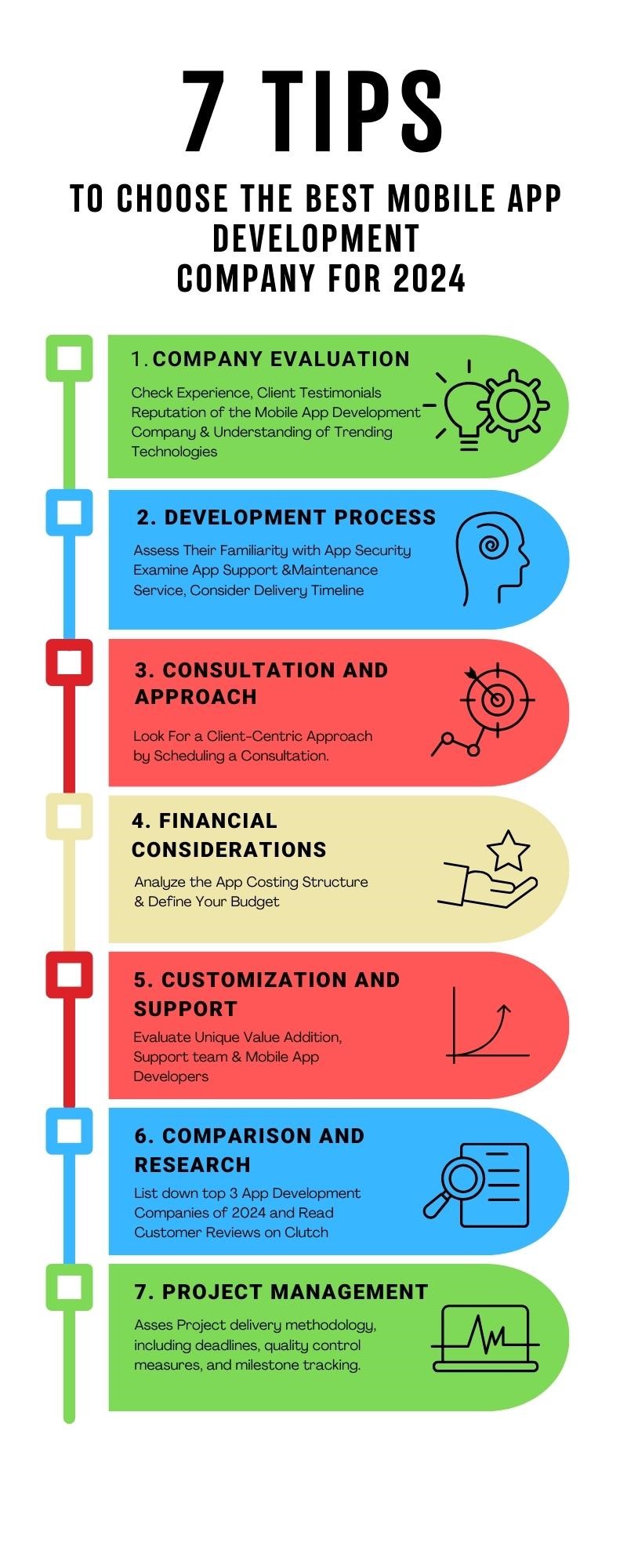
How do you choose the best app development company? 7 Proven Tips

  1. Company Evaluation
  2. Development Process
  3. Consultation and Approach
  4. Financial Considerations
  5. Customization and Support
  6. Comparison and Research
  7. Project Management

Now, lets look at them in detail:

1. Company Evaluation

The first step in choosing the best mobile app development company in 2024 is to thoroughly study the mobile app development company you are going for. Below are some of the points from our experts that can help you evaluate a mobile app development company:

Experience

When selecting a mobile app development company, it’s crucial to evaluate its experience and portfolio. Experienced firms better understand your needs and possess the expertise to handle potential challenges effectively. By studying the company’s portfolio, you can assess its adaptability to different project sizes and industries, confirming its capability to develop solutions tailored to your business domain.

Client Testimonials

Exploring case studies and client testimonials provides insights into their success stories and client satisfaction rates, further validating their ability to meet your project requirements. It’s advisable to directly engage with the company to discuss project specifics like deadlines, budget, and requirements, ensuring alignment with your objectives and expectations.

Reputation of the Mobile App Development Company

When evaluating a mobile app development company’s reputation, consider factors such as client feedback, case studies, and industry recognition. A company with a positive reputation is likely to offer reliable services and prioritize professionalism, quality, and customer satisfaction. Analyzing a company’s involvement in the developer community can also provide valuable insights into its standing within the industry.

Assess Their Understanding of Trending Technologies

To ensure your mobile app stays at the forefront of innovation, check for a mobile app development company that thinks about the future of mobile app development. Companies like ours at TNB are committed to staying ahead of the curve, as highlighted in our blogs on AI App trends for 2024 and UI/UX trends. By leveraging insights from these articles, you can gauge our proficiency in cutting-edge technologies like AI, AR, blockchain, and more, ensuring your app remains competitive and future-proof.

2. Development Process

A robust development process is essential to ensure a seamless and functional app. Inquire about the methodologies and frameworks a company uses, such as Agile or Scrum. By evaluating a company’s development process, you can gain insight into their approach to app development and their ability to meet your project requirements.

Assess Their Familiarity with App Security

Look for a firm that comprehensively understands the intricacies of app security in today’s digital landscape. They should be adept at implementing robust security measures throughout the development process to protect user data, thwart potential cyber threats, and uphold the integrity of the app. Prioritizing a company that prioritizes app security demonstrates a commitment to safeguarding user privacy and maintaining trust.

Examine App Support and Maintenance Service

Launching a mobile app is just the beginning; ongoing support and maintenance are essential for its success. Choose a development company that offers comprehensive support services post-launch. This ensures that the app remains responsive, updated with industry trends, and aligned with evolving user needs. Evaluating a company’s dedication to providing reliable support guarantees that your app will receive timely updates, improvements, and troubleshooting as necessary, fostering long-term success.

Consider Their Commitment to the Delivery Timeline

Timely delivery is crucial for the success of any app development project. Look for a company that demonstrates a strong commitment to meeting deadlines. This commitment not only ensures timely project completion but also reflects the company’s professionalism and effective project management. Clear communication and adherence to timelines instill confidence in clients, assuring them that their projects will be delivered on schedule. Evaluating a company’s track record in meeting delivery timelines helps in selecting a reliable partner capable of delivering high-quality projects within agreed-upon deadlines.

3. Consultation and Approach

Beyond simply understanding your idea, it’s essential to seek out a mobile app development company that embraces a consultative approach. This means they go beyond the basics of app development services and offer strategic guidance and advice based on their expertise. A company with a consultative approach will challenge your ideas, offering suggestions and improvements to refine your app concept and maximize its potential for success.

For instance, consider presenting an idea for a fitness tracking app to an app development company, only to realize it closely resembles existing apps in the market. A reputable company will provide honest feedback, advising against pursuing an idea with limited differentiation. Instead, they may suggest innovative features or unique angles to set your app apart and meet the specific needs of fitness enthusiasts.

Moreover, a consultative approach involves guiding you through app market research to validate your idea before diving into development. This ensures that your app addresses real user needs and market gaps, increasing its chances of success upon launch.

Additionally, experienced app consultants will help prioritize features for the initial release, emphasizing the importance of scalability and flexibility for future growth. By collaborating with a company that offers a consultative approach, you can benefit from their insights and expertise to create a compelling and competitive app that resonates with your target audience.

Schedule a Consultation to Experience the Process Firsthand

Once you’ve narrowed down your options to two or three potential companies, take the next step by reaching out for further information. Avoid rushing through the decision-making process. Instead, schedule a call to discuss your project and explore the range of services offered. This conversation will give you valuable insight into whether the app development company aligns with your needs and vision.

At TechnBrains, we invite you to book a free consultation to dive deeper into the details of your project. Our team will present a comprehensive roadmap outlining how we’ll bring your idea to fruition. Additionally, you’ll receive a transparent price estimate demonstrating how TechnBrains can deliver exceptional value compared to other agencies in the market.

Client-Centric Approach

Choose a mobile app development company that prioritizes a client-centric approach by looking for strong communication channels, active engagement, and a willingness to accommodate feedback and requests. Positive client feedback is a clear indicator of a company’s dedication to achieving client success. A client-centric approach ensures a collaborative and mutually beneficial relationship that leads to the creation of a high-quality, customized mobile app that meets and exceeds your expectations.

4. Financial Considerations

Below are the two main focus points when selecting a mobile app development company for 2024:

Define Your Budget

Determining your budget for app development is a key step in the decision-making process. Consider how much you are willing to invest in creating your app and ensure it aligns with your project’s scope and objectives. While some agencies may offer lower prices, it’s essential to weigh the value of their services against the cost.

Remember that the cheapest option may not always deliver the best results, and paying a higher price does not guarantee quality. Instead of focusing solely on the price tag, consider the expertise, experience, and support offered by the mobile app development company. Having a clear understanding of your budget will help you narrow down your options and make informed choices that align with your financial resources and project goals.

Analyzing the App Costing Structure

Understanding the financial aspects of app development is crucial for making informed decisions. When evaluating mobile app development companies, thoroughly review their pricing structures to ensure transparency and clarity. Seek detailed breakdowns of costs, including payment terms and any additional expenses that may arise during the development process, as discussed in our detailed blog on app development costs.

It’s essential to avoid hidden costs that could impact your budget down the line. While custom software development cost is an important factor, prioritize value over price. Investing in a reputable and experienced mobile app development team may require a higher upfront investment but can yield better long-term outcomes and return on investment. To answer your question, “How Much Does It Cost To Make An App?” The cost of developing a basic mobile app ranges from $5,000 to $10,000. For a more complex app, the cost can go up to $50,000-$75,000 or even exceed $300,000.

5. Customization and Support

When evaluating mobile app development companies, prioritize those offering extensive customization options tailored to your project’s unique requirements. Assess any potential limitations or constraints they may have and ensure transparent communication about their capabilities aligns with your project goals.

For example, if your project focuses on developing a productivity app or a healthcare solution, limitations related to gaming or entertainment features may not impact your project’s objectives. While assessing developers, consider minor constraints within the context of your project’s scope and priorities.

Furthermore, inquire about post-launch maintenance and support services. A reputable development company should offer ongoing support beyond the app’s launch to address issues, implement updates, and ensure compatibility with evolving technologies.

Mobile app development is an iterative process, and having a dedicated support team ensures the app’s long-term success. With reliable support services, you can navigate future enhancements and updates with confidence, ensuring your app remains competitive and meets user expectations over time.

When evaluating developers, consider the distinction between custom apps and white-label apps. This choice can significantly impact your project’s scalability, uniqueness, and long-term success.

6. Comparison and Research

Before committing to a mobile app development company, conducting thorough research and comparisons is essential to ensure you make the right choice for your project. This stage of the process allows you to assess which company aligns best with your project goals, budget, and timeline, ultimately leading to a successful partnership and the development of a high-quality mobile application.

Compare Mobile App Development Companies

Starting the process of selecting a mobile app development company can feel overwhelming, but it’s crucial to begin with a clear understanding of your project’s requirements. Begin by conducting thorough research, starting with a search for “best mobile app development companies” or similar terms. This initial step will yield various options, ranging from web apps to hybrid mobile app development. However, to narrow down your choices effectively, you must define the type of mobile app you need. Consider factors such as whether you require Android, iOS, or cross-platform development, as well as any specific features or functionalities. As you answer these questions, you’ll be able to eliminate options that don’t align with your project goals. Utilize resources like our comprehensive guide to the top custom software development companies to refine your list further as you progress through the selection process.

Mobile App Developers

Mobile app developers are professionals who create software applications for mobile devices. These applications are usually developed on either Android or iPhone operating systems. With the increasing use of mobile devices, a well-designed mobile app can improve brand recognition, sales, productivity, and visibility.

Businesses need either a website or a mobile app. You can browse leading mobile app developers, compare their profiles, portfolios, and client reviews, and choose the best Mobile App Development Company for 2024 for your project. You can also explore other popular mobile app services such as gaming, healthcare, or financial services app development. Make sure to search for app developers near you, such as the top app developers in the United States.

Read Customer Reviews and Consider the Company’s Reputation

When selecting a mobile app development company, it’s crucial to read customer reviews to evaluate their reputation and reliability. Look for patterns in overall customer satisfaction and prioritize companies with positive reviews and high-quality services that align with your project needs. Platforms like Clutch offer valuable insights into companies’ reputations and client experiences, so be sure to explore reviews on Clutch to aid in your decision-making process.

7. Project Management

When selecting a mobile app development company, it’s crucial to consider their project management practices and the lifecycle of your project. A dedicated project manager ensures smooth collaboration and maintains transparent communication channels throughout the development process. Evaluate the company’s project delivery methodology, including deadlines, quality control measures, and milestone tracking.

Understanding the company’s operational framework is essential to ensure it aligns with your project’s requirements, enabling agility, customization, and efficient issue resolution. Additionally, reputable companies provide guidance and valuable insights into the mobile app development lifecycle, ensuring clients have a clear understanding of each stage of the process. To explore deeper into the intricacies of the software development process, check out our comprehensive guide: Software Development Process: The Ultimate Guide.

Build Exceptional Mobile Apps with TechnBrains

In 2024, the demand for customized mobile apps has surged dramatically, reshaping the digital landscape. As businesses navigate through an increasingly competitive market, the significance of tailored mobile applications cannot be overstated. Today, consumers expect seamless user experiences and personalized solutions that cater to their unique needs and preferences. This paradigm shift underscores the pivotal role of mobile apps in enhancing brand visibility, driving customer engagement, and fostering long-term loyalty.

To meet these evolving demands and stay ahead of the curve, partnering with the best mobile app development company for 2024 is TechnBrains. At TechnBrains, we specialize in crafting exceptional mobile apps that resonate with your audience, elevate your brand, and propel your business toward unprecedented success. With our expertise and dedication, we empower you to build innovative, user-centric mobile solutions that redefine industry standards and unlock limitless opportunities in the digital realm—Trust TechnBrains to transform your vision into reality and lead the way in the mobile-first era.

Faqs

How to choose mobile application development company?

To choose a mobile application development company, assess their experience, portfolio, expertise in trending technologies, client reviews, and project management approach.

How to hire the best mobile app development company?

To hire the best mobile app development company, prioritize firms with a strong track record, client-centric approach, innovative mindset, transparent communication, and commitment to quality and deadlines.

How to choose the best mobile app development outsourcing company?

To select the best mobile app development outsourcing company, evaluate their technical proficiency, past projects, security protocols, communication channels, scalability, and post-launch support services.

How do I find a good mobile app developer?

To find a good mobile app developer, utilize platforms like LinkedIn, Upwork, or Clutch to search for experienced developers with relevant skills, check their portfolios, read client reviews, and conduct interviews to assess their fit for your project.