


How Outsourcing Mobile App Projects Accelerates Innovation

If you’re leading a product team, you already feel the pressure: roadmaps growing faster than your ability to hire, and delivery timelines slipping quarter after quarter. In my experience, scalable outsourced mobile teams change that dynamic by adding bandwidth and expertise when you need it most.

Organizations partnering with external development teams can achieve up to 37% faster delivery and time-to-market compared to traditional models. 

That’s not theoretical. It’s the difference between winning users today or chasing them tomorrow. Outsourcing allows you to compress cycles, run parallel streams, and keep innovation moving without sacrificing product quality or architectural stability.

Let’s discuss it in detail! 

TL;DR

Outsourcing mobile app development isn’t about cutting costs. It’s about increasing delivery speed, reducing time-to-revenue, and scaling innovation. When governed correctly, outsourced teams enable parallel development, faster release cycles, and better ROI than in-house hiring alone.

Why Scalable Outsourced Teams Reduce Time-to-Market

It’s simple! They allow you to add delivery capacity faster than traditional hiring ever can, and they do it without destabilizing your core product or architecture. 

In practice, high-performing outsourced mobile teams function as plug-in pods of senior engineers that integrate with your backlog, tooling, and release cadence, meaning product work streams run in parallel, not serially.

Companies leveraging external development talent consistently ship features 30% or even faster than teams limited to internal staff alone. 

That acceleration isn’t magic. It’s the result of capacity scaling, reduced onboarding overhead, and mature execution practices built into the partner’s delivery model.

How Parallel Sprint Execution Works in Outsourced Teams

In traditional in-house models, sprint execution capacity is constrained by the size of your internal team. If you need to add features, fix technical debt, and improve performance all in the same cycle, someone gets deprioritized.

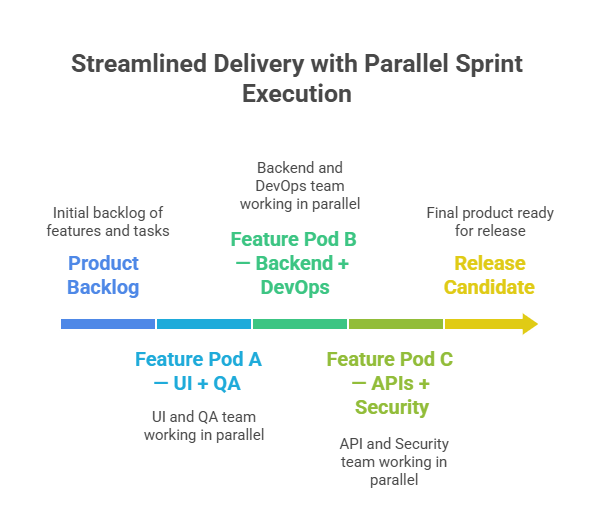
Scalable outsourced teams shift that dynamic by enabling parallel sprint execution:

  • Integrated sprint planning: Outsourced engineers participate in your sprint ceremonies and align with your Definition of Done.
  • Dedicated feature pods: Instead of bolting on “extra heads,” you form autonomous feature pods that own vertical slices (UI, backend, API, QA) for specific backlog items.
  • Standardized tooling and standards: They adopt your existing CI/CD, code review, and quality gates so there’s zero rework after handovers.
Outsourcing Mobile App Projects

Release Velocity vs In-House Bottlenecks

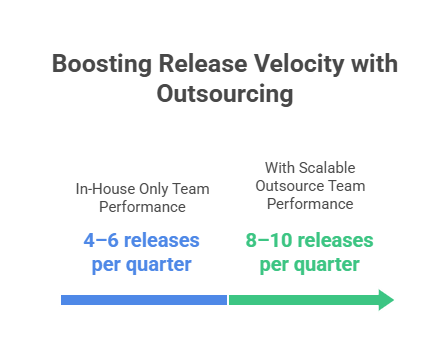
Release velocity, the frequency at which your team ships working software, is the ultimate measure of time-to-market efficiency. Two common bottlenecks in in-house models are:

  1. Hiring & ramp-up delays:

Even with aggressive recruiting, ramp-up time for mid-to-senior engineers can be 3–6 months before productivity matches team expectations.

  1. Context switching & bottleneck queues:

In a fully internal team, UI work, backend services, QA validation, and DevOps deployments often back up in sequence.

Scalable outsourced teams mitigate both:

  • Senior expertise from day one: Partners bring engineers who already follow modern practices (e.g., clean architecture, automated testing, CI/CD).
  • Parallel workflows: Instead of linear task queues (design → build → test → deploy), outsourced capacity allows overlap: while one pod builds, another integrates and yet another validates.
Outsourcing Mobile App Projects

How Outsourcing Cuts Development Cycles by 30–50%

Outsourcing reduces development cycles not by cutting corners, but by removing the two biggest drag factors in software delivery: constrained capacity and sequential workstreams

When you augment your core team with seasoned dedicated mobile developers, backend engineers, DevOps specialists, and QA professionals, you eliminate waiting periods between handoffs and dramatically reduce idle time. 

Below, we break down the delivery mechanics that make this possible.

Team Topology: Pods vs Functional Silos

In traditional development models, teams are often organized as functional silos, like UI folks in one group, backend in another, QA separately, DevOps in ops, etc. This creates serial handoffs, where each group must wait for the previous one to finish before starting their work. That’s a natural brake on cycle time.

Outsourcing flips this by organizing work into cross-functional pods:

Functional Silos

  • UI team
  • Backend team
  • QA team
  • DevOps team

Work flows serially through these groups.

Cross-Functional Outsourced Pods

  • Developer(s)
  • QA engineer
  • DevOps specialist
  • Product integrator

Work flows in parallel, within one cohesive unit aligned to a specific feature or product slice.

QA, DevOps & Frontend Running in Parallel

Outsourcing accelerates cycles by breaking the classic waterfall sequence, where frontend waits on backend, QA waits on build completion, and DevOps waits on QA, and instead enables these functions to operate concurrently.

To do this effectively, your outsourced teams should include or align to:

  • Dedicated QA automation engineers who write tests as code, not afterthought scripts.
  • DevOps specialists who embed CI/CD from day one, not just at release time.
  • Frontend engineers who consume APIs in parallel with backend development.
  • Shared sprint ownership aligned with your backlog priorities.

Here’s a practical checklist to ensure parallel execution:

Parallel Execution Checklist

  • Shared sprint cadence with internal team
  • Unified backlog with prioritized feature slices
  • CI/CD pipelines running at every commit
  • Automated test suites (unit, integration, UI)
  • Dedicated DevOps support for deployment automation
  • Real-time dashboards tracking build and test health

When these elements are in place, the result is continuous delivery and compressed cycle times, not a series of dependent checkpoints.

Modernizing or expanding an existing mobile app?

Validate your architecture, capacity, and timelines before committing to major delivery decisions.


How to Manage Outsourced App Teams Without Losing Control

You don’t “hand over work” and hope for the best. You build governance, ownership clarity, and delivery visibility into the way your outsourced teams operate. The goal isn’t micromanagement, it’s predictable delivery with aligned accountability. 

High-trust governance models allow you to enforce standards, protect architecture integrity, and ensure velocity without sacrificing product quality or internal decision authority. 

The most reliable way to do this is through a clear RACI model tied to your delivery process, combined with role-specific ownership of architecture, codebase, and roadmap cadence.

Below, we break down the governance structures that make outsourcing a controlled, scalable extension of your core team.

Who Owns Architecture, Code & Velocity

When you bring outsourced engineers into your development ecosystem, it’s vital to define who owns what, because ambiguity kills delivery speed and technical quality.

Architecture Ownership

  • Internal Architects / Tech Leads: Retain architectural authority, especially for core modules and interfaces.
  • Outsourced Senior Developers: Implement architecture under guidance and contribute to non-core modules within approved patterns.

Code Ownership

  • Internal Repositories & Standards: You own the codebase, branch policies, and static analysis rules.
  • Outsourced Contributors: Follow and enforce those standards through pre-merge checks and shared linting/test suites.

Velocity Ownership

  • Internal Engineering Leadership: Own release commitments, sprint goals, and quality metrics.
  • Outsourced Teams: Own delivery of agreed sprint items and work against your velocity targets.

Sprint, Roadmap & Backlog Governance

Once ownership is clear, the next challenge is orchestrating delivery within your product rhythm, meaning sprints, backlogs, and roadmaps must be shared and transparent.

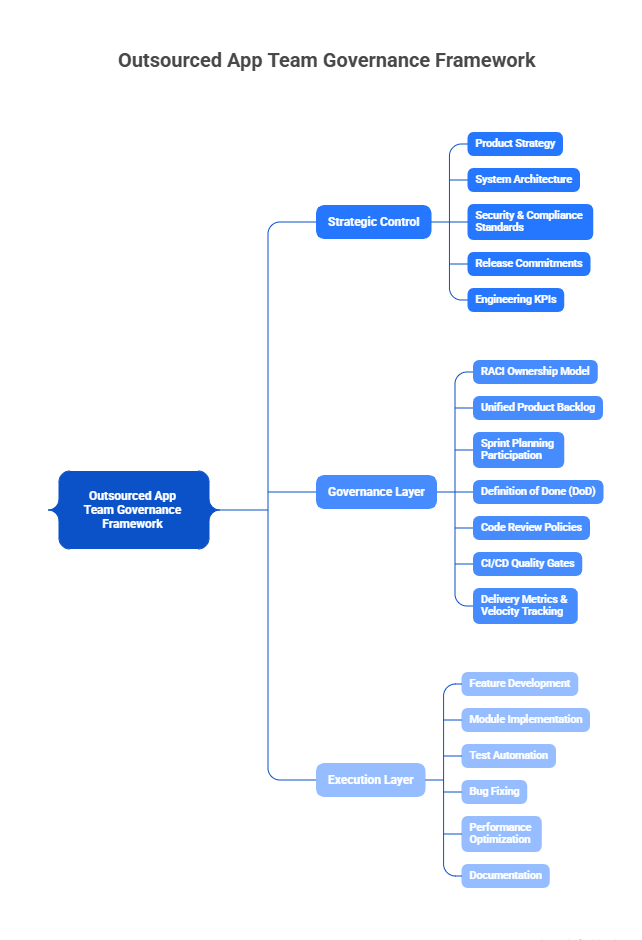
The solution is a governance layer that treats outsourced teams as first-class participants in your delivery process:

  • Unified Backlog: All work, internal or outsourced, lives in the same backlog with transparent priorities.
  • Sprint Sync: Outsourced teams join your sprint planning, standups, demos, and retros, just like internal teams.
  • Definition of Done: Shared acceptance criteria for every story, including performance, security, and compliance gates.
  • Velocity Metrics: Measure outsourced contributions as part of team velocity, not separate KPIs.

Here’s a simple, repeatable template for sprint governance:
Outsourcing Mobile App Projects - 3

RACI for Delivery Governance

To operationalize the above, a RACI matrix is invaluable:

Activity Internal Product Internal Engineering Outsourced Team Delivery Lead
Define Architecture A R C C
Code Development C A R C
Code Review & Quality C A R R
Sprint Planning A R R C
Deployment & Release R A R C
Performance Monitoring R A C C

R = Responsible | A = Accountable | C = Consulted | I = Informed

This governance model locks accountability where it matters, but still leverages the execution power of outsourced teams.

What is the real ROI for startups when they outsource mobile app development versus building internally?

Outsourcing mobile app development is a return-on-velocity and time-to-revenue strategy. For startups, speed, experiment iterations, and early monetization matter more than ever. 

When executed right, outsourcing can drive measurable ROI through faster delivery, lower burn rate, and earlier revenue capture, without sacrificing product quality or long-term technical viability. 

Below, we break down the ROI math and what it looks like in real terms.

How does outsourcing impact your monthly burn compared to in-house scaling?

Startups often assume that outsourcing equals higher per-hour cost. In reality, the effective cost per delivered feature often goes down because velocity increases and internal friction drops.

Here’s a simplified model comparing internal hiring vs outsourcing for a typical mobile app sprint:

Cost Element In-House Team (4 engineers + QA + DevOps) Outsourced Model (Dedicated External Team)
Monthly Salaries + Benefits $80,000 $50,000
Recruiting & Ramp-Up $30,000 (one-time) $0
Overhead (HR, tools, training) $10,000 $5,000
Delivery Velocity (Story Points per Sprint) 20 35
Cost per Story Point $4,000 ~$1,571

In this example, even though external rates may seem higher on paper, you get nearly double the throughput per dollar spent, and you avoid long recruiting cycles that add hidden costs to your burn. 

The larger the backlog and the more complex the delivery needs, the more outsourcers unlock ROI through parallel workstreams and expertise leverage.

How much earlier can a startup start generating revenue when outsourcing accelerates delivery?

Time-to-revenue is one of the most compelling ROI levers for founders and investors: shipping core features faster means capturing users and monetization earlier.

Let’s break down a simple calculation:

  • In-house delivery estimate for MVP: 24 weeks
  • Outsourced delivery estimate: 14 weeks
  • Projected weekly revenue post-launch: $15,000

Revenue difference from faster launch:

(24 weeks − 14 weeks) × $15,000 = $150,000 additional revenue

For startups on a tight runway, bringing forward revenue by even a quarter can dramatically improve financial stability, investor confidence, and product–market fit validation.

ROI Table — Startups (Example)

Metric In-House Outsourced
Time to MVP 24 weeks 14 weeks
Launch Revenue Acceleration $0 $150,000+
Burn Rate Impact High Lower
Feature Throughput Medium High
Quality & Market Fit Variable More predictable

Outsourcing becomes not just an expense, it becomes a strategic lever that compresses runway risk and maximizes monetization potential earlier in the startup lifecycle.

When should a startup or scaling company rely on in-house teams vs outsourced teams for mobile app delivery?

The decision is about what part of your delivery engine needs scale, specialization, or flexibility right now. In-house teams are essential for deep product knowledge, strategic ownership, and long-term platform evolution. 

Nearly 66% of US businesses outsource at least one department. Outsourced teams are most effective when you need burst capacity, specialized skills, or parallel execution without slowing the internal organization. The real ROI comes when you combine both in a way that leverages each model’s strengths.

Below, we compare the two models and show why hybrid approaches are often the best path for scaling mobile products.

When In-House Fails to Scale

65% of tech leaders report that talent shortages directly slow development cycles, especially for mobile and cloud-native capabilities.

In-house teams can struggle when the product roadmap outpaces hiring capacity or when specialized skills are needed faster than the market supply can deliver. Common scaling failure patterns include:

Constraint In-House Team Impact
Hiring Lag 3–6 months to onboard senior engineers Delivery timelines slip
Expertise Gaps Limited to generalists Complex domains (DevOps, AI, security) suffer
Ramp-Up Overhead Cultural + tooling training Lower early throughput
Cost Pressure High fixed labor cost Budget squeeze

When these constraints hit, teams often resort to overtime, re-prioritization, or de-scoping; all signs that in-house capacity has maxed out.


How can you get the best of both worlds?

Hybrid delivery models combine the strategic ownership of in-house teams with the execution horsepower of outsourced expertise. Instead of outsourcing entire products, hybrid models assign:

  • In-house teams: Product strategy, architecture vision, core platform ownership
  • Outsourced teams: Feature pods, parallel workstreams, specialized tasks (e.g., QA automation, DevOps pipeline setup, performance engineering)

This approach retains core decision authority while scaling capacity on demand.

Key benefits of hybrid models:

  • Architectural continuity: In-house architects steer the platform’s long-term evolution.
  • Elastic delivery: Outsourced pods accelerate specific streams without disrupting core squads.
  • Cost predictability: You pay for capacity you need when you need it.
  • Knowledge transfer: Internal teams benefit from external expertise through paired development and documentation standards.

This hybrid approach is widely adopted in scaling tech organizations because it balances control, velocity, and quality, exactly what CTOs and Heads of Product care about.

Is Outsourcing Right for Your App Roadmap?

Use this checklist the way I do when evaluating whether external delivery capacity will actually improve execution, not just add noise. If you can check most of these, outsourcing is likely to increase your roadmap velocity without increasing risk.

Strategic Fit

  • Our product roadmap requires more delivery capacity than our current team can realistically staff in the next 90 days.
  • We have revenue, growth, or competitive milestones tied to faster feature releases.
  • We need specialized skills (mobile, DevOps, QA automation, cloud, AI) that are hard to hire quickly.

Execution Readiness

  • We have a clear backlog and sprint cadence that external teams can plug into
  • Our architecture and APIs are documented well enough for parallel development
  • We can enforce code quality, CI/CD, and security standards across all contributors

Financial & ROI Logic

  • Faster releases would materially impact revenue, churn, or user acquisition
  • Hiring internally would take longer than our market window allows
  • We can measure velocity, cost per feature, and time-to-revenue

Governance & Control

  • We can assign internal owners for architecture, roadmap, and release decisions
  • We are prepared to run unified sprint planning and demos across teams
  • We can use shared tools for backlog, source control, and deployment

If you reach the end thinking, “Yes, that’s exactly where we are,” then outsourcing isn’t a risk, it’s a delivery lever.

If you want to sanity-check your situation, you can always talk to engineering and walk through your roadmap, timelines, and team structure with someone who’s done this before.

Wrapping it Up

Outsourcing, when done with proper governance, architecture ownership, and integrated delivery models, becomes a way to increase engineering throughput and reduce time-to-market while maintaining technical control. 

Whether you’re a startup racing to product–market fit or an enterprise modernizing a legacy mobile platform, scalable external teams allow you to run more experiments, release faster, and turn roadmap ambition into shipped software, without the friction and delays of traditional hiring.

Working on a mobile platform that needs to move faster?

Get a clear view of what’s slowing delivery and what would actually improve release velocity.


Top-Rated Mobile App Development Services for Startups

When you sit in a few dozen founder and CTO meetings, you start hearing the same story: 

“The idea was solid, but the product became too slow, too expensive, or too fragile to keep up.” That’s not anecdotal. Approx. 90% of startups eventually fail, a brutal reminder that product execution, not just ideas, determines survival.

In mobile, those two collide fast. A poorly built MVP doesn’t just waste time. It burns the runway every sprint through rework, bugs, and architecture that can’t scale.

That’s why top-rated mobile app development services for startups don’t just focus on getting something live. They focus on how that first version survives real users, real traffic, and real change. 

This article is written for founders and CTOs who want a mobile product that can grow without being rebuilt every six months.

TL;DR

Top-rated mobile app development services for startups focus on scalable MVP architecture, agile delivery, and full-cycle mobile product development. The best MVP development companies balance pricing packages, speed, and technical quality so startups can launch fast, validate users, and scale without costly rewrites or technical debt.

What “Top-Rated” Actually Means for Startup Mobile Development

In startup mobile development, “top-rated” is one of the most misleading labels in the industry. Reviews and awards usually reflect sales volume, brand visibility, or client count, not whether a team can deliver a product that survives real users, real traffic, and real product pivots.

From an execution standpoint, a top-rated mobile app development company is not the one that builds the fastest demo. It’s the one that minimizes rework, technical debt, and scaling risk over the next 12–36 months. That distinction matters. 

Industry benchmarks consistently show that 30–45% of engineering effort in growing startups is lost to refactoring and architectural cleanup, not new feature development. 

When the first version is built poorly, every sprint that follows becomes more expensive and slower.

So when you evaluate mobile app development partners, the real question is not “How impressive is their portfolio?” It’s “How much future pain does their delivery model create or prevent?”

Top-rated teams distinguish themselves in three ways:

  • Delivery maturity (not just developer skill, but planning, QA, DevOps, and handover discipline)
  • Architecture discipline (MVPs built to evolve, not to be thrown away)
  • Governance and accountability (how work is prioritized, reviewed, released, and supported)

That is what separates a vendor who ships something from a partner who builds a product that can scale.

Delivery Maturity vs Agency Size

Large agencies usually optimize for throughput, not outcomes. Work gets fragmented across analysts, designers, developers, QA, and account managers, which creates handoff delays, diluted ownership, and slow decision cycles. 

For startups, that’s dangerous. When product direction changes, which it always does, big teams adapt slowly and expensively.

Smaller, delivery-mature teams operate differently. They run with tight feedback loops, senior engineers close to product decisions, and fewer handoffs between design, development, and QA. 

This makes them faster to correct mistakes, adjust scope, and ship iterations that actually reflect user data.

What matters most is whether the team can:

  • Make architectural decisions without waiting for layers of approval
  • Release, measure, and adjust within weeks, not quarters
  • Own outcomes instead of just closing tickets

In startup environments, coordination cost kills velocity long before lack of talent does.

What Startups Need at Seed, Series A, and Series B

The definition of a “top-rated” mobile app development partner changes as a startup grows, and many founders choose the wrong type of team for their stage.

Startup Stage What Actually Matters What Breaks When You Choose Wrong
Seed Speed, learning, and MVP architecture that won’t need a rewrite Over-engineered platforms or cheap code that collapses after first traction
Series A Predictable delivery, scalable backend, analytics, and stability Teams that can’t handle production users or security requirements
Series B+ Platform reliability, DevOps, compliance, and growth engineering Vendors who only know how to build MVPs, not run products

At Seed, you don’t need a massive agency. You need a small, senior team that can move fast without creating architectural landmines.

At Series A, you need a team that can support real users, uptime, performance, and compliance, not just prototype screens.

At Series B and beyond, you’re no longer buying “development”. You’re buying operational reliability and platform maturity.

Top-rated mobile app development services understand these transitions. They sell you what your stage actually requires.

Best MVP Development Companies for Startups

When startups ask me who the best MVP development companies are, the honest answer isn’t a short list of logos. It’s a framework for evaluation. The “best” vendor is the one that can take an idea from concept to validated users with minimal rework, minimal technical debt, and a growth-ready foundation, not just a clickable prototype.

More than 30% of software projects fail because of poor execution and quality issues, not because the idea was bad. This highlights why choosing the right MVP partner matters more than picking the most visible one.

Below is a comparison of critical dimensions that differentiate real MVP teams from run-of-the-mill dev shops:

Evaluation Dimension What Top MVP Teams Get Right What Most Vendors Get Wrong
Discovery & Scope Data-driven product discovery that avoids unnecessary features Assumes requirements upfront, leading to overbuild
Architecture Planning Scalable foundation, modular by design Fragile, single-purpose codebases
Delivery Cadence Fast feedback loops + prioritized sprints Slow handoffs + waterfall tendencies
Quality Engineering Automated testing, CI/CD pipelines Manual, ad-hoc QA
User Validation Early prototypes with real metrics Internal demos, no external validation

The goal is to ensure the team you choose reduces product risk while maximizing learning velocity.

Why Most “Top” MVP Vendors Still Build Fragile Products

It may sound counterintuitive, but many vendors with strong portfolios and big brand names still build MVPs that fall apart once real users arrive. The reason is simple: they’re optimized for selling work, not owning outcomes.

Here’s the real breakdown of where fragile MVPs typically fail:

  • Architecture that can’t scale: The code may work for 100 users, but performance drops and bugs creep in at 1,000+.
  • Lack of automated testing: Without CI/CD and proper test suites, fixes in one area break others.
  • Inflated scope: Vendors add nice-to-have features instead of focusing on validated learning metrics.
  • No real feedback loop: Deliverables are shipped without mechanisms to measure retention, engagement, or user behavior.

In my experience, I’ve seen MVP projects with seemingly expert teams still produce code that requires major rewrites within 3–6 months, not because the developers were bad, but because the engagement model prioritized deliverables over product resilience and learning velocity.

What High-Quality MVP Teams Do Differently

Top MVP development teams think like product builders, not order takers. They treat every sprint as a hypothesis test and every release as a learning opportunity. Here’s what they consistently deliver:

  • Strategic Product Discovery
  • Scalable, Modular Architecture
  • Clean Code with Automated Testing CI/CD from Day One
  • Early Integration of Analytics
  • Rapid, Data-Driven Iterations
  • Clear Feature Prioritization Based on Value

These attributes aren’t buzzwords. They’re execution practices observed in MVPs that went on to become market winners, not rewrite disasters.

For example, 

Teams that integrate analytics early can pivot within weeks instead of quarters, because they’re responding to real user behavior, not assumptions. This dramatically shortens time to true product-market fit, and that’s the real definition of MVP success.

Pricing Packages 

Startup leaders don’t struggle because they can’t find developers. They struggle because they can’t predict what their product will actually cost to own. 

Most pricing pages focus on hourly rates, but experienced ones know the real question is total cost of delivery over 12–24 months: development, rework, scaling, maintenance, and downtime.

That’s why two teams with the same hourly rate can produce radically different financial outcomes.

In practice, startup mobile app pricing usually falls into three tiers:

  • MVP Packages ($30k–$100k): Rapid validation, core flows, and minimal backend, but only valuable if built on scalable foundations.
  • Growth Packages ($100k–$300k): Production-ready apps with cloud infrastructure, CI/CD, security, and analytics.
  • Scale Packages ($300k+): Platform engineering, DevOps, compliance, performance tuning, and long-term support.

Top-rated mobile app development services don’t sell “cheap builds.” They sell predictable product economics, meaning fewer rewrites, lower maintenance, and a roadmap you can actually finance.

Why Cheap Development Becomes the Most Expensive Option

Every startup that comes to us after a failed MVP tells the same story:
“We saved money on the build, and then spent twice as much fixing it.”

Here’s why:

  • No automated testing means every change breaks something else.
  • No CI/CD means slow releases and production risk.
  • Weak architecture means features get harder and slower to add.

What looked like a $50k MVP quietly becomes a $200k recovery project within a year. Cheap teams optimize for speed to invoice, not speed to stability. High-quality teams optimize for lifecycle cost, not just launch cost.

How to Budget Mobile Development from MVP to Scale

Smart startups budget like product companies, not project buyers. A realistic financial model includes three phases:

1) MVP Phase – Validate the idea without locking in bad architecture
2) Growth Phase – Add users, data, and reliability
3) Scale Phase – Optimize performance, compliance, and automation

Instead of asking, “How much does this sprint cost?” experienced founders ask:
“How much will this product cost to run and evolve over the next two years?”

That’s the mindset top-rated mobile app development partners bring, helping you protect the runway while building something that can actually survive success.

Agile Mobile App Development Process for Startups

Agile is the default delivery model for modern mobile app development, but in startups, it only works when it’s paired with tight governance, real-time feedback, and engineering discipline. 

Most rework on software projects represents a large portion of effort, typically 30–50% of total activity.

For startups with limited runway, that means you’re paying for movement, not progress.

Top-rated mobile app development services use agile to do three things exceptionally well:

  • Validate fast (ship small, learn fast, iterate)
  • Control scope (what gets built, when, and why)
  • Protect architecture (so today’s shortcut doesn’t become tomorrow’s rewrite)

In practice, that looks like short sprint cycles, continuous integration, automated testing, and a product owner who is empowered to make decisions, not just approve tickets.

How Agile Breaks When Outsourcing

Most agile failures in outsourced mobile app development come from one root cause: no one owns outcomes, only tasks.

Here’s how it usually breaks:

  • Sprints become feature factories, not learning loops
  • Backlogs grow, but priorities stay unclear
  • Technical debt accumulates, because no one is accountable for long-term quality
  • Feedback arrives too late, after architecture is already locked in

Without a strong product owner, QA gates, and release discipline, agile becomes a delivery treadmill: the team keeps running, but the business doesn’t move forward.

High-maturity teams fix this by:

  • Defining acceptance criteria tied to user and business outcomes
  • Enforcing automated testing and CI/CD before anything reaches production
  • Running retrospectives that drive architectural and process changes, not just sprint rituals

Sprint, Release, and Stakeholder Control Models

Real startup teams run on decision cadence and release control. That’s where most vendors fall short.

High-performing mobile product teams use a simple but powerful structure:

  • Weekly or bi-weekly sprints to control scope and velocity
  • Release trains (e.g., every 2–4 weeks) so production stays predictable
  • Clear RACI so everyone knows who decides, who builds, and who approves

In this model:

  • CTOs control architecture and quality
  • Product leaders control priorities and roadmap
  • Engineering teams control execution and delivery

Full-Cycle Mobile Product Development for Startups

More than 50% of software features are rarely or never used after launch, meaning early delivery without a strategy for ownership and growth is mostly wasted effort.

Full-cycle mobile product development is about long-term ownership, not just delivery. It covers the entire lifecycle: from discovery and MVP development to launch, analytics, iteration, monitoring, and ongoing ops. 

A partner who understands this continuum helps you avoid the invisible tax of thrown-away work and tech debt that kills velocity later.

What Happens After Launch (Where Most Vendors Disappear)

Most vendors treat launch as a finish line, not a starting point. That’s where the real challenges begin:

  • Bug spikes with real users: Issues you never saw during test drives
  • Performance challenges: Load, latency, and concurrency problems at scale
  • User feedback accumulation: Changing priorities vs original spec
  • Maintenance backlogs: Piles of tech debt that slow every sprint

Good mobile partners build ops discipline into the contract, not just launch deliverables.

Strong post-launch support includes:

  • 24/7 monitoring and alerting
  • SLA commitments on bug resolution
  • Automated test coverage extending into production
  • Analytics instrumentation for real user behavior

How Real Product Teams Manage Growth

Successful startups treat mobile products like platforms, not projects. Here’s how elite teams handle growth once the app is live:

  1. Release trains: Regular, predictable releases instead of ad-hoc pushes
  2. Feature flags: Control rollouts and reduce risk in production
  3. Telemetry-driven decisions: Data, not intuition, drives the roadmap
  4. Dedicated product operations: A team focused on health, metrics, and reliability
  5. Scalable backend pipelines: Autoscaling, caching, and performance guards

This operational mindset allows teams to grow from hundreds to thousands, even millions, of active users without rewriting core systems.

In startups that successfully make this transition, engineering efficiency increases over time, not decreases. That’s the opposite of what happens when launch is treated as an endpoint and the vendor disappears.

Scalable MVP Architecture for Tech Startups

More than 60% of scalability issues in production trace back to early architectural decisions, not just traffic spikes.

A scalable MVP architecture isn’t about adding more servers; it’s about choosing patterns that let product and engineering teams evolve without painful rewrites. It should support modular growth, observability, performance under load, and seamless deployment pipelines. 

In practice, this means separating concerns, using asynchronous processing where appropriate, and embracing cloud capabilities that let your app scale elastically, not manually.

Below, we cover the failure modes most startups encounter and the architectural patterns that actually support 10× growth without crippling rework.

Why Most MVPs Collapse Under Real Traffic

When you put an MVP into real user environments, not staging, the typical failure triggers are:

  • Monolithic backends: Tight coupling of services that can’t scale independently
  • No load testing: Systems that look fast with synthetic tests but fall apart under real patterns
  • Synchronous workflows: Slow API dependencies that block throughput
  • Stateful services without sharding: Bottlenecks in memory or database layers

These are the most common root causes when performance degrades at scale. In one case we observed, an e-commerce MVP that performed well with 500 daily users started failing at just 2,000 concurrent sessions because the backend was a single process handling all logic.

The key point: Performance risk is an architectural risk, and most teams discover it too late.

What Architecture Supports 10× Growth

To build an MVP that can grow into a platform instead of a liability, senior architects lean on patterns that decouple, distribute, and automate:

  1. Microservices (or Modular Services)

Break responsibilities into independent services that can scale separately.

  1. Cloud Native Infrastructure

AWS, GCP, or Azure components that autoscale on demand (e.g., serverless functions, managed databases).

  1. Event-Driven Asynchronous Workflows

Reduce blocking calls, enable distributed processing, and improve responsiveness.

  1. CI/CD + Blue/Green Deployments

Automate releases without downtime or user impact.

  1. Observability (Logging, Tracing, Metrics)

Know what breaks before users notice.

  1. API Gateways & Caching Layers

Protect backend resources during peaks.

For example, using cloud functions and managed databases lets you handle 10× traffic without redesigning your core codebase. Combining this with feature flags and rollout controls lets you scale features gradually and safely.

In short, building for scale is about architecting for growth patterns that are observable, manageable, and elastic.

How CTOs Should Compare Startup App Development Partners

Experienced CTOs don’t evaluate app development partners on resumes or portfolios alone. They score vendors on delivery capability, execution risk, and long-term ownership cost, not just how convincing the sales pitch sounds.

A practical scoring model usually looks like this:

Dimension What to Evaluate Why It Matters
Capability Architecture skill, senior engineering, DevOps, QA Determines whether the product can scale and be maintained
Delivery Model Sprint cadence, QA gates, CI/CD, release governance Controls how predictable and safe delivery will be
Risk Profile Dependency on juniors, turnover, documentation Predicts how likely the project is to derail
Ownership Cost Code quality, testing, handover Determines what it costs to operate and evolve the product

This approach turns vendor selection into a risk management exercise, not a beauty contest.

Capability vs Headcount vs Delivery Risk

One of the most dangerous myths in outsourcing is that more people equals less risk. In reality, it often means the opposite.

Large teams reduce individual cost but increase:

  • Coordination overhead
  • Knowledge fragmentation
  • Handoffs between roles
  • Delays in decision-making

Small, senior teams cost more per hour but dramatically reduce:

  • Rework
  • Miscommunication
  • Architectural mistakes
  • Release risk

From an economics standpoint, startups should optimize for throughput per decision, not bodies per sprint. 

The goal is to maximize how quickly a team can go from idea → build → feedback → improvement without breaking the product.

This is why high-performing startups often choose smaller, delivery-mature partners over large offshore factories. 

If this guide raised questions about your roadmap, architecture, or vendor choices, that’s a good thing

Strong products are built by teams that validate assumptions early, before scale makes mistakes expensive.


Key Takeaways For Mobile App Development Services

Projects with strong delivery governance are over 2× more likely to hit their business goals than those that rely on ad-hoc outsourcing. Before you sign a contract, use this final checklist:

  • Can this team design a scalable MVP, not just a demo?
  • Do they run agile with real governance, testing, and CI/CD?
  • Can they support the product after launch, not disappear?
  • Is their pricing aligned to long-term ownership, not short-term speed?
  • Do they have senior engineers who make architecture decisions, not just follow specs?

The right mobile app development team helps you move fast without breaking, scale without rewrites, and protect your runway while your product grows. That’s what separates successful startups from expensive lessons.

How to make a Social media app like Instagram in 2023

Overview: Instagram is one of the most popular social media apps that has gained recognition throughout the years. Influencers, business and Meme Pages have made Instagram their go to app. With all the greatness it has, we bring to you today a complete guide on apps like Instagram, including the tech stack, cost and features so you build the next Instagram with TechnBrains.

It’s hard to imagine our daily routine without social media nowadays, isn’t it? Among them, Instagram stands out as one of the most popular and influential platforms, allowing users to share their moments, connect with others, and express themselves creatively.  

In the third quarter of 2021, Instagram reached over 2 billion users and is predicted to have 2.5 billion monthly active users by the close of 2023.

Have you ever wondered how to create a social media app like Instagram? This article will guide you through the process, uncover the secrets of Instagram’s success, delve into the app development process, explore the costs involved, and highlight essential KPIs for a photo-sharing app.

Instagram

Instagram is a widely used social media platform that allows users to share photos and videos, as well as interact with others through likes, comments, and direct messages. It was launched in 2010 and quickly gained popularity for its focus on visual content and user-friendly interface. 

People use Instagram to highlight their daily lives, connect with friends, family, and followers, follow their favorite celebrities, brands, and influencers, and discover new trends and interests. The platform has various features like Stories, IGTV, and Reels, making it a versatile platform for both personal and business use.

Stats about Instagram in 2023

  • Based on data from SEMrush, Instagram is ranked among the top 10 most-visited websites in the world, with a total of 4.25 billion visits per month.
  • Around 30.94% of the world’s 4.48 billion internet users regularly utilize Instagram. 
  • Instagram is used by approximately 25.31% of the global population.

Here is a table of monthly users of Instagram:

YearUsers
2013110 million
2014200 million
2015370 million
2016500 million
2017700 million
20181 billion
20191.1 billion
20201.3 billion
20212 billion
20222.3 billion
2023 (estimated)2.5 Billion

Secrets behind Instagram’s Success

Instagram’s remarkable success can be attributed to various factors that have resonated with users worldwide. The platform’s user-friendly interface, focus on visual content, and constant innovation have all contributed to its widespread popularity. Moreover, Instagram’s seamless integration with other social media platforms and its strategic use of influencers have propelled it to new heights. By maintaining a balance between catering to user preferences and embracing technological advancements, Instagram has managed to create a compelling and addictive user experience.

CTA- make an app like Instagram

Features of App like Instagram

In the next section of our guide on creating an app similar to Instagram, we’ll discuss the importance of incorporating various features.

Instagram owes much of its success to the diverse range of features it offers its users. Over the years, the platform has expanded its repertoire from a simple photo-sharing app to something truly remarkable.

Who would have thought a photo-sharing app could help users generate thousands of dollars? Each new feature added to Instagram serves a specific purpose, from increasing engagement with Stories to enhancing interaction through direct messaging. There’s also IGTV, in-app purchases, GPS, search functionality, integration with other platforms, and much more.

To ensure that your app surpasses existing offerings, you too must incorporate these features. After learning how to create an app, it’s crucial to identify which features to include to make it stand out. Below, we’ve listed some of the must-have features to consider when building an app like Instagram.

1. Photo and Video Upload

Uploading photos and videos is a fundamental aspect of creating an app like Instagram. It is essential to provide users with features such as preview, editing, filters, tagging, and the ability to capture images. This is also an opportunity to enhance your application and surpass Instagram’s functionalities. 

For instance, Instagram users cannot directly crop their photos when posting them. Although they can apply various filters and adjustments, cropping is not an available option. Uploading photos and videos, along with applying filters, requires coding on both the front-end and back-end. In total, it can take around 300 hours of coding to establish the video upload structure.

Developing a 15-20 second video and recording it can consume at least 200 hours of front-end coding. Additionally, applying filters and special effects can take 8 hours of coding each. Furthermore, enabling features such as camera flip, beauty mode toggle, flash toggle, and speed settings can also take eight hours each. 

2. Registration Process

The registration process for an app like Instagram is important, as it can impact the user’s first impression. Making the user wait for too long or requiring too much information can increase the chances of them opting out. 

To avoid frustration, consider extracting information from Facebook or sending push notifications for users to complete their profile later. Google also delays asking for phone numbers and profile pictures until later stages. Adding a login option through social media or Google can be helpful. 

To set up the registration process for an app like Instagram, front-end coding for username, password, phone number, and email will take 14 hours. Back-end coding for the same process will take about 32 hours. Setting profile pictures and user interests will take 8 hours each on both ends. Allowing users to watch videos without registration takes 6 hours, while adding registration through Gmail or Facebook takes another 6 hours for each platform. In total, it takes 140 hours to set up the registration process.

TechnBrains Instagram bio

3. Searching

Instagram users have the ability to search for hashtags, people, and pages. Incorporating this search feature into your application is crucial for enhancing the user experience.

Although it may seem insignificant, the search function is the key feature on Instagram. By allowing users to search for their favorite pages, people, and hashtags, you can improve the overall appeal of the application.

4. Notifications

The registration process is complete. However, how can you ensure that the user returns to your application? Push notifications are the solution. Instagram uses this feature to notify users of newly added stories and when someone adds a photo. These functions encourage users to revisit the app multiple times. 

Instagram’s notification system is user-friendly and effective, but back-end coding is necessary to determine who likes your post, video, or photo. This takes approximately 20 hours of coding, while front-end coding takes around 16 hours. 

Other features, such as “Who has followed you,” “notifications,” “who has shared your video,” “comments,” and “profile views,” require front-end coding that takes 88 hours on an app like Instagram. Back-end development for these features takes around 110 hours.  Mobile app developers need approximately 198 hours of expertise and time to complete the notification feature.

5. Integration with other Platforms

Did you know that Instagram allows users to share photos on Facebook? As Facebook owns Instagram, why not add this feature to your own app? By including this feature, you can use Facebook to promote your app and attract new users. Sharing photos is easy and convenient, and it can help increase exposure for your app. Additionally, integrating with Facebook can be a useful marketing tactic, especially if you have a business Instagram account. Don’t miss out on the benefits of this integration

6. Interacting with Stories

This feature is especially crucial for advertising, especially when it comes to using Instagram for business purposes. With this feature, users can create polls, surveys, ask questions, and more to enhance engagement. Messaging through stories is also an excellent way to boost interaction, which is essential for any business on Instagram. Check out the picture below to see how this feature can increase engagement with stories on Instagram.

7. Location Integration

A lot of users prefer to share their whereabouts with their followers. To make your application more dynamic, it’s essential to incorporate a GPS function. Your application should be able to automatically obtain the user’s location. However, in areas where GPS targeting is weak, it’s important to include a mechanism that lets users set their location manually.

Including GPS tagging is also crucial for user engagement. Tagging places or people in stories has been shown to be a great feature for users. As demonstrated in the attached picture, Instagram has effectively integrated location into their platform.

8. The Activities Section or Instagram Feed

For Instagram users who are interested in keeping up with their followers’ activities, the activity section is the place to go. In the past, it was also possible to see which posts a user had liked or which pages they were following. However, Instagram has removed this feature, despite its popularity among users. Nonetheless, there are still ways to benefit from this functionality. The attached picture depicts the Instagram feed.

9. Sending Messages

Communication with followers and other users is a crucial aspect of Instagram. Throughout its history, direct messaging has been well received by users. 

TechnBrains Instagram feed

In addition, this is an opportunity to introduce new features to direct messaging. This requires research and a dedicated team to identify any weaknesses in Instagram and enhance them. 

By doing so, you can surpass Instagram and develop a superior version of the app. The image displays an instance of sending messages.

10. Instagram Stories 

Instagram stories function similarly to Facebook and WhatsApp stories, but with Instagram, users receive notifications after new stories are added. Additionally, Instagram has introduced the “Close Friends” feature, which allows users to share their stories exclusively with selected close friends. Furthermore, there are various story downloaders available to download Instagram stories. These unique features are exclusive to Instagram and are not present on WhatsApp or Facebook. 

CTA- create an app like Instagram

App like Instagram Tech-Stack

If you are wondering how to create a mobile app like Instagram, there are several technologies involved in both front-end and back-end development, as well as designing and maintaining the server-side of the application.

For back-end development, we recommend using Laravel, and for front-end development, React Native is a great option. When it comes to maintaining your database, PostgreSQL is a reliable choice. For cloud services, Amazon Services is a good option.

For payment gateways, PayPal, Braintree, and Stripe are all great choices. Additionally, tools like Elastic-Search, Google Maps, Google Analytics, and Twilio can be helpful in handling various services and functions.

The Instagram tech stack is a good example of the many technologies and tools involved in creating a mobile app. It’s important to work with a team that has the necessary expertise and knowledge in these areas, from full-stack developers to design experts. You can choose to hire an in-house team or outsource your project.

How to make an app like Instagram

If you are inspired by Instagram’s success and want to create a social media app like Instagram, here is a guide to create an app like Instagram in just 8 steps

  1. Idea Generation and Market Research 
  2. Define Features and Functionalities  
  3. Choose the Right Technology Stack  
  4. Design the User Interface  
  5. Front-End and Back-End Development  
  6. Testing and Quality Assurance  
  7. Launch and Marketing  
  8. Continuous Improvement  

Let’s take a look at these steps in detail:

1. Idea Generation and Market Research 

Before diving into development, identify your app like Instagram’s unique selling points and conduct thorough market research to understand user preferences and competition.

2. Define Features and Functionalities  

Outline the core features your app like Instagram will offer, such as user profiles, photo sharing, comments, likes, and direct messaging. Consider incorporating additional features to distinguish your app from the competition.

3. Choose the Right Technology Stack  

Select the appropriate technology stack for your app like Instagram’s development, including programming languages, frameworks, and tools that align with your vision.

4. Design the User Interface  

Create an intuitive and visually appealing UI/UX design of apps like Instagram that ensures seamless navigation and a delightful user experience.

5. Front-End and Back-End Development  

Develop the front-end and back-end of your app like Instagram, focusing on functionality, performance, and security. Implement features like user authentication, data storage, and real-time interactions.

6. Testing and Quality Assurance  

Thoroughly test your app like Instagram across various devices and scenarios to identify and fix any bugs or glitches. Prioritize user feedback to refine the app further.

7. Launch and Marketing  

Prepare a compelling launch strategy to generate buzz and attract users. Utilize social media, influencer partnerships, and app store optimization techniques. Post-launch, you need to optimize your app store rating and reviews

8. Continuous Improvement  

Gather user feedback post-launch and implement updates and new features regularly to keep your app engaging and relevant.

CTA- make an app like Instagram

Cost of app like Instagram 2023

The main question that’s on everyone’s mind: what’s the cost of creating an app like Instagram? To determine this, we’ll need to calculate the total number of hours required for the project. Let’s take a closer look at the key components that go into building an app like this, and estimate the required hours for each.

TaskNumber of Hours
Back-end Development659
Front-end Development1008
Wireframes 100
Designing90
Quality Assurance335
Project Management252
Total Number of Hours2454

Based on real-time estimation, we have prepared estimates for developing an app like Instagram. The amount of work required for this task is now clear, so let us discuss the cost involved. 

When creating an app like Instagram, factors such as its design, aesthetic, and the location of its developers can all influence the cost. Additionally, the hourly rates of developers can also be a significant factor. Developing an app like Instagram may cost around $500,000.

8 Apps Like Instagram That Offer the Same Excitement

Now that we have discovered all we need to know about an app like Instagram, let’s get down to Instagram alternatives. While Instagram has become one of the most popular social networks, other apps offer a different experience while incorporating some of its best features. 

These apps have their own unique feel and are just as visually appealing and community-driven as Instagram. Check out the following list for some refreshing options to try out.

TikTok

tiktok logo

TikTok is a strong competitor of Instagram. An app like TikTok can easily compete with Instagram because of the unique and diverse features that it has to offer. TikTok and Instagram stand out as two prominent platforms, each offering a unique experience for users to connect, share, and engage. TikTok is better for raw content whereas Instagram is better for polished content.

Retrica

Retrica Logo

Retrica is a social network and photo/video platform, app like Instagram. Unlike Instagram, Retrica supports GIF image formats and allows you to create your own GIFs from a collection of photos or a video. 

With Retrica, you can enjoy all the features you love from Instagram, plus additional ones. The app offers a variety of fun filters and editing effects, as well as stickers and stamps, to help you express yourself creatively. Moreover, you can connect with like-minded people in the community who share your interests and ideas.

Vigo Video (formerly Flipagram)

Vigo Video logo

If you are looking to create fun videos and photo slideshows with your favorite or trending songs in the background, Vigo Video (formerly Flipagram) is the app for you. Unlike Instagram, Vigo Video allows you to import music and sound effects into your videos. 

Vigo Video is a social network where you can follow other talented users, get inspired by their videos or slideshows, have your posts featured, and participate in fun challenges to get your creative juices flowing. This app like Instagram includes a library of music clips, so you don’t need to have the perfect song in your device’s music library to import it.

Snapchat

Snapchat logo

It’s worth noting Snapchat as it competes with Instagram in terms of popularity and features, particularly as both strive to be the preferred platform for users to share their personal stories. You can easily make an app like snapchat to capture pictures or short videos to add to your Snapchat story, which will be automatically removed after 24 hours. 

Snapchat has also introduced Snapchat web, which is a game changer in the photo sharing app industry. If you prefer the concept of temporary posts, Snapchat might be the perfect app for you since all your photos and videos, whether sent as messages or part of your story, will eventually vanish.

We Heart It

We Heart It Logo

If you enjoy sharing and viewing inspirational content, We Heart It is a popular image-sharing platform that you might enjoy. Unlike Imgur, the content on this app is more introspective and consists mainly of motivational photos and quotes. The platform is similar in layout to Pinterest, allowing users to browse and add photos to their collection. 

You can also create your own profile, known as a “Canvas,” by uploading your own photos and liking other users’ photos to add them to your “Hearts” section. It’s a great way to connect with positive and inspiring users in the community.

Pinterest 

Pinterest logo

Did you know that Pinterest is not just for wedding planning and recipe collecting? If you love the visually appealing aspect of Instagram, then you will definitely love Pinterest’s super slick and eye-catching platform. Unlike Instagram, Pinterest allows its users to “repin” or save pins from other users. These pins can also link out to other web pages, providing you with more information related to the pinned image.

Tumblr

Tumblr logo

You may be familiar with Tumblr, a popular blogging platform that mainly revolves around sharing images and GIFs. Along with posting photos and videos, you have the option to create text posts, audio posts, chats, photosets, and more. By following other Tumblr users, you can even “reblog” their posts to your own Tumblr blog. 

Tumblr is one of the most versatile social networks available, and its mobile apps make it simple and enjoyable to post and interact with the community. You can post almost any type of content you desire and customize your layout to resemble a genuine blog when viewed on the web from a browser.

Flickr

Flickr Block | Drupal.org

Have you ever wondered if people still use Flickr? The answer is a resounding yes! You might be surprised to learn that Flickr’s mobile apps have undergone some impressive updates, including cool photo filters and editing effects, as well as a sleek feed. 

Some people even say that Flickr is better than Instagram! After Instagram’s privacy policy controversy in 2012, many switched to Flickr and never looked back. If you’re someone who loves taking photos with your phone but aren’t completely satisfied with Instagram, it might be worth checking out Flickr’s mobile apps.

Imgur

Imgur logo

Imgur is a widely used and popular free platform for hosting images on the internet. Millions of people use it every day to find amusing pictures, animated GIFs, and videos that have been shared and interacted with extensively, leading to their rise in popularity. 

The mobile app boasts a sleek design that showcases the best content, app like Instagram. You can also create a profile and share your own content, similar to other social networks.

TechnBrains can help you make the next Instagram

TechnBrains offers premier Mobile app development services to help you build an app like Instagram seamlessly. Our skilled team covers every aspect:

  1. Strategy: We’ll refine your concept and create a tailored plan.
  2. Technology: We use cutting-edge tools for robust performance.
  3. Design: A visually stunning interface with user experience in mind.
  4. Features: We integrate engaging functionalities like photo sharing.
  5. Testing: Rigorous testing for a flawless user experience.
  6. Launch: A well-strategized launch for maximum impact.
  7. Support: Ongoing updates and user support post-launch.
  8. Monetization: Guidance on effective revenue models.
  9. Security: Stringent measures to protect user data.
  10. User-Centric: Continuous improvements based on user feedback.

With TechnBrains, your custom app dreams become reality, setting you up for success in the competitive app market.

CTA- build an app like Instagram

FAQs

1. How does Instagram make money?

Instagram generates revenue through various channels, primarily:

  1. Advertising: Businesses and brands pay to promote their products or services to a targeted audience through sponsored posts, Stories, and Explore sections.
  2. Shopping: Instagram allows businesses to set up a virtual storefront, enabling users to directly purchase products from posts.
  3. IGTV Ads: Creators can monetize their IGTV videos through ads.
  4. Instagram Shopping Ads: Brands can promote their products within the Shopping section of the app.
  5. Influencer Partnerships: Influencers collaborate with brands for sponsored content.

2. How much does it cost to create an app like Instagram?

The cost of developing an app like Instagram can vary widely based on factors such as features, complexity, development team rates, and location. Developing an app like Instagram may cost around $500,000. 

3. What is Instagram’s technology stack?

Create a mobile app like Instagram using various technologies for front-end and back-end development, as well as server-side design and maintenance. Laravel and React Native for back-end development, while PostgreSQL and Amazon Services are reliable options for database maintenance. Payment gateways like PayPal, Braintree, and Stripe. Utilize tools like Elastic-Search, Google Maps, Google Analytics, and Twilio for various services. Hire a team with expertise in these areas, either in-house or outsource.

4. How can I build an app like Instagram?

To build an app like Instagram, follow these 9 steps:

  1. Idea Generation: Define your unique value proposition.
  2. Market Research: Understand your target audience and competitors.
  3. Features: Outline the features you want to include.
  4. Design: Create an intuitive UI/UX design.
  5. Development: Build the app’s frontend and backend.
  6. Testing: Thoroughly test the app for bugs and user experience.
  7. Launch: Prepare a strategic launch plan.
  8. Marketing: Promote your app through various channels.
  9. Feedback: Gather user feedback and continuously improve.

5. What are the top competitors of Instagram?

Some of the notable competitors of Instagram include:

  1. Facebook: Instagram’s parent company offers a similar platform.
  2. Snapchat: Known for its disappearing photo and video sharing.
  3. TikTok: Focuses on short-form video content.
  4. Twitter: Allows users to share text, photos, and videos.
  5. Pinterest: Primarily used for discovering and sharing ideas through images.

Each platform has its unique features and user base, contributing to the competitive landscape in the social media industry.

How to choose the Best Mobile App Development Company – A Comprehensive Guide

Overview 

If you are looking to hire the best mobile app development company for your next project, TechnBrains has 10 tips for you that will help you make an informed decision. The 10 tips for choosing the Best mobile app development company are opting for a top mobile app development company, making sure they have the relevant experience, checking reviews and references, asking for estimates, getting to know your team, starting a trial contract, make sure they don’t compromise on security and be transparent in communication and collaboration.

In this competitive landscape of finding the best mobile app development company, there are many options to choose from. If we talk about mobile apps, in the year 2023, there will be 2.87 million apps available for download alone on the Google Play Store. Now imagine the competitive market of the Apple App Store and more. When it comes to top mobile app development companies, people prefer them because they have all that they need to build a competitive mobile app that will stand out in the crowd. 

Finding the right mobile app development company can be a daunting task. In this blog, TechnBrains is here with its expert ten tips for you to choose the right mobile app development company in the USA so you can take your business to new heights. Read below to make the right choice.

10 Tips to Choose the Best mobile app development company

Find out what to look for in the top mobile app development company to build your next project:

5 tips to choose the best mobile app development company infographic

Alt text – mobile app development company

Tip 1 > Pick a Professional Mobile App Development Company

First things first, you need to look for companies that are professionals in the mobile app development industry. You need to look for companies that have experience in the relevant field that you are looking for. This skims out all the other companies with one having a deeper knowledge and expertise.

If your goal is to create an AR/VR-based app, you should contact a mobile app development company that specializes in AR/VR App development. You can also check the portfolio or the amount of iOS app developers and Android app developers. They have to have a clear picture of the company. But remember, not all projects make it to the portfolio due to confidentiality agreements.

Tip 2 > App Development Company should have relevant Industry Expertise

Building an off-the-shelf solution is not enough to stay competitive in the mobile app industry. Your product should be based on innovation, and it should solve the particular problems of your industry. For example, building an app like Uber gets you the idea that the app-building company has the relevant experience to pull off a top-notch solution.

Furthermore, industry experts can provide additional insight into your solution. Examine a vendor’s portfolio to see if they have domain competence. You can also ask the potential mate personally for this information.

Tip 3 > Check for References and Reviews

Before buying a product on Amazon, you probably read reviews on different groups or Amazon. Feedbacks and ratings are vital to making a choice, and this same implies to the software development industry.

For mobile app development company reviews, you can use Clutch or GoodFirms, which are one of the best directories for B2B. You can easily read the client’s opinions about the app-building company you are going for. Clutch reviews go through rigorous testing, ensuring that no fake feedback is ever submitted. With Clutch, you can confidently select a project from a developer’s portfolio and request the representative’s contact information for the client’s company.

technbrains client reviews

Alt text: Technbrains Client Reviews

 A trustworthy company that specializes in app development will ensure that you have all the necessary information to feel assured of their capabilities. Moreover, sharing their references with you enables the potential vendor to showcase their past achievements. Thus, references benefit both parties involved.

Tip 4 > Choose a partner with a variety of App Development Services

Custom mobile app development is not only design and coding, but it goes beyond it. It takes a lot of effort and expertise to make a competitive final product. Choosing a mobile app development company that can handle the entire process from beginning to end is often the more practical and cost-effective choice. Consider these, for instance:

  • Market Research and Idea Generation
  • Defining Goals and Objectives
  • Wireframing and Prototyping
  • UI/UX Design
  • Technology Stack
  • Security and Privacy Enhancements
  • Integration of APIs and Third-Party Services
  • App Store Optimization (ASO)
  • Regular Updates and Maintenance
  • Future Improvements and Feature Updates

By consolidating all of these services in one place, your mobile app development process can be greatly streamlined, saving you significant time and effort. This approach also guarantees the quick resolution of any issues that may arise and promotes consistency across your product.

Tip 5 > Ask for Estimates

When it comes to mobile app development, it is essential to provide a detailed request for proposal (RFP) to potential vendors if you want accurate estimates for your project. Many clients approach app development companies with requests like “a food delivery app like Uber Eats” without providing sufficient information. While simultaneously requesting proposals and estimates, these clients may be seeking the best bid without realizing that their lack of details prevents accurate proposals.

To obtain an accurate estimate for your project, it is crucial to provide an in-depth description of your product in the RFP. By doing so, potential vendors can assess the complexity, features, and functionalities required, enabling them to offer more precise estimations and proposals. This approach allows you to compare companies without the concern of misunderstandings regarding the scope of work.

5 more tips to choose app development company

Tip 6 > Get familiar with your Team before making any Agreements

Before making any agreements or commitments in the process of mobile app development, it is crucial to ensure that you are familiar with your team. While reviewing a potential vendor’s portfolio can provide insight into the type of projects they have delivered, it is essential to remember that it is the employees of the company who will be working on your project.

Each employee brings a unique background and overall experience to the table. Therefore, it is highly recommended to conduct interviews with the app developers before commencing the project. An excellent example of the importance of knowing your team can be illustrated by a situation where we assigned two of our app developers, who happen to be enthusiastic online grocery shoppers, to a customer creating an Ez grocery application. This shared interest and understanding resulted in a great experience for both the customer and our developers, as they were able to work together seamlessly.

By getting to know your team members, you can assess their expertise, skills, and compatibility with your project requirements. Building a strong personal connection and understanding their interests can foster a collaborative and productive work environment. Additionally, familiarity with your team enables effective communication, trust, and a shared commitment to the success of the mobile app development project.

Tip 7 > Have a Segmented Trial Contract

A segmented trial contract provides a valuable approach to assessing the suitability of a mobile app development agency for your project. By incorporating a trial period into the hiring process, you have the opportunity to observe the development team in action without committing to a long-term collaboration. This enables you to define the scope of work for the initial one to two months in a trial contract.

One of the advantages of a trial contract is its flexibility. Unlike a long-term agreement, terminating a trial contract is relatively straightforward. If the collaboration does not meet your expectations, you have the freedom to change contractors without extensive legal complications. The trial period serves as a means to gauge your comfort level with the vendor for a long-term cooperation based on firsthand experience.

Tip 8 >Select the Right Vendor Scope

When it comes to choosing the best app development company for your project, one crucial factor to consider is the size of the vendor. The size of the vendor can have a significant impact on the outcome of your app development process. It is important to select a vendor that aligns with the specific requirements and goals of your project.

Small-sized app development companies often provide a more personalized and flexible approach. They can offer close collaboration, direct communication, and quick decision-making. With a smaller team, you may have a dedicated project manager who can give your project individual attention and ensure that your vision is accurately translated into the final product. 

On the other hand, larger app development companies have their own set of advantages. They typically have a broader skill set and a larger talent pool, which means they can handle complex projects and provide expertise in various areas. Moreover, larger companies often have established processes and resources, ensuring scalability and stability throughout the development lifecycle. Just like TechnBrains, we have experience in managing larger projects that can contribute to smoother coordination and timely delivery.

Tip 9 > Keep your data confidential, secure, and compliant

Lastly, consider how well a mobile app development company prioritizes data confidentiality, security, and compliance. 

The best app development companies employ robust security measures to safeguard your data from unauthorized access. They implement encryption techniques, secure authentication protocols, and data encryption in transit and at rest. Additionally, they follow industry best practices in secure coding and regularly update their software to address any security vulnerabilities.

Ensure that the app development company adheres to relevant data protection regulations, such as the General Data Protection Regulation (GDPR) or the California Consumer Privacy Act (CCPA), depending on your target audience and business location. A reputable company will have a clear understanding of these regulations and incorporate privacy features into their app design.

Look for companies that conduct regular security audits and have a designated data protection officer responsible for overseeing compliance with data protection laws. Lastly, it is crucial to inquire about the company’s track record in terms of data breaches or security incidents. Ask for references or case studies that demonstrate their commitment to data security and their ability to respond effectively to any potential breaches.

Tip 10 > Have a clear set of Goals

To ensure you make the right choice, it is crucial to have a clear set of goals and criteria in mind. Here are a few reasons why having well-defined goals is important in selecting an app development company.

  • Having clear goals allows you to align your objectives with the capabilities and expertise of the app development company. 
  • Each company has its own strengths and specializations, whether it’s in designing user-friendly interfaces, building complex backend systems, or integrating third-party APIs. 
  • By identifying your specific goals, you can prioritize the skills and experience required and choose a company that best fits your requirements.
  • Clear goals help in assessing the track record and portfolio of app development companies. By defining what you expect your app to achieve, you can evaluate potential partners based on their past projects and success stories. 

Look for companies that have experience in developing apps similar to your desired functionality and target audience. This will give you confidence in their ability to deliver the desired results.

Choosing a Mobile App Development Company: Conclusion

When it comes to hiring the best mobile app development company for your next project, you need to consider their expertise, reviews, and portfolio, ask for estimates, get a trial contract, and have a clear set of goals to choose the right vendor. Now that you have explored all that you need to know in this blog, you can make an informed decision. TechnBrains has over 20+ years of experience in the mobile app development industry, creating custom solutions that are revolutionizing the world.

So are you Ready to bring your app idea to life? Contact the top mobile app development company today and turn your vision into reality!

CTA - Technbrains blog

FAQs

How to find an app development partner?

To find the best app development partner, you need to look for a company. You need to have a clear set of goals aligned for your app then you need to check if the company has relevant industry experience for your app. Based on experience, expertise, communication, and collaboration, you can choose TechnBrains, which can be your trusted mobile app development partner.

How much does it cost to hire someone to develop an app?

The cost of hiring someone to develop an app can vary greatly depending on factors such as complexity, features, platform, location, and developer experience. Generally, app development costs can range from a few thousand dollars to several hundred thousand dollars or more.

What factors should you consider when choosing a mobile app development company?

To begin with, it’s essential to possess a comprehensive understanding of your product and the underlying technologies. We suggest creating a concise development brief outlining your target audience, market, user requirements, competition, and other pertinent specifications. This will facilitate finding a suitable vendor equipped with the necessary skills. Additionally, consider the scale of your project while selecting a mobile app company, ensuring they have the capacity to deliver your product successfully.

How much does it cost to hire an app developer?

The cost of hiring an app developer can vary based on several factors, such as their experience, location, complexity of the app, and the development platform. On average, app developers can charge anywhere from $25 to $250 per hour. Additionally, fixed project rates may range from a few thousand dollars to tens or even hundreds of thousands of dollars, depending on the scope and complexity of the app. It is advisable to obtain detailed quotes and discuss project specifics with potential developers to get a more accurate estimate. You can hire an app developer here. 

How do I find the best app development company?

Review platforms like Clutch or GoodFirms are valuable resources for finding experienced development companies. These platforms feature vetted companies with client testimonials and showcased projects. Prioritize companies with comprehensive expertise and practical experience in developing mobile apps for the best results.

Can I hire someone to create an app?

By enlisting a team of skilled professionals for your project, you can expedite development, enhance the quality of your solution, and optimize app development expenses. Get in touch with us, and we’ll connect you with a group of app developers who will seamlessly handle your project from start to finish.

10 qualities to look for in top App Development Companies in 2023

Developing an app for your business can be a game-changer, but finding the right app development company can be an overwhelming task. With so many app development companies in the USA, it’s important to know what qualities to look out for to ensure you get the best results.

In the digital age, a mobile application is a critical component of any business that wants to stay ahead of the competition. However, developing a successful mobile app requires expertise, creativity, and technical know-how. Therefore, it’s essential to partner with a top-notch app development company to ensure your app’s success.

In this blog, we’ll cover the top qualities to look out for in top app development companies in the USA in 2023.

1/ TECHNICAL EXPERTISE

One of the most important qualities to look out for in a top app development company is technical expertise.

You want a company that has a team of skilled developers who are experienced in developing apps for various platforms, including iOS and Android.

2/ EXPERIENCE AND REPUTATION

Look for a company that has

  • a proven track record of developing successful apps for clients.
  • See their portfolio and previous clients’ testimonials.
  • Learn about their history and reputation.
  • Thorough knowledge of advanced technologies.

You want a company that has experience in developing apps for various industries and can provide solutions to different challenges.

3/ COMMUNICATION AND COLLABORATION

A good app development company should be able to communicate effectively with clients and collaborate with them throughout the development process.

They should be able to understand your requirements and provide regular updates on the progress of your app development project. They should also be able to provide suggestions and recommendations to help you make the best decisions.

TnB

TechnBrains is remarkable in terms of technical knowledge, experience, reputation, and collaborative abilities for developing apps.”

4/ PROBLEM SOLVING

When it comes to developing a successful app, problem-solving skills are crucial. The ability of an app development company to quickly identify and solve problems can make or break the success of your app. App development can be full of unexpected problems.

Look for a team that can quickly identify issues and comes up with effective solutions. When problems do arise, a skilled app development team will be able to quickly identify the root cause and come up with effective solutions. This means your app will be up and running again in no time.

5/ USER-CENTERED DESIGN

The best app development companies prioritize user-centered design. They understand the importance of creating a user-friendly app that meets the needs of your target audience.

They should conduct thorough user research and testing to ensure the app is intuitive, easy to navigate, and visually appealing.

6/ APP MAINTENANCE AND SUPPORT

A top app development company should offer ongoing maintenance and support services to ensure your app remains up-to-date and functional. They should provide regular updates and bug fixes, and be available to answer any questions or concerns you may have after the launch of your app.

7/ CREATIVE THINKING

A successful mobile app requires not only technical expertise but also creativity. The app development company you choose should have a team of designers and developers who can think outside the box and come up with unique and innovative ideas to ensure that your app stands out from the crowd.

A good app development company should put the customer’s needs first. They should be willing to listen to your requirements, provide solutions to your challenges, and work with you to create an app that meets your business needs. They should also be willing to provide ongoing support after the app is launched to ensure its success.

8/ STRONG PORTFOLIO

Before you choose an app development company, it’s essential to review its portfolio. A good app development company should have a strong portfolio of successful mobile apps they have developed for other businesses. Reviewing their portfolio will give you an idea of their expertise, creativity, and the types of apps they have developed.

9/ POST-LAUNCH SUPPORT

Launching an app is just the beginning. Look for a company that provides post-launch support to ensure that your app continues to function correctly and stays up-to-date with the latest technologies. They should provide regular updates and bug fixes to ensure that your app remains competitive in the market.

10/ QUALITY ASSURANCE

Finally, the app development company you choose should have a robust quality assurance process in place. They should test the app thoroughly to ensure it is free of bugs and glitches and meets your business requirements. Quality assurance should be an ongoing process, even after the app is launched, to ensure its continued success.

CONCLUSION:

When it comes to finding the best app development company in the USA, it’s important to consider a range of factors. Choosing the right app development company can boost your growth and attract customers. TechnBrains is exceptional when it comes to technical expertise, experience, reputation, effective communication, and collaboration skills for App development. With these qualities in mind, TechnBrains will provide services that can help bring your app idea to life and help you achieve your business goals.

Under Co-founder Muzammil Rawjani’s Leadership, TechnBrains Is a Powerful Force Poised for Significant Growth: GoodFirms

Founded in 2013 and situated in Dallas, US, TechnBrains is a one-stop-shop for web design, online marketing, lead generation, branding, mobile app development, graphics, and other online activities.

TECHNBRAINS’ PROCESSES ARE BUILT ON LEAN CONCEPTS

TechnBrains’ processes are built on lean concepts, rapid prototyping methodologies, and agile development, a fast-paced way to deliver value to users. Every project TechnBrains undertakes supports its purpose: to assist outstanding businesses in increasing their revenue through skilled digital marketers.

The team takes pleasure in the commitment to constantly inventing new ideas and laser-like focus on achieving the objectives and providing complete client satisfaction. Before building a product or application that is ideally linked with your business vision and strategies, TechnBrains take the time to understand your organization, your professional issues, and your specific needs. The experts’ team uses cutting-edge technologies to create an online experience unlike any other.

Technbrains’ imaginative staff will create the most inventive Designs to satisfy your unique taste. Their principal focus is to protect the secrecy of their clients by enforcing stringent NDA compliance.

Moreover, as a multi-award-winning full-stack software firm situated in the United States, TechnBrains creates innovative and cost-effective digital solutions for IOS, Android, and Windows. The company’s clientele range from ground-breaking start-ups and SMEs to large corporations.

Looking to such accomplishments, GoodFirms’ team approached Technbrains’ co-founder Muzammil Rawjani to know more about the company and its standard of working.

STARTING WITH THE INTERVIEW

Starting with the interview, Muzammil mentions that we have spent significant time designing specialized mobile applications with prior programming agreements. We have industry experts on staff, including the most experienced application designers in the United States.

Furthermore, Muzammil beams that I have over ten years of experience in the software industry. I have a thorough understanding of software systems, including desktop software, web development, and mobile app development.

He adds to the above explanation that I’ve also worked on mobile apps, including their history, restrictions, constraints, project management, digital marketing, and other related areas. In addition, I discuss modern technologies such as AI, machine learning, intelligent systems, and their future significance.

COMPANY’S CONCEPT

When it comes to the company’s concept, Muzammil says, “This was the beginning of my career as a software engineer.” Working in similar businesses, I noticed a want for high-quality programming development administrations. I was amazed by the unsatisfactory quality of existing items, which convinced me that there is a massive demand for worldwide mobile and web application administrations.

I intended to start this business, a working business where I could put my considerable skills to use. Despite working in a software company for over ten years, I began my career as an engineer. It was the perfect time to launch TechnBrains. I realized that demand for such services was growing – we’re always looking for new people to join our growing team. In addition, we provide services to clients ranging from small enterprises to SMEs.

Further, when asked about the company’s business model, Muzammil elucidates that We offer in-house full-cycle item advancement. TechnBrains has a team of UI designers and developers who in-house work as front-end and back-end engineers. We have an internal school for those involved in web/mobile events. We need 4-5 months of instructive contact before providing the designer access to the onboarded project. If the client needs additional services, other allocated members will assist them and deliver them.

Muzammil brags about Technbrains’ mobile app development services, saying, “At TechnBrains, we build powerful, scalable, and futuristic native applications that are produced by our experienced app developers.”

DIGITALIZATION

We want to make the world a better place through digitalization, and we want to help businesses worldwide thrive by leveraging technology and cutting-edge development tools. With our development teams working around the clock to fulfill your business goals and make the most of your best app design, our application development services and app optimization standards will bring you success.

Muzammil further mentions that TechnBrains has delivered iOS app development services for more than a decade. We create modern, feature-rich, and complex native iOS app solutions that improve the user experience while remaining cost-effective.

TECHNBRAINS CREATES LONG-LASTING AND CONVINIENT iOS APP SOLUTIONS

TechnBrains is responsible for creating long-lasting, super-fast, and convenient iOS app solutions as a top-tier iPhone app development company. Our skilled developers leave no stone to create unique and intriguing apps that attract users’ attention.

Thus, TechnBrains will soon burgeon as one of the top mobile app development companies among the included ones at GoodFirms by building tech-savvy and visually appealing mobile apps and assisting businesses in generating incredible ROI. Its mobile app development services will help you increase client interaction and make your native apps on iPhone and iPad devices stand out.

The below displayed review confirms the robust services rendered by Technbrains.

Technbrains Review

MUZAMMIL CONCLUDES THE INTERVIEW

Muzammil concludes the interview by stating that TechnBrains is a top web company. When we wish to go above and beyond what is often expected at the start of a project, we exceed our clients’ expectations. Throughout the years, what has kept us apart is a vow to complete tasks to the best of our abilities. That means understanding what the client aims to offer, capturing that value and vision, and being genuinely enthusiastic about delivering it.

He says that our staff believes in personal growth and learning from one another. When it comes to serving others, we believe in putting our best foot forward. Our business concept is based on treating our clients with respect and providing a steady revenue stream. It has to do with gathering many people who share a similar work ethic and sense of responsibility and who will treat clients as prominent associates. As trusted partners, we’ve contributed to and shared our clients’ victories.

We are a one-of-a-kind programming house in the United States with a strong technical team. This shows that our responses are reliable and well-established in the new hi-tech methodology.

Thus, having read the above shared information by TechnBrains co-founder, one can also go through the detailed one published at GoodFirms.

ABOUT THE AUTHOR

Blog author

Working as a Content Writer at GoodFirms, Anna Stark bridges the gap between service seekers and service providers. Anna’s dominant role lingers to form every company’s achievement and critical attributes into words. She strongly believes in the charm of words and equips new approaches that work, always with concepts, something new to create, and something unique to enhance the firm’s identity.